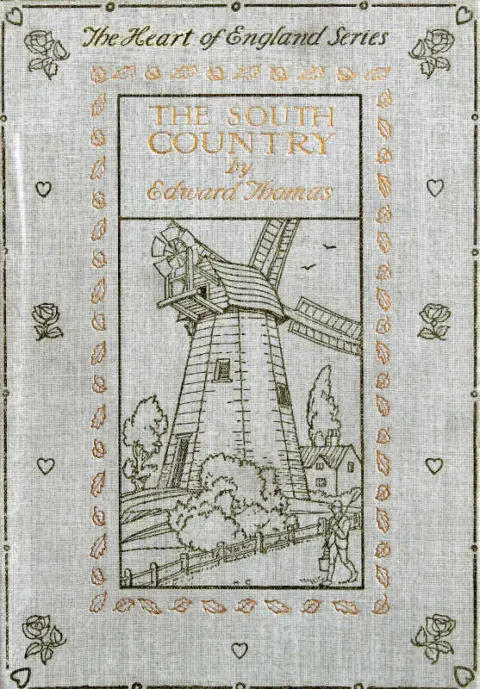
The South Country
Edward Thomas

THE CLASSIC COLLECTION · 1913
"The Happy-go-lucky Morgans" by Edward Thomas is a novel written in the early 20th century. The story centers around the lives of the Morgan family and their home, Abercorran House, in Balham, which is characterized by a lively, chaotic atmosphere filled with both family members and various animals. The narrative captures themes of nostalgia, childhood adventures, and the bittersweet passage of time as the narrator reflects on a family steeped in Welsh culture while facing inevitable changes. At the start of the novel, we are introduced to Abercorran Street, where the Morgans reside. The narrator reminisces about the family, revealing vivid details about their lively household, the various rooms, and the gardens that once thrived, invoking a sense of warmth and familiarity. As memories unfold, the narrator hints at the family's decline and the shifting dynamics as children grow up and move away, leaving behind only echoes of their past laughter and chaos. Ann, the devoted servant, remains a constant presence, connecting the past to the present. This opening portion sets the stage for a reflection on the Morgans’ unique way of life and the impending changes that loom over them.
Introduction adapted from the source catalogue; source summaries may be automatically generated.
Free to read · English · 63,704 words · No account needed
MAKE TIME FOR A GOOD BOOK
On by default. Untick to stop anonymous reading totals. Each page counts after 10 seconds in view. How this works.
Anonymous counting is on unless you have switched it off.
Some people called him a little man, but in his size as in other things he seemed rather to be of another species than a diminutive example of our own. He was smaller than a man, but not unpleasantly small, neither were his hands too long and delicate, nor were they incapable of a man’s work. In every way he was finely made and graceful, with clear large features, curled dark-brown hair and beard almost auburn. His clothes were part of him, of a lighter brown than his hair and of some substance which was more like a natural fur than a made cloth. These clothes, along with his voice, which was very deep, his hair, and his silent movements, increased his pleasing inhumanity. He sat among many people and said trivial things, or more often nothing, looking very far away and very little, turning all light somehow to moonlight, his dark eyes full of subdued gleaming; and both speech and silence drew upon him an attention which gave the casual observer an excuse for calling him vain. Children liked him, though he never troubled to show a liking for children, and while we sat on his lap or displayed a book for him he would be talking busily to others, but without offending us. He did not often tell us tales or play games with us, but he had a swift, gentle way of putting his hand on our heads and looking at us which always seemed an honour.
I recall chiefly, in connection with Aurelius, an evening near the end of winter at the great house. There had been a week of frost, some days silent and misty, others loud and clear with a north-east wind. Then came the west wind, a day’s balmy sun, and at last rain. This day I recall was the next. It was full of goings to and fro of loose cloud, of yellow threatenings on the hills. The light was thin and pale, falling tenderly over green fields and their fresh sprinkling of mole-heaps. But the rain would not descend, and as we got to the big house for tea the sky cleared, and in the twilight blackbirds were chinking nervously before sleep and now and then hurrying across the dim grass between the dark hedges and copses. A robin sang at the edge of a holly, and a thrush somewhere remote, and the world had become narrow and homely, the birds sounded secure like happily tired boys lazily undressing, and evidently they did not expect men. Three-quarters of a moon hung at the zenith, cold and fresh and white like an early spring flower. We grew silent, but at tea were particularly noisy and excited, too excited and near to tears, when I rushed upstairs. In the library I found Aurelius reading, with his back to the uncurtained window, by a light that only illuminated his face and page. Running at first to the window, I pressed my face on the pane to see the profound of deepening night, and the lake shining dimly like a window through which the things under the earth might be seen if you were out. The abyss of solitude below and around was swallowing the little white moon and might swallow me also; with terror at this feeling I turned away. “What?” said Aurelius, without even looking round, but apparently aware of my feeling. Seated in his lap, he took hardly more notice of me, but I was comforted. His silence was not a mere absence of words. It was not the peevish silence of one too cautious or too fearful to speak; nor the silence of one who has suddenly become isolated and feels it, yet cannot escape. Up out of the silence rose the voice of Aurelius reading out of the book before him. Over my shoulder came the rustling of ivy, and the sighing of trees, and the running of the brook through the coomb; the moon, close at hand, out in the black garden, pressed her face against the window and looked in at me. Aurelius was reading of that great king who had under him a hundred thousand kings, and whose chief delight was in ancient books telling of the loveliness of Paradise: “And when he met with this description of the world to come, and of Paradise and its pavilions, its lofty chambers, its trees and fruits, and of the other things in Paradise, his heart enticed him to construct its like on earth....” The world extended to a vastness that came close up to me and enfolded me as a lake enfolds one swan. Thus at the building of that Paradise I easily imagined doorways that would have admitted Orion and the Pleiades together. And at last, at the cry of destruction, though I was sorry, I was intensely satisfied with both the sadness and the splendour. I began to dream in the following silence. I dreamed I was lying at the edge of an immense sea, upon a rock scarcely raised above the water of the colour of sapphires. I saw go by me a procession of enormous seals whose backs swelled out of the wavelets like camels, and as they passed in deep water, a few yards away, each one cast on me his dark soft eyes, and they were the eyes of Aurelius. There were more coming behind when I awoke. Aurelius lighted another lamp. I went over again to the window and looked out. In a flash I saw the outer vast world of solitude, darkness, and silence, waiting eternally for its prey, and felt behind me the little world within that darkness like a lighthouse. I went back to the others. Aurelius for all I knew went to the kingdoms of the moon.
Your reading position is saved on this browser. Take it to another device with a library code. Reading pages adapt to text, rather than matching a printed edition.
Edward Thomas

Edward Thomas

Edward Thomas
Edward Thomas
BEHIND THE BOOK
This eBook is for the use of anyone anywhere in the United States and most other parts of the world at no cost and with almost no restrictions whatsoever. You may copy it, give it away or re-use it under the terms of the Project Gutenberg License included with this eBook or online at www.gutenberg.org. If you are not located in the United States, you will have to check the laws of the country where you are located before using this eBook. Read the source licence.
The original source file, including credits and licence, is retained by this library. Request an original-format copy at no charge. Please include the book title and Project Gutenberg identifier #63268.
KEEP YOUR CURIOSITY GOING
Coulson Kernahan

Maurice Baring
Frances Wright
Cécile Tormay

Frederic Jesup Stimson

W. H. P. (William Henry Pope) Jarvis