
The Writing of News A Handbook with Chapters on Newspaper Correspondence and Copy Reading
Charles G. (Charles Griffith) Ross
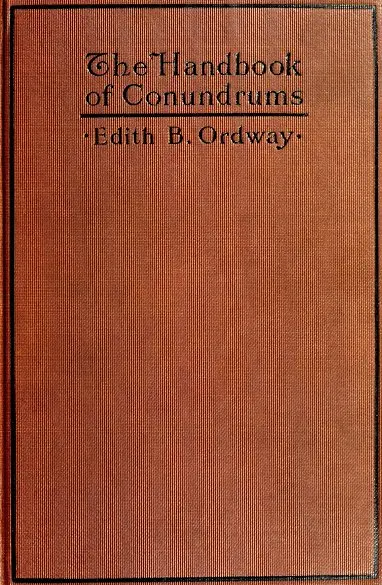
THE CLASSIC COLLECTION · 1914
"The Handbook of Conundrums" by Edith B. Ordway is a collection of riddles and witty wordplay written in the early 20th century. The text focuses on various forms of conundrums, puns, and riddles, exploring their history and significance across cultures while also engaging readers to challenge their wits. This work blends humor with an intellectual exercise, making it ideal for lovers of language and playful challenges. At the start of the book, the author introduces the concept of a conundrum as a riddle that typically involves a pun, providing context on their historical and cultural importance. The preface likens the book to a grindstone meant to sharpen the intellect, and the introduction elaborates on the origins of riddles, showcasing their role in ancient societies as markers of wisdom and wit. The ensuing chapters promise a plethora of humorous conundrums categorized into themes like historical, literary, and geographical topics, inviting readers to enjoy the clever interplay of language as they solve each riddle.
Introduction adapted from the source catalogue; source summaries may be automatically generated.
Free to read · English · 32,322 words · No account needed
MAKE TIME FOR A GOOD BOOK
On by default. Untick to stop anonymous reading totals. Each page counts after 10 seconds in view. How this works.
Anonymous counting is on unless you have switched it off.
Why is an aged man like a deserted house? His gait (gate) is broken,
and his locks are few.
What did a blind man take at breakfast which restored his sight? A
cup and saucer (saw, sir!).
Which is the laziest plant, and which the most active? The creeper
and the running vine.
Why is an autoist whose machine has been completely wrecked like a reformed autoist? Because he has suddenly given up motoring.
What does a hen do when she stands on one foot? Lifts up the other.
Why should the largest tree be near a church? There should be no
bigger tree (bigotry) there.
Why is a stupid servant like a church bell? He has to be often told
(tolled).
Why are sailors in a leaky vessel like dancing masters? They depend
on their pumps.
Why does a duck go into water? For diver's (diverse) reasons.
Why does a duck come out of water? For sun-dry (sundry) reasons.
What is the difference between a duck with one wing and one with two? Merely a difference of a pinion (opinion).
Why wasn't Peary buried in New York? He isn't dead yet.
When is the wind like a woodchopper? When it cuts.
What makes the ocean get angry? It has been crossed so often.
What is the characteristic of a watch? Modesty, as it keeps its hands before its face, and runs down its own works.
When is a clock on the stairs dangerous? When it runs down.
Why is a girl like an arrow? Because she is sure to be in a quiver till her bow comes, and can't go off without one.
Why are teeth like verbs? Because they are regular, irregular, and
defective.
What hands are those which work night and day, yet never wear out; which, although they strike, do not stop? Clock hands.
What's the difference between a gardener and a billiard marker? One minds his peas, the other his cues.
What is that which denotes the state of mind and of the body? The
tongue.
Why are books your best friends? Because, when they bore you, you can shut them up without giving offense.
Why, when you are out in a boat, should you never be surprised by a
sudden squall? Because, if you go for a sale, you may expect to be
sold.
Why is no country free? Because anybody is liable to be sold by auction whom it is possible for the auctioneer to take in.
Why, if a man has a gallery of paintings, may you pick his pockets? Because he has picked yours (pictures).
Why are pipes all humbugs? Because the best of them are but
meer-shams.
Your reading position is saved on this browser. Take it to another device with a library code. Reading pages adapt to text, rather than matching a printed edition.
BEHIND THE BOOK
This eBook is for the use of anyone anywhere in the United States and most other parts of the world at no cost and with almost no restrictions whatsoever. You may copy it, give it away or re-use it under the terms of the Project Gutenberg License included with this eBook or online at www.gutenberg.org. If you are not located in the United States, you will have to check the laws of the country where you are located before using this eBook. Read the source licence.
The original source file, including credits and licence, is retained by this library. Request an original-format copy at no charge. Please include the book title and Project Gutenberg identifier #32898.
KEEP YOUR CURIOSITY GOING
Charles G. (Charles Griffith) Ross
Hannah Webster Foster

Emily Lawless
Edwin Hamlin Carr

Charles De Lano Hine
Andrew Ure