
The Writing of News A Handbook with Chapters on Newspaper Correspondence and Copy Reading
Charles G. (Charles Griffith) Ross
THE CLASSIC COLLECTION · 1914
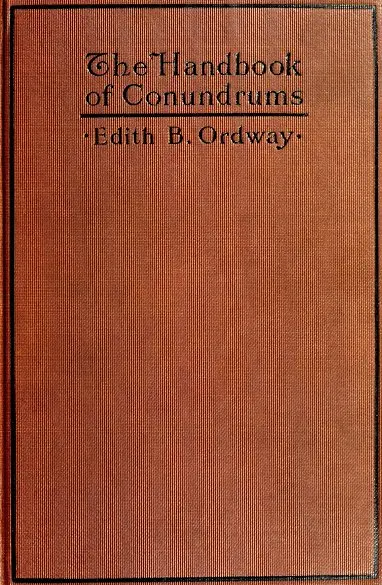
"The Handbook of Conundrums" by Edith B. Ordway is a collection of riddles and witty wordplay written in the early 20th century. The text focuses on various forms of conundrums, puns, and riddles, exploring their history and significance across cultures while also engaging readers to challenge their wits. This work blends humor with an intellectual exercise, making it ideal for lovers of language and playful challenges. At the start of the book, the author introduces the concept of a conundrum as a riddle that typically involves a pun, providing context on their historical and cultural importance. The preface likens the book to a grindstone meant to sharpen the intellect, and the introduction elaborates on the origins of riddles, showcasing their role in ancient societies as markers of wisdom and wit. The ensuing chapters promise a plethora of humorous conundrums categorized into themes like historical, literary, and geographical topics, inviting readers to enjoy the clever interplay of language as they solve each riddle.
Introduction adapted from the source catalogue; source summaries may be automatically generated.
Free to read · English · 32,322 words · No account needed
MAKE TIME FOR A GOOD BOOK
On by default. Untick to stop anonymous reading totals. Each page counts after 10 seconds in view. How this works.
Anonymous counting is on unless you have switched it off.
Why is a baby like a sheaf of wheat? Because it is first cradled, then threshed, and afterward becomes the flower of the family.
What is it that is queer about flowers? They shoot before they have
pistils.
What is the worst thing to catch afire? Nothing.
Why is a man who has parted from his bed like one obliged to keep it?
He is bedridden.
What is the oldest coupler in use? The wedding ring.
Why are hot rolls like caterpillars? Because they make the butterfly.
What is the difference between a mouse and a young lady? The one harms the cheese, the other charms the "he's."
When is a man thinner than a lath? When he is a-shaving.
Why is a pretty young lady like a wagon-wheel? Because she is
surrounded by felloes (fellows).
Of what religious persuasion is the sea? A Quaker--for it has a broad
brim.
Though I dance at a ball, yet am I nothing at all. A shadow.
What is that which, though black itself, enlightens the world? Ink.
When is a sailor not a sailor? When he's a-board.
What is the difference between a chess-player and an habitual toper? One watches the pawn, the other pawns the watch.
Which animal is the heaviest in all creation? A le(a)d horse.
What sort of tune do we all enjoy most? For-tune, made up of
bank-notes.
Why is a spendthrift, with regard to his fortune, like the water in a filter? Because he soon runs through it, and leaves many matters behind to settle.
Why is English grammar like gout? Because it's torture (taught yer).
Why is an office with no work to do like a good dinner eaten by an invalid? Because it's a sign-o'-cure (sinecure).
Why is a shoeblack like an editor? Because he polishes the
understandings of his patrons.
Why is opening a letter like taking a very queer method of entering a room? Because it is breaking through the sealing (ceiling).
Why are persons with short memories like office-holders? Because they are always for-getting everything.
What word is it which expresses two things we men all wish to get, one bringing the other, but which if we do get them, the one bringing the other, we are unhappy? Miss-fortune.
When is sugar like a pig's tooth? When in a hog's head.
Why is a joint company not like a watch? Because it does not go after
it is wound up.
When may a man be said to be personally involved? When he is wrapped
up in himself.
What wind should a hungry sailor wish for? One that blows fowl and
chops about.
Your reading position is saved on this browser. Take it to another device with a library code. Reading pages adapt to text, rather than matching a printed edition.
BEHIND THE BOOK
This eBook is for the use of anyone anywhere in the United States and most other parts of the world at no cost and with almost no restrictions whatsoever. You may copy it, give it away or re-use it under the terms of the Project Gutenberg License included with this eBook or online at www.gutenberg.org. If you are not located in the United States, you will have to check the laws of the country where you are located before using this eBook. Read the source licence.
The original source file, including credits and licence, is retained by this library. Request an original-format copy at no charge. Please include the book title and Project Gutenberg identifier #32898.
KEEP YOUR CURIOSITY GOING
Charles G. (Charles Griffith) Ross
Hannah Webster Foster

Emily Lawless
Edwin Hamlin Carr

Charles De Lano Hine
Andrew Ure