
The Writing of News A Handbook with Chapters on Newspaper Correspondence and Copy Reading
Charles G. (Charles Griffith) Ross
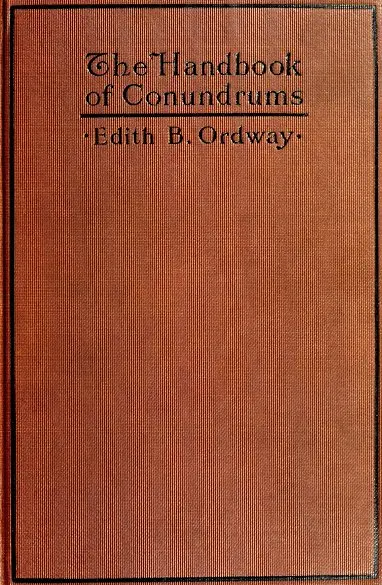
THE CLASSIC COLLECTION · 1914
"The Handbook of Conundrums" by Edith B. Ordway is a collection of riddles and witty wordplay written in the early 20th century. The text focuses on various forms of conundrums, puns, and riddles, exploring their history and significance across cultures while also engaging readers to challenge their wits. This work blends humor with an intellectual exercise, making it ideal for lovers of language and playful challenges. At the start of the book, the author introduces the concept of a conundrum as a riddle that typically involves a pun, providing context on their historical and cultural importance. The preface likens the book to a grindstone meant to sharpen the intellect, and the introduction elaborates on the origins of riddles, showcasing their role in ancient societies as markers of wisdom and wit. The ensuing chapters promise a plethora of humorous conundrums categorized into themes like historical, literary, and geographical topics, inviting readers to enjoy the clever interplay of language as they solve each riddle.
Introduction adapted from the source catalogue; source summaries may be automatically generated.
Free to read · English · 32,322 words · No account needed
MAKE TIME FOR A GOOD BOOK
On by default. Untick to stop anonymous reading totals. Each page counts after 10 seconds in view. How this works.
Anonymous counting is on unless you have switched it off.
When is a man a muff? When he holds a lady's hand without squeezing
it.
When is a man a spoon? When he touches a lady's two lips without
kissing them.
How would you measure a lover's sincerity? By his sighs (size).
When is music like vegetables? When there is two beats (beets) to a
measure.
Why is the Outlook like a man of fourscore? Because it's weekly.
Why is a false oath like a trial in the criminal court? Because it is
per-jury.
Why are doctors always wicked men? Because the worse people are the
more they are with them.
What sort of music should a girl sing whose voice is cracked and
broken? Pieces.
What is better than an indifferent singer in a drawing room after
dinner? A different one.
What animals always have gaiters on? Alligators.
What nation has always overcome in the end? Determination.
Why should you never sleep in a railway train? The train runs over
sleepers.
What most frequently becomes a woman? A little girl.
What is an Englishman's notion of woman's mission? Sub-mission.
What remedy does an Irishman take for a scolding wife? He takes an
e-lix-ir (he licks her).
What is the difference between a cloud of rain and a beaten child? One pours with rain, the other roars with pain.
What did the sunbeam say to the violet? "Wilt thou?" And she wilted.
What rose is "born to blush unseen"? Neg-roes.
What relation is a loaf of bread to a locomotive? The mother--bread being a necessity, a locomotive being an invention, and "Necessity is the mother of invention."
What is more moist than a young lady with a waterfall on her head, a cataract in her eye, a little lake on each cheek, high-tied shoes, and a crick in her back? A young lady with a notion (an ocean) in her head.
What is the best kind of agricultural fair? A farmer's very pretty
daughter.
Why is a photograph like a member of Congress? Because it's a
representative.
Why is a pelted actor like a pardoned criminal? Because he's glad to
get off.
When is a bank note like iron? When it is forged.
Why is the sun like a good loaf? It is light when it rises.
Why may a dyspeptic hope for a long life? He can't die just (digest)
now.
Why does a person who is ailing lose his sense of touch? Because he
does not feel well.
If you were to swallow a man, what sort of man would you prefer? A
little London porter.
Why should you never make love in the country? Because corn has ears, potatoes eyes, and the beans talk.
Your reading position is saved on this browser. Take it to another device with a library code. Reading pages adapt to text, rather than matching a printed edition.
BEHIND THE BOOK
This eBook is for the use of anyone anywhere in the United States and most other parts of the world at no cost and with almost no restrictions whatsoever. You may copy it, give it away or re-use it under the terms of the Project Gutenberg License included with this eBook or online at www.gutenberg.org. If you are not located in the United States, you will have to check the laws of the country where you are located before using this eBook. Read the source licence.
The original source file, including credits and licence, is retained by this library. Request an original-format copy at no charge. Please include the book title and Project Gutenberg identifier #32898.
KEEP YOUR CURIOSITY GOING
Charles G. (Charles Griffith) Ross
Hannah Webster Foster

Emily Lawless
Edwin Hamlin Carr

Charles De Lano Hine
Andrew Ure