THE CLASSIC COLLECTION✦Ruben and Ivy SênCLASSIC FREE BOOKS
Ruben and Ivy Sên
Louise Jordan Miln
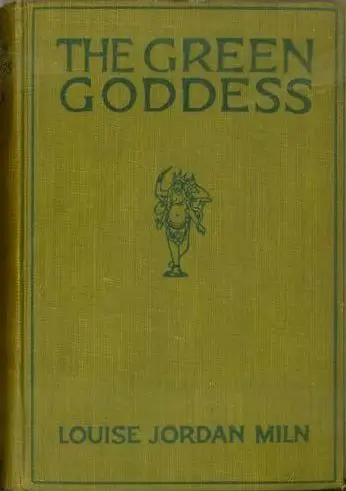
THE CLASSIC COLLECTION · 1922
"The Green Goddess" by Louise Jordan Miln is a novel written in the early 20th century. The story revolves around the Reverend Philip Reynolds, a devoted father and vicar grappling with profound loss as he prepares to marry off his beloved daughter, Lucilla. Set against a backdrop of pastoral life and the struggles of human emotion, the narrative explores themes of love, faith, and the complexities of relationships. The opening of the book introduces the character of Philip Reynolds, highlighting his deep love for his deceased wife, Helen, their son, Jack, and his living daughter, Lucilla. As the vicar reflects on his past, the reader learns about his joyful life filled with books, gardening, and a close relationship with his daughter, who is about to embark on a new chapter by marrying Captain Crespin. The narrative poignantly captures the quiet yet profound changes in their lives, as Philip struggles to maintain his sunny facade despite the impending loss of his daughter, underscoring the themes of love and the bittersweet nature of letting go.
Introduction adapted from the source catalogue; source summaries may be automatically generated.
Free to read · English · 88,728 words · No account needed
MAKE TIME FOR A GOOD BOOK
On by default. Untick to stop anonymous reading totals. Each page counts after 10 seconds in view. How this works.
Anonymous counting is on unless you have switched it off.
“Rukh! Rukh! Rukh! Rukh!” in a herald voice that proclaimed that the fortress-like castle was Rukh, the ground they stood on Rukh, the cave-temple, the immense horn of metallic lacquer poised on a crag beyond the castle—the most unique and surprising thing in all the amazing picture—the sky above, all of creation that mattered or counted—Rukh, imperial, incomparable Rukh—Rukh, the apex of the world.
But for all that his statement meant to them Crespin said disgustedly, “What the deuce is he rooking about?”
“Goodness knows,” Traherne rejoined.
But the woman jumped to it.
“I believe I know!” she broke in. Crespin and Traherne gazed at her in surprise—her husband incredulous, Traherne very curious. “Wait a minute!” she commanded, searching her pockets excitedly—almost, in her quiet, well-bred English way, as excited as Yazok himself. “I thought I had the paper with me. I wish I could find it. But I did have it, and I did read it. I know I did. I read it in the Leader just before we started, that the three men who murdered the Political Officer at Abdulabad came from a wild region at the back of the Himalayas, called Rukh.”
“Yes,” Traherne told them, “now that you mention it, I have heard of the
place.”
“Well, that’s something,” Crespin exclaimed. “Come, we’re getting on.”
“Perhaps,” the physician said under his breath, as he turned again to Yazok the priest and accosted him once more in a few Russian words, pointing interrogatively to the palace.
But the priest’s Russian was little, less than Traherne’s own, and Yazok had no intention of being over-communicative.
“Raja Sahib,” he said—so he had some smattering of Hindustani after all—“Raja Sahib,” he repeated several times; but that was all that he would say.
But those two familiar words told them a good deal of what they wished
to know.
“Oh,” Crespin grunted, “it’s Windsor Castle, is it? Well, we’d better make tracks for it. Come, Lucilla.” He put his hand on her arm, and they turned to go.
But the priest barred their way, in a frenzy of excitement, pouring forth a wild torrent of, to them, quite unintelligible language.
Traherne intervened, speaking again in Russian, and it served to calm the hillsman measurably, though the native throng at his elbows still muttered and gesticulated threateningly. But Yazok listened, if surlily, and presently vouchsafed in reply a few Russian words which he spoke slowly and with evident difficulty.
“His Russian is even more limited than mine,” Traherne told the others, “but I gather that the Raja has been sent for, and will come here.”
Your reading position is saved on this browser. Take it to another device with a library code. Reading pages adapt to text, rather than matching a printed edition.
Louise Jordan Miln
Louise Jordan Miln & Harold Owen & Harry M. Vernon
William Archer
Louise Jordan Miln
BEHIND THE BOOK
This eBook is for the use of anyone anywhere in the United States and most other parts of the world at no cost and with almost no restrictions whatsoever. You may copy it, give it away or re-use it under the terms of the Project Gutenberg License included with this eBook or online at www.gutenberg.org. If you are not located in the United States, you will have to check the laws of the country where you are located before using this eBook. Read the source licence.
The original source file, including credits and licence, is retained by this library. Request an original-format copy at no charge. Please include the book title and Project Gutenberg identifier #48112.
KEEP YOUR CURIOSITY GOING
Coulson Kernahan

Maurice Baring
Frances Wright
Cécile Tormay

Frederic Jesup Stimson

W. H. P. (William Henry Pope) Jarvis