THE CLASSIC COLLECTION✦Ruben and Ivy SênCLASSIC FREE BOOKS
Ruben and Ivy Sên
Louise Jordan Miln
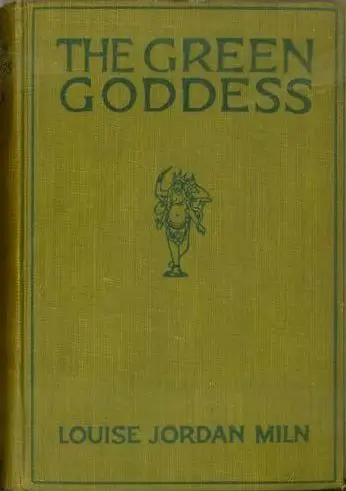
THE CLASSIC COLLECTION · 1922
"The Green Goddess" by Louise Jordan Miln is a novel written in the early 20th century. The story revolves around the Reverend Philip Reynolds, a devoted father and vicar grappling with profound loss as he prepares to marry off his beloved daughter, Lucilla. Set against a backdrop of pastoral life and the struggles of human emotion, the narrative explores themes of love, faith, and the complexities of relationships. The opening of the book introduces the character of Philip Reynolds, highlighting his deep love for his deceased wife, Helen, their son, Jack, and his living daughter, Lucilla. As the vicar reflects on his past, the reader learns about his joyful life filled with books, gardening, and a close relationship with his daughter, who is about to embark on a new chapter by marrying Captain Crespin. The narrative poignantly captures the quiet yet profound changes in their lives, as Philip struggles to maintain his sunny facade despite the impending loss of his daughter, underscoring the themes of love and the bittersweet nature of letting go.
Introduction adapted from the source catalogue; source summaries may be automatically generated.
Free to read · English · 88,728 words · No account needed
MAKE TIME FOR A GOOD BOOK
On by default. Untick to stop anonymous reading totals. Each page counts after 10 seconds in view. How this works.
Anonymous counting is on unless you have switched it off.
An English boy sauntered in—three of Rukh’s soldiers half escorting, half guarding him. A fair, sunny-faced, blue-eyed youngster, trim and straight in his khaki-drill, the shoes below his “slacks” shining like polished, brown glass, two stripes on his epaulets, his black tie beautifully done, one yellow wisp of curl almost coquettishly peeping from under his immaculate service cap, and an avenue of ribbons cutting across his tunic—the blue, white and yellow of the G. S., the rainbow of the Victory, the red, white and blue of the 1914-15, of course, but the white and purple diagonals of the D. F. C. were there too, and the tiny rosette on the blue, dark-red and blue of his D. S. O. told that he had won it doubly. And he looked, as he was, a “mother’s boy” and no end of a wag. Truly, “the conquerors of the air have all been mere boys”!
“Who are you, sir?” the Raja demanded.
“One moment.” The English boy threw the word crisply over his shoulder to the bedizened figure sitting cross-legged and sovereign on its bedizened throne, and crossed to his countryman and woman, and saluted—the R. A. F. do not uncover.
Lucilla held out both her hands—they had met before at Delhi and at Simla. She was afraid to speak, almost afraid to look, lest she welcome him with a torrent of womanish tears.
“Mrs. Crespin!” the young pilot said, as he took the hands she gave. “I’m very glad we’re in time. Dr. Traherne, I presume? And,” when they had shaken hands gravely, “Major Crespin?” he asked.
“Shot whilst transmitting our message,” Traherne told him.
“I’m so sorry, Mrs. Crespin,” the boy said gravely. “By whom?” he demanded of Traherne.
Traherne pointed silently to the throne-seated Raja, who was watching
quite impassively.
But Rukh spoke now. “I am sorry,” he said, drawling his clear voice lazily, “to interrupt these effusions, but—”
“Who are you, sir?” The English lad’s voice barked something like a gun.
“I am the Raja of Rukh,” the prince replied. “And you?”
“Flight-Lieutenant Cardew,” the boy-pilot said formally. “I have the honor to represent His Majesty, the King-Emperor.”
Rukh looked uninterested. “The King-Emperor? Who is that, pray? We live so out of the world here, I don’t seem to have heard of him,” he lied.
“You will in a minute, Raja,” the youth muttered back, “if you don’t instantly hand over his subjects.”
“His subjects?” The Raja seemed puzzled. “Ah,” he exclaimed not unindifferently, but as if a light had broken in, “I see you mean the King of England. What terms does His Majesty propose?”
Your reading position is saved on this browser. Take it to another device with a library code. Reading pages adapt to text, rather than matching a printed edition.
Louise Jordan Miln
Louise Jordan Miln & Harold Owen & Harry M. Vernon
William Archer
Louise Jordan Miln
BEHIND THE BOOK
This eBook is for the use of anyone anywhere in the United States and most other parts of the world at no cost and with almost no restrictions whatsoever. You may copy it, give it away or re-use it under the terms of the Project Gutenberg License included with this eBook or online at www.gutenberg.org. If you are not located in the United States, you will have to check the laws of the country where you are located before using this eBook. Read the source licence.
The original source file, including credits and licence, is retained by this library. Request an original-format copy at no charge. Please include the book title and Project Gutenberg identifier #48112.
KEEP YOUR CURIOSITY GOING
Coulson Kernahan

Maurice Baring
Frances Wright
Cécile Tormay

Frederic Jesup Stimson

W. H. P. (William Henry Pope) Jarvis