THE CLASSIC COLLECTION✦Ruben and Ivy SênCLASSIC FREE BOOKS
Ruben and Ivy Sên
Louise Jordan Miln
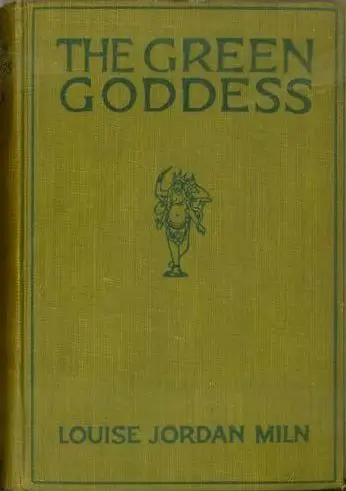
THE CLASSIC COLLECTION · 1922
"The Green Goddess" by Louise Jordan Miln is a novel written in the early 20th century. The story revolves around the Reverend Philip Reynolds, a devoted father and vicar grappling with profound loss as he prepares to marry off his beloved daughter, Lucilla. Set against a backdrop of pastoral life and the struggles of human emotion, the narrative explores themes of love, faith, and the complexities of relationships. The opening of the book introduces the character of Philip Reynolds, highlighting his deep love for his deceased wife, Helen, their son, Jack, and his living daughter, Lucilla. As the vicar reflects on his past, the reader learns about his joyful life filled with books, gardening, and a close relationship with his daughter, who is about to embark on a new chapter by marrying Captain Crespin. The narrative poignantly captures the quiet yet profound changes in their lives, as Philip struggles to maintain his sunny facade despite the impending loss of his daughter, underscoring the themes of love and the bittersweet nature of letting go.
Introduction adapted from the source catalogue; source summaries may be automatically generated.
Free to read · English · 88,728 words · No account needed
MAKE TIME FOR A GOOD BOOK
On by default. Untick to stop anonymous reading totals. Each page counts after 10 seconds in view. How this works.
Anonymous counting is on unless you have switched it off.
“Bribe your dead grandmother’s parrot!” Crespin jibed.
And, “I don’t believe it’s a bit of good,” Lucilla objected.
“Nor I,” Traherne owned. “The fellow’s a thorough-paced scoundrel. But we might succeed, and, if we don’t even try, they’ll suspect that we’re plotting something else. If we can convince them that we’re at our wits’ end, we’ve the better chance of taking them off their guard.”
“Yes,” Lucilla urged quickly. “You see that, Antony.”
He patted her hand. “Perhaps you’re right,” he told Traherne. “But, even if the damned scoundrel can be bought, what good is it, if I can’t remember the wave-length to Amil-Serai?” He threw his wife’s hand off unconsciously as he felt again for his handkerchief, and mopped at his troubled face. But Lucilla laid her hand again on his arm.
“You’ll think of it all of a sudden,” she told him.
“Not if I keep racking my brains for it,” he groaned. “If I could get my mind off it, the damned thing might come back to me.”
“Yes,” Traherne agreed, “and that’s all the more reason for action. But first, we must settle what message to send, if we get the chance.”
“Yes—oh—yes,” Mrs. Crespin said breathlessly, and she went hurriedly to the writing-table, and flung herself into Rukh’s writing-chair. “Dictate!” she ordered. “I’ll write.” She snatched an envelope, her fingers flew to a pen. Crespin bent over her shoulder, and pulled the ink nearer her hand.
“What about this?” Traherne suggested, after a moment: “‘Major Crespin, wife, Traherne, imprisoned Rukh, Raja’s palace; lives in danger,’” he dictated slowly, while Mrs. Crespin, writing it down feverishly, waited impatiently after each word for the next.
“We want something more definite,” Crespin objected, when Traherne had
finished.
Traherne considered. “Yes,” he said thoughtfully, “you’re right. We do.”
“How would this do?” Mrs. Crespin asked, picking up her pen again: “‘Death threatened to-morrow evening. Rescue urgent.’”
“Excellent!” Dr. Traherne exclaimed.
She wrote again, and when she held the envelope up to him, Crespin took it, and read aloud slowly, “‘Major Crespin, wife, Traherne, imprisoned, Rukh, Raja’s palace. Death threatened to-morrow evening. Rescue urgent.’ Right. I’ll keep it ready,” he said as he carefully pocketed it.
“Now,” Traherne demanded, “how to get hold of Watkins?”
Lucilla still sat in the swivel-chair—leaning back in it wearily, her eyes half closed, when she had finished writing. She roused herself now, and glanced about. “There’s a bell here,” she said suddenly, seeing it on the writing table. “Shall I try it?” and she put her hand over it.
Your reading position is saved on this browser. Take it to another device with a library code. Reading pages adapt to text, rather than matching a printed edition.
Louise Jordan Miln
Louise Jordan Miln & Harold Owen & Harry M. Vernon
William Archer
Louise Jordan Miln
BEHIND THE BOOK
This eBook is for the use of anyone anywhere in the United States and most other parts of the world at no cost and with almost no restrictions whatsoever. You may copy it, give it away or re-use it under the terms of the Project Gutenberg License included with this eBook or online at www.gutenberg.org. If you are not located in the United States, you will have to check the laws of the country where you are located before using this eBook. Read the source licence.
The original source file, including credits and licence, is retained by this library. Request an original-format copy at no charge. Please include the book title and Project Gutenberg identifier #48112.
KEEP YOUR CURIOSITY GOING
Coulson Kernahan

Maurice Baring
Frances Wright
Cécile Tormay

Frederic Jesup Stimson

W. H. P. (William Henry Pope) Jarvis