THE CLASSIC COLLECTION✦Ruben and Ivy SênCLASSIC FREE BOOKS
Ruben and Ivy Sên
Louise Jordan Miln
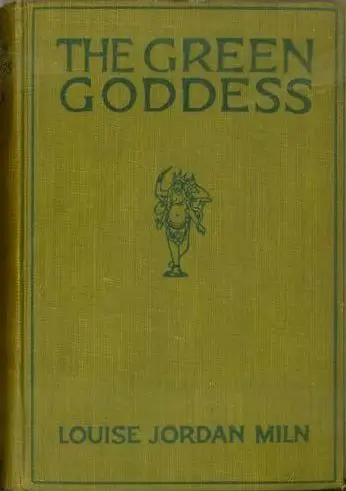
THE CLASSIC COLLECTION · 1922
"The Green Goddess" by Louise Jordan Miln is a novel written in the early 20th century. The story revolves around the Reverend Philip Reynolds, a devoted father and vicar grappling with profound loss as he prepares to marry off his beloved daughter, Lucilla. Set against a backdrop of pastoral life and the struggles of human emotion, the narrative explores themes of love, faith, and the complexities of relationships. The opening of the book introduces the character of Philip Reynolds, highlighting his deep love for his deceased wife, Helen, their son, Jack, and his living daughter, Lucilla. As the vicar reflects on his past, the reader learns about his joyful life filled with books, gardening, and a close relationship with his daughter, who is about to embark on a new chapter by marrying Captain Crespin. The narrative poignantly captures the quiet yet profound changes in their lives, as Philip struggles to maintain his sunny facade despite the impending loss of his daughter, underscoring the themes of love and the bittersweet nature of letting go.
Introduction adapted from the source catalogue; source summaries may be automatically generated.
Free to read · English · 88,728 words · No account needed
MAKE TIME FOR A GOOD BOOK
On by default. Untick to stop anonymous reading totals. Each page counts after 10 seconds in view. How this works.
Anonymous counting is on unless you have switched it off.
But Traherne laughed frankly. “I’m afraid you’re jealous, Raja! You don’t like having to play second fiddle to a still more absolute ruler.”
“Perhaps you’re right, Doctor,” the Rajah owned; “perhaps it’s partly that. But there’s something more to it. I can’t help resenting—”
He interrupted himself to urge Crespin to “try” the Kümmel a servant was
offering him.
Lucilla bit her lip to keep back the, “Don’t, Antony, please don’t,” that she wanted to say.
“What is it you resent?” Traherne asked.
“Oh,” Rukh said, “the respect paid to mere size—to the immensity, as they call it, of the universe. Are we to worship a god because he’s big?”
“If you resent his bigness, what do you say to his littleness?” Traherne objected. “The microscope, you know, reveals him no less than the telescope.”
“And reveals him,” Rukh added, “in the form of death-dealing specks of matter, which you, I understand, Doctor, are impiously proposing to exterminate.”
“I am trying,” Traherne amended, “to marshal the life-saving against the death-dealing powers.”
“To marshal God’s right hand against his left, eh? or vice versa” the Raja demanded. “But I admit you have the better of the astronomers, in so far as you deal in life, not in dead mechanism.” He slapped a palm sharply down on the back of his other hand. “This mosquito that I have just killed—I am glad to see you smoke, Madam: it helps to keep them off—this mosquito, or any smallest thing that has life in it, is to me far more admirable than a whole lifeless universe. What do you say, Major?”
“I say, Raja,” Crespin replied lazily, and keeping his cigar alight, “that if you’ll tell that fellow to give me another glass of Kümmel, I’ll let you have your own way about the universe.”
He got his Kümmel.
“But what,” Mrs. Crespin asked, “if the mechanism, as you call it, isn’t dead? What if the stars are swarming with life?”
“Yes—” Traherne agreed, and pushed her argument on, “suppose there are planets, which of course we can’t see, circling round each of the great suns we do see? And suppose they are all inhabited?”
“I’d rather not suppose it,” Rukh asserted quickly. “Isn’t one inhabited world bad enough? Do we want it multiplied by millions?”
“But haven’t you just been telling us that a living gnat is more wonderful than a dead universe?” Lucilla check-mated, or thought that she had.
Your reading position is saved on this browser. Take it to another device with a library code. Reading pages adapt to text, rather than matching a printed edition.
Louise Jordan Miln
Louise Jordan Miln & Harold Owen & Harry M. Vernon
William Archer
Louise Jordan Miln
BEHIND THE BOOK
This eBook is for the use of anyone anywhere in the United States and most other parts of the world at no cost and with almost no restrictions whatsoever. You may copy it, give it away or re-use it under the terms of the Project Gutenberg License included with this eBook or online at www.gutenberg.org. If you are not located in the United States, you will have to check the laws of the country where you are located before using this eBook. Read the source licence.
The original source file, including credits and licence, is retained by this library. Request an original-format copy at no charge. Please include the book title and Project Gutenberg identifier #48112.
KEEP YOUR CURIOSITY GOING
Coulson Kernahan

Maurice Baring
Frances Wright
Cécile Tormay

Frederic Jesup Stimson

W. H. P. (William Henry Pope) Jarvis