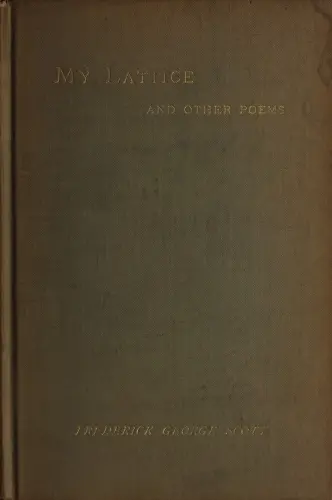
My Lattice, and Other Poems
Frederick George Scott
THE CLASSIC COLLECTION · 1922
"The Great War As I Saw It" by Frederick George Scott is a historical account written in the early 20th century. This memoir offers a personal perspective on the First World War, specifically focusing on the experiences of the author as a chaplain with the First Canadian Division. The book aims to convey both the grandeur and the tragedy of the sacrifices made by soldiers during the war, while providing insights into the camaraderie and challenges faced by those involved. At the start of the book, Scott describes his emotions and thoughts leading up to his decision to volunteer for the war, highlighting the initial excitement mixed with apprehension. He recounts events such as his departure from Quebec, the preparations at Valcartier, and the collective spirit of the Canadian soldiers as they prepare to leave for Europe. His reflections capture the profound sense of duty felt by him and his comrades as they confront the realities of war, setting the tone for a moving narrative that balances personal anecdotes with broader themes of bravery, loss, and the impact of conflict on human lives.
Introduction adapted from the source catalogue; source summaries may be automatically generated.
Free to read · English · 137,539 words · No account needed
MAKE TIME FOR A GOOD BOOK
On by default. Untick to stop anonymous reading totals. Each page counts after 10 seconds in view. How this works.
Anonymous counting is on unless you have switched it off.
The position of a chaplain as the war went on became very different from what it had been at the beginning. The experience through which the army had passed had showed to the military authorities that there was something more subtle, more supernatural behind the life of the men, than one might gather from the King's Regulations. Our chaplains had done splendid work, and I think I may say that, with one or two exceptions, they were idolized by their units. I could tell of one (p. 116) of our chaplains who lived continually at the advanced dressing station in great hardship and discomfort, sharing the danger and privation of his men. The curious thing about a chaplain's popularity was that the men never praised a chaplain whom they knew without adding "It is a pity that all chaplains are not like him". On one occasion when I was going through the Division, I was told by the men of one unit that their chaplain was a prince, and it was a pity that all chaplains were not like him. I went to another unit, and there again I was told that their chaplain was a prince, and it was a pity that all chaplains were not like him. It seems to be a deeply rooted principle in a soldier's mind to beware of praising religion overmuch. But it amused me in a general survey to find that ignorance of the work of other chaplains led to their condemnation. I fancy the same spirit still manifests itself in the British Army and in Canada. I find officers and men eager enough to praise those who were their own chaplains but always adding to it a condemnation of those who were not. An officer said to me one day that the war had enabled chaplains to get to know men. I told him that the war also had enabled men to get to know chaplains. Large numbers of men in ordinary life are very seldom brought into contact with religion. They have the crude notion of it which they carried away as unfledged boys from Sunday School, and a sort of formal bowing acquaintance through the conventions of later life. In the war, when their minds and affections were put to a severe strain, it was a revelation to them to find that there were principles and relationships of divine origin which enabled the ordinary human will easily to surmount difficulties moral and physical, and which gave a quiet strength that nothing merely earthly could supply. Certainly the war gave chaplains a splendid opportunity of bearing witness to the power of Christ. A great deal has been written about the religion of the men at the front. Some have spoken of it in terms of exaggerated optimism, as though by the miracle of the war men had become beings of angelic outlook and temper. Others have taken a despairing attitude, and thought that religion has lost its real power over the world. The truth is, I think, that there was a revelation to most men, in a broad way, of a mysterious soul life within, and of a huge responsibility to an infinite and eternal Being above. There was a revelation also, wide and deep, to many individual men, of the living force and example of Him who is both God and Brother-man. Where the associations of (p. 117) church and home had been clean and helpful, men under the batterings of war felt consciously the power of religion. In the life at the front, no doubt there was much evil thinking, evil talking and evil doing, but there was, underlying all this, the splendid manifestation in human nature of that image of God in which man was made. As one looks back upon it, the surface things of that life have drifted away, and the great things that one remembers are the self-sacrifice, the living comradeship, and the unquestioning faith in the eternal rightness of right and duty which characterized those who were striving to the death for the salvation of the world. This glorious vision of the nobility of human nature sustained the chaplain through many discouragements and difficulties. I have often sat on my horse on rainy nights near Hill 63, and watched the battalions going up to the line. With wet rubber sheets hanging over their huge packs and with rifles on their shoulders, the men marched up through the mud and cold and darkness, to face wounds and death. At such times, the sordid life has been transfigured before me. The hill was no longer Hill 63, but it was the hill of Calvary. The burden laid upon the men was no longer the heavy soldier's pack, but it was the cross of Christ, and, as the weary tramp of the men splashed in the mud, I said to myself "Each one has fulfilled the law of life, and has taken up his cross and is following Christ."
Your reading position is saved on this browser. Take it to another device with a library code. Reading pages adapt to text, rather than matching a printed edition.
Frederick George Scott
BEHIND THE BOOK
This eBook is for the use of anyone anywhere in the United States and most other parts of the world at no cost and with almost no restrictions whatsoever. You may copy it, give it away or re-use it under the terms of the Project Gutenberg License included with this eBook or online at www.gutenberg.org. If you are not located in the United States, you will have to check the laws of the country where you are located before using this eBook. Read the source licence.
The original source file, including credits and licence, is retained by this library. Request an original-format copy at no charge. Please include the book title and Project Gutenberg identifier #19857.
KEEP YOUR CURIOSITY GOING
Cécile Tormay

Moritz Busch
John L. Ransom
Frances Wright
Cécile Tormay

Mabel Potter Daggett