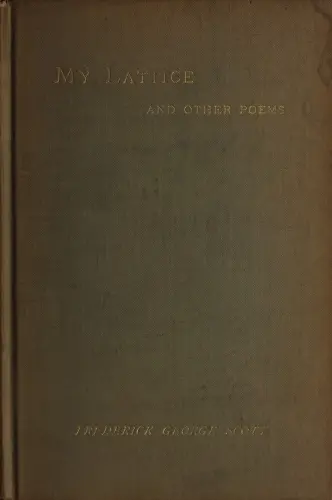
My Lattice, and Other Poems
Frederick George Scott
THE CLASSIC COLLECTION · 1922
"The Great War As I Saw It" by Frederick George Scott is a historical account written in the early 20th century. This memoir offers a personal perspective on the First World War, specifically focusing on the experiences of the author as a chaplain with the First Canadian Division. The book aims to convey both the grandeur and the tragedy of the sacrifices made by soldiers during the war, while providing insights into the camaraderie and challenges faced by those involved. At the start of the book, Scott describes his emotions and thoughts leading up to his decision to volunteer for the war, highlighting the initial excitement mixed with apprehension. He recounts events such as his departure from Quebec, the preparations at Valcartier, and the collective spirit of the Canadian soldiers as they prepare to leave for Europe. His reflections capture the profound sense of duty felt by him and his comrades as they confront the realities of war, setting the tone for a moving narrative that balances personal anecdotes with broader themes of bravery, loss, and the impact of conflict on human lives.
Introduction adapted from the source catalogue; source summaries may be automatically generated.
Free to read · English · 137,539 words · No account needed
MAKE TIME FOR A GOOD BOOK
On by default. Untick to stop anonymous reading totals. Each page counts after 10 seconds in view. How this works.
Anonymous counting is on unless you have switched it off.
August to October 1917.
Hill 70 being now in our grip the Division came out of the line on August 21st, and moved back to our old billets in Bruay.
Every night, as usual, our concert party gave a performance in the theatre. We were very proud of them. The men's costumes were well made and very tasteful. "Babs," our leading lady, was most charming and engaging, in spite of the fact that her hands looked decidedly masculine. The townspeople enjoyed the entertainments as much as we did, and the battalions were given their own special nights. Occasionally, some of the jokes appeared to me a trifle too broad. At such times I would pay a visit to the Green-room, as Senior Chaplain, and mildly suggest their withdrawal. I must say that the men took my interference in good part and kept their exuberance of spirits well in check. Our Divisional band was up to high-water mark, and their rendering of the hymns and chants on Sundays made our services in the theatre extraordinarily hearty.
One afternoon I motored over to Quatre Vents to take a funeral service in the cemetery there. Instead of returning, I went down to Cambligneul to see the men of the 7th Battalion. They were enjoying a rest in the quaint old town. In the evening, I went down to the Y.M.C.A. hut which was in charge of the British. Here I found our men crowded into the building, not knowing what to do with themselves. The officer in charge of the hut was a quiet man, who was doing his best in superintending the work at the counter. It struck me, however, that he felt a little embarrassed by the situation, and did not know how to provide amusement for the wild Canadians. I asked him if he would object to our having a stag-dance. He said, "Certainly not, you may do anything you like." At once we got several dozen candles and illuminated the place. Then we sent out for a pianist and some violinists, and got up a scratch orchestra. We then cleared away the tables and benches and turned the place into a dance-hall. The orchestra struck up a lively two-step, and great burly chaps chose their equally burly partners, and (p. 204) started off in the dance with such gusto that the place was filled with the sounds of dissipation. This attracted more men from outside, and finally we had the liveliest scene imaginable. I actually found myself joining in the mazes of the waltz, and amid roars of laughter the dancing went on fast and furious. So delighted was the Y.M.C.A. officer, that he mounted the platform at the end of a dance, and in spite of my protest, called for three cheers for the man who had suggested the entertainment. At the close of the evening, we had cups of hot coffee and biscuits, and parted in the best of humours. I was then confronted by a problem that had not presented itself to me before, and that was, how I was to get back to my home in Bruay, which was about ten miles off. Once more my favourite text came to my mind, "The Lord will provide." So I bid good-bye to my friends in the hut and went off, trusting that a car or lorry would pick me up on the road. This time I found that the Lord did not provide, so I started at about half-past ten on my homeward journey on foot. As I passed through the sleeping village of Estree-Cauchie, I came upon some men of another Division who had been imbibing very freely in an estaminet, and who were about to wind up a heated argument with a free fight. It was very dark, and it was hard for me to convince them that I was a chaplain with the rank of Lieut.-Colonel, until I turned my flashlight upon my white collar. Happily, my efforts as peacemaker were not in vain. I poured oil on the troubled waters till I saw them subside, and the men went off to their billets. One young fellow, however, was experiencing that interest in spiritual problems, which was sometimes aroused in the most unexpected quarters by free libations of spirituous liquors. He caught hold of my arm and implored me to enlighten him on the theological differences which separated Anglicans and Presbyterians. I forget which he was himself, but at the time the problem was a matter of extraordinary interest to him. While I always considered it my duty to impart enlightenment to darkened souls whenever I could, the recollection that I had about seven miles to walk to my home that night rather tempered my missionary zeal, and by a promise to discuss the whole matter on our next meeting I managed to tear myself away and proceed on my journey.
Your reading position is saved on this browser. Take it to another device with a library code. Reading pages adapt to text, rather than matching a printed edition.
Frederick George Scott
BEHIND THE BOOK
This eBook is for the use of anyone anywhere in the United States and most other parts of the world at no cost and with almost no restrictions whatsoever. You may copy it, give it away or re-use it under the terms of the Project Gutenberg License included with this eBook or online at www.gutenberg.org. If you are not located in the United States, you will have to check the laws of the country where you are located before using this eBook. Read the source licence.
The original source file, including credits and licence, is retained by this library. Request an original-format copy at no charge. Please include the book title and Project Gutenberg identifier #19857.
KEEP YOUR CURIOSITY GOING
Cécile Tormay

Moritz Busch
John L. Ransom
Frances Wright
Cécile Tormay

Mabel Potter Daggett