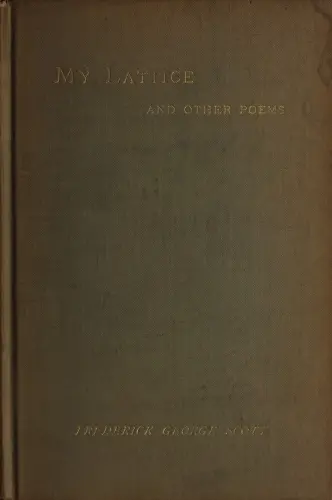
My Lattice, and Other Poems
Frederick George Scott
THE CLASSIC COLLECTION · 1922
"The Great War As I Saw It" by Frederick George Scott is a historical account written in the early 20th century. This memoir offers a personal perspective on the First World War, specifically focusing on the experiences of the author as a chaplain with the First Canadian Division. The book aims to convey both the grandeur and the tragedy of the sacrifices made by soldiers during the war, while providing insights into the camaraderie and challenges faced by those involved. At the start of the book, Scott describes his emotions and thoughts leading up to his decision to volunteer for the war, highlighting the initial excitement mixed with apprehension. He recounts events such as his departure from Quebec, the preparations at Valcartier, and the collective spirit of the Canadian soldiers as they prepare to leave for Europe. His reflections capture the profound sense of duty felt by him and his comrades as they confront the realities of war, setting the tone for a moving narrative that balances personal anecdotes with broader themes of bravery, loss, and the impact of conflict on human lives.
Introduction adapted from the source catalogue; source summaries may be automatically generated.
Free to read · English · 137,539 words · No account needed
MAKE TIME FOR A GOOD BOOK
On by default. Untick to stop anonymous reading totals. Each page counts after 10 seconds in view. How this works.
Anonymous counting is on unless you have switched it off.
August 8th to 16th, 1918.
It was strange and exhilarating to go off on an expedition of that kind in the cool air and fading light of the evening. Something told us that at last the hour of victory was drawing near. The moving of the Corps had been so splendidly conducted and the preparation had been so secret that success seemed assured. This was an achievement which was completely different from all our past experience. The only question was, had we taken the Germans by surprise, or were they waiting with massed forces to resist our attack? As I left the outskirts of the wood behind me, and made my way over the green plain, now fading into the twilight, I passed a battalion of the 3rd Division manning a line of trenches. I had a talk with some of the men and told them that I had heard from a tank officer that nearly one thousand tanks were to be engaged in the attack on the following morning. Far over to the left, on a rise in the ground I saw the remains of a village, and was told that a mud road across the fields would lead me in the direction of the 1st Division front. I met as usual many men whom I knew, and finally some officers of the 15th Battalion in a dugout. The light began to fade and I had difficulty in seeing far ahead of me, but the track at last brought me to a sunken road which turned to the right. Here on the hillside more men were waiting in dugouts, and I was directed to a quarry, on the top of which I was to take a path that would lead me to a group of trees, where I should find the Headquarters of the 16th Battalion. When I got to the quarry I found many roads there, and whether it was that the information I had received was incorrect, or that I was more than usually stupid, I do not know. I wandered up and down for a long time, tripping over bits of wire and slipping into holes, before I was able to get to the top of the hill and look over in the direction of the German lines. At last I found a track which had evidently been used by men going up to the front. I went along it for a considerable distance and found myself on what appeared to be a plateau, but as far as I could see, no object stood out against the starry sky-line. Shells were falling in the fields to the left, and at different points on the eastern (p. 275) horizon the bright light of a German flare would tell us the position of the enemy's lines. I went on for some distance, straining my eyes in the darkness to see if I could discover any trees. I thought I had lost my way again. Suddenly the dim figure of a man approached, and when he came up to me, I found he belonged to one of the Imperial Battalions from whom we were taking over the line. He asked me the way to the quarry, and I was able to tell him. Then he gave me the direction I had to take to reach my destination. I resumed my walk along the narrow path and at last, to my great delight, I saw a black object in the distance. When I came up to it I found it was the group of trees for which I had been looking. The trees were growing out of a curious round hole in the ground. Here, a signaller of the 16th Battalion happened to turn up and acted as my guide. He led me down a path to the bottom of the hole where were several dugouts. In one of these I found more men of the Battalion. They were intensely keen over the prospect of a great victory on the morrow. I was told that the battalion and the companies which were going over in the first wave were in advanced trenches to the left. So, after bidding the men good-bye and good luck, I started off. At last I reached the trench, and getting down into it found the Headquarters of the Battalion had arrived there not long before. On asking where the Colonel was, I was taken to a place where a piece of canvas hung down the side of the trench. When this was lifted, I looked down into a little hole in the ground and there saw the C.O., the Adjutant and another officer studying a map by the light of a candle. The place was so tiny that I had to crawl in backwards, and finding that there was no room for a visitor, I soon took my departure. The Colonel ordered me to stay in the trench, but I had made up my mind to go forward and see the companies which were going over in the first wave. They lay along the side of a road some distance down the slope in front of us. In making my way there I passed a trench where the 5th Battalion was waiting to follow up the advance. A German machine-gun was playing freely upon the spot, but no one got hit. When I came to the advanced companies of the 16th Battalion, I passed along their line and gave them my blessing. It was splendid to meet and shake hands with those gallant lads, so soon to make the attack. They were in high spirits in spite of the seriousness of their enterprise.
Your reading position is saved on this browser. Take it to another device with a library code. Reading pages adapt to text, rather than matching a printed edition.
Frederick George Scott
BEHIND THE BOOK
This eBook is for the use of anyone anywhere in the United States and most other parts of the world at no cost and with almost no restrictions whatsoever. You may copy it, give it away or re-use it under the terms of the Project Gutenberg License included with this eBook or online at www.gutenberg.org. If you are not located in the United States, you will have to check the laws of the country where you are located before using this eBook. Read the source licence.
The original source file, including credits and licence, is retained by this library. Request an original-format copy at no charge. Please include the book title and Project Gutenberg identifier #19857.
KEEP YOUR CURIOSITY GOING
Cécile Tormay

Moritz Busch
John L. Ransom
Frances Wright
Cécile Tormay

Mabel Potter Daggett