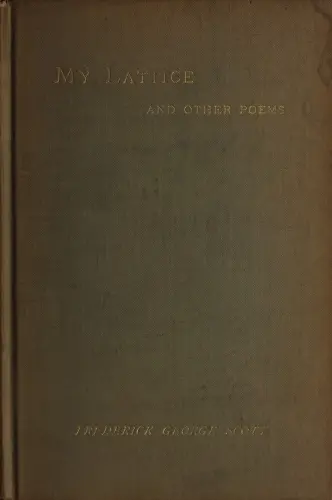
My Lattice, and Other Poems
Frederick George Scott
THE CLASSIC COLLECTION · 1922
"The Great War As I Saw It" by Frederick George Scott is a historical account written in the early 20th century. This memoir offers a personal perspective on the First World War, specifically focusing on the experiences of the author as a chaplain with the First Canadian Division. The book aims to convey both the grandeur and the tragedy of the sacrifices made by soldiers during the war, while providing insights into the camaraderie and challenges faced by those involved. At the start of the book, Scott describes his emotions and thoughts leading up to his decision to volunteer for the war, highlighting the initial excitement mixed with apprehension. He recounts events such as his departure from Quebec, the preparations at Valcartier, and the collective spirit of the Canadian soldiers as they prepare to leave for Europe. His reflections capture the profound sense of duty felt by him and his comrades as they confront the realities of war, setting the tone for a moving narrative that balances personal anecdotes with broader themes of bravery, loss, and the impact of conflict on human lives.
Introduction adapted from the source catalogue; source summaries may be automatically generated.
Free to read · English · 137,539 words · No account needed
MAKE TIME FOR A GOOD BOOK
On by default. Untick to stop anonymous reading totals. Each page counts after 10 seconds in view. How this works.
Anonymous counting is on unless you have switched it off.
The 10th Battalion was relieved that night by the 8th, the C.O. of which made his headquarters with the C.O. of the 5th Battalion in a large dugout by the sunken road. There, late at night, I shared a bunk with a young machine-gun officer and had a few hours of somewhat disturbed sleep. The next morning, Sunday, September the 29th, the fourth anniversary of our sailing from Quebec, our men were having a hard time. The German defence at Cambrai was most determined, and they had a large quantity of artillery in the neighbourhood. I went back to the road and into the trench beyond the wire and found a lot of men there. The parapet was so low that the men had dug what they called, "Funk holes" in the clay, where they put as much of their bodies as they could. Sitting in a bend of the trench where I got a good view of the men, I had a service for them, and, as it was that festival, I read out the epistle for St. Michael and All Angel's Day, and spoke of the guardianship of men which God had committed to the Heavenly Hosts. Going down the trench later on, I came to a place from which I could see, with my glasses, a German machine-gun emplacement and its crew. I went back and asked for a sniper. A man who said he was one came up to me and I showed him the enemy and then directed his fire. I could see from little puffs of dust where his bullets were landing. He was a good shot and I think must have done some damage, for all of a sudden the machine-gun opened fire on us and we had to dive into the trench pretty quickly. I told him that I thought we had better give up the game as they had the advantage over us. To snipe at the enemy seemed to be a curious way to spend a Sunday afternoon, but it was a temptation too hard to resist. I crawled back through the trench to the road, and there finding a man who had just lost his hand, directed him to (p. 316) the aid post near Battalion Headquarters. I accompanied him part of the way and had reached the edge of the sunken road, when a major of the Engineers came up to me and said, "I have got a better pair of German glasses than you have." It was an interesting challenge, so we stood there on a little rise looking at the spires of Cambrai and comparing the strength of the lenses. Very distinctly we saw the town, looking peaceful and attractive. Suddenly there was a tremendous crash in front of us, a lot of earth was blown into our faces, and we both fell down. My eyes were full of dirt but I managed to get up again. I had been wounded in both legs, and from one I saw blood streaming down through my puttees. My right foot had been hit and the artery in the calf of my leg was cut. I fell down again with a feeling of exasperation that I had been knocked out of the war. The poor major was lying on the ground with one leg smashed. The same shell had wounded in the chest the young machine-gun officer who had shared his bunk with me the night before. I believe an Imperial officer also was hit in the abdomen and that he died. The chaplain of the 10th Battalion who happened to be standing in the sunken road, got some men together quickly and came to our help. I found myself being carried off in a German sheet by four prisoners. They had forgotten to give me my glasses, and were very much amused when I called for them, but I got them and have them now. The major not only lost his leg but lost his glasses as well. The enemy had evidently been watching us from some observation post in Cambrai, for they followed us up with another shell on the other side of the road, which caused the bearers to drop me quickly. The chaplain walked beside me till we came to the aid post where there were some stretchers. I was placed on one and carried into the dressing station at Haynecourt. They had been having a hard time that day, for the village was heavily shelled. One of their men had been killed and several wounded. I felt a great pain in my heart which made it hard to breathe, so when I was brought into the dressing station I said, "Boys, I am going to call for my first and last tot of rum." I was immensely teased about this later on by my friends, who knew I was a teetotaller. They said I had drunk up all the men's rum issue. A General wrote to me later on to say he had been terribly shocked to hear I was wounded, but that it was nothing in comparison with the shock he felt when he heard that I had taken to drinking rum. Everyone in the dressing station was as usual most kind. The (p. 317) bitter thought to me was that I was going to be separated from the old 1st Division. The nightmare that had haunted me for so long had at last come true, and I was going to leave the men before the war was over. For four years they had been my beloved companions and my constant care. I had been led by the example of their noble courage and their unhesitating performance of the most arduous duties, in the face of danger and death, to a grander conception of manhood, and a longing to follow them, if God would give me grace to do so, in their path of utter self-sacrifice. I had been with them continuously in their joys and sorrows, and it did not seem to be possible that I could now go and desert them in that bitter fight. When the doctors had finished binding up my wounds, I was carried off immediately to an ambulance in the road, and placed in it with four others, one of whom was dying. It was a long journey of four hours and a half to No. 1 C.C.S. at Agnez-les-Duisans, and we had to stop at Queant on the way. Our journey lay through the area over which we had just made the great advance. Strange thoughts and memories ran through my mind. Faces of men that had gone and incidents that I had forgotten came back to me with great vividness. Should I ever again see the splendid battalions and the glad and eager lives pressing on continuously to Victory? Partly from shell holes, and partly from the wear of heavy traffic, the road was very bumpy. The man above me was in terrible agony, and every fresh jolt made him groan. The light of the autumn afternoon was wearing away rapidly. Through the open door at the end of the ambulance, as we sped onward, I could see the brown colourless stretch of country fade in the twilight, and then vanish into complete darkness, and I knew that the great adventure of my life among the most glorious men that the world has ever produced was over.
Your reading position is saved on this browser. Take it to another device with a library code. Reading pages adapt to text, rather than matching a printed edition.
Frederick George Scott
BEHIND THE BOOK
This eBook is for the use of anyone anywhere in the United States and most other parts of the world at no cost and with almost no restrictions whatsoever. You may copy it, give it away or re-use it under the terms of the Project Gutenberg License included with this eBook or online at www.gutenberg.org. If you are not located in the United States, you will have to check the laws of the country where you are located before using this eBook. Read the source licence.
The original source file, including credits and licence, is retained by this library. Request an original-format copy at no charge. Please include the book title and Project Gutenberg identifier #19857.
KEEP YOUR CURIOSITY GOING
Cécile Tormay

Moritz Busch
John L. Ransom
Frances Wright
Cécile Tormay

Mabel Potter Daggett