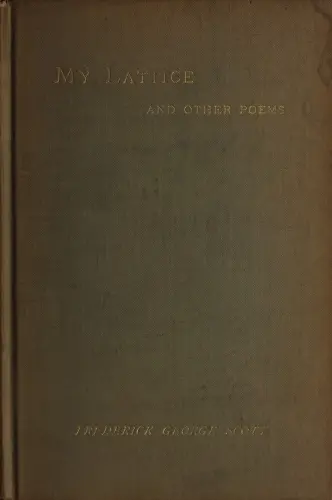
My Lattice, and Other Poems
Frederick George Scott
THE CLASSIC COLLECTION · 1922
"The Great War As I Saw It" by Frederick George Scott is a historical account written in the early 20th century. This memoir offers a personal perspective on the First World War, specifically focusing on the experiences of the author as a chaplain with the First Canadian Division. The book aims to convey both the grandeur and the tragedy of the sacrifices made by soldiers during the war, while providing insights into the camaraderie and challenges faced by those involved. At the start of the book, Scott describes his emotions and thoughts leading up to his decision to volunteer for the war, highlighting the initial excitement mixed with apprehension. He recounts events such as his departure from Quebec, the preparations at Valcartier, and the collective spirit of the Canadian soldiers as they prepare to leave for Europe. His reflections capture the profound sense of duty felt by him and his comrades as they confront the realities of war, setting the tone for a moving narrative that balances personal anecdotes with broader themes of bravery, loss, and the impact of conflict on human lives.
Introduction adapted from the source catalogue; source summaries may be automatically generated.
Free to read · English · 137,539 words · No account needed
MAKE TIME FOR A GOOD BOOK
On by default. Untick to stop anonymous reading totals. Each page counts after 10 seconds in view. How this works.
Anonymous counting is on unless you have switched it off.
Our machine gun battalion was quartered south of the St. Pol road at a place called Averdoignt. It was a lovely little village, very quiet and well away from the line, with pretty orchards and a stream at the back. When it was only possible to have a voluntary service in the evening, I would get a group of men as a body-guard and start off down the village to the quaint old church, halting at every farmyard on the way and calling out to those billeted there, "Come on, you heathen, come to the voluntary church parade." In the most good-natured (p. 259) way, dragging their reluctant pals with them, men would come out and swell our ranks until, by the time we reached the church, there was a good congregation. There against the wall of the building I would plant a table borrowed from the Cure's house, make it into an altar, distribute hymn books, and start the service, while the evening lights in the sky tinged the scene with a soft beauty.
When we were in the line the machine-gunners were always split up into small sections over the front, their guns of course being very carefully concealed. In consequence, just when I thought I had reached an area which was quite uninhabited, I would stumble on some queer little hole, and, on calling down it to see if there were any men there, the answer would be, "The machine-gun battalion," and I would find myself among friends. At Averdoignt they had one of the best rest billets they ever had, and they enjoyed it thoroughly.
Owing to the great distance which I had to cover in doing my parish visiting among the battalions, the difficulty of transportation, which had been serious from the beginning, became even more pressing, and some good friend suggested to me on the quiet that I should try to get a Clino, (that is a machine-gun side-car) from the Motor Machine-Gun Brigade. With great trepidation, I made an excursion one day to their headquarters at Verdrel. The O.C. was most kind and sympathetic. I shall never cease to invoke blessings upon his head. He took me over to the machine-shop and there presented to me, for my use until it should be recalled, a new Clino which had just come up from the base. The officer in charge uttered a protest by saying that they only had six Clinos for the Brigade, but the major remarked dryly, "And after Canon Scott has got his we shall only have five." Surely once again the Lord had provided for me. I was driven back to the Chateau in the new machine, but then had to find a driver. One was provided by the signallers. He was a graduate in science of McGill, so I used to lay stress upon my personal greatness from the fact that I had a university graduate for my chauffeur. Many and varied were the drives which Lyons and I had together, and many and varied were our adventures. Had the Clino not been both exceedingly strong and very new it would have come to grief long before it did. To go rattling down the St. Pol road at forty-five kilometres an hour was a frequent occurrence. All I had to sit upon was a seat without arms, while my foot rested on a bar in (p. 260) front. People asked me how it was I did not tumble off. I told them that I tied myself to the back of the seat with my spinal cord. I got the sappers to make me a large box which fitted on the back of the vehicle and had a padlock. In it I used to carry my bag of a thousand hymn books and other necessaries for church parades, and on the top of the box, as a protection to my car, I had the words "Canon Scott" painted in large white letters. The dust as we threaded our way through the streams of lorries almost choked us, but we could cover the ground in a short space of time which was a great thing. Lyons never managed the lights very successfully, and one rainy night after midnight, when I was returning from saying good-bye to the artillery who were moving South, in a lonely part of the road he ran the machine into some bushes on a bank by the wayside, and we found ourselves sitting in the mud without our hats. We did not know where we were and the rain was heavy, but we managed to disentangle the car and finally got home, resolving that further night excursions were out of the question. About a fortnight afterwards I received an order to return the Clino, but before I did so I journeyed to Corps Headquarters and made a passionate appeal to General Currie for its retention. As a result I received a private intimation to keep the car and say nothing about it. Of course I was the envy of everyone, and when they asked me how I got the Clino I said I did not exactly know. Whether it was sent to me from heaven with the assistance of General Currie, or whether it was sent to me from General Currie with the assistance of heaven, was a theological question which I had no time to go into during the war. When our Division was marching into Germany, after I was knocked out of the campaign, the dear old signallers used to patch up the Clino, even making new parts for it, in order that Canon Scott's car might get into Germany. Alas! the poor thing, like the one-horse shay, went to pieces finally one day and had to be left at Mons. During those last busy months, I do not know how I could have got on without it.
Your reading position is saved on this browser. Take it to another device with a library code. Reading pages adapt to text, rather than matching a printed edition.
Frederick George Scott
BEHIND THE BOOK
This eBook is for the use of anyone anywhere in the United States and most other parts of the world at no cost and with almost no restrictions whatsoever. You may copy it, give it away or re-use it under the terms of the Project Gutenberg License included with this eBook or online at www.gutenberg.org. If you are not located in the United States, you will have to check the laws of the country where you are located before using this eBook. Read the source licence.
The original source file, including credits and licence, is retained by this library. Request an original-format copy at no charge. Please include the book title and Project Gutenberg identifier #19857.
KEEP YOUR CURIOSITY GOING
Cécile Tormay

Moritz Busch
John L. Ransom
Frances Wright
Cécile Tormay

Mabel Potter Daggett