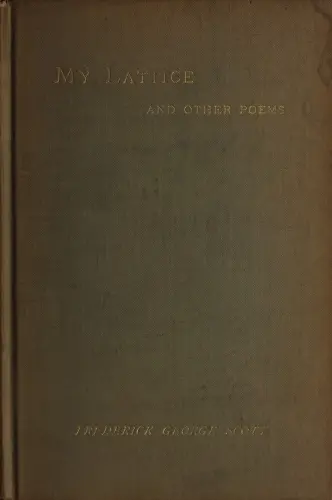
My Lattice, and Other Poems
Frederick George Scott
THE CLASSIC COLLECTION · 1922
"The Great War As I Saw It" by Frederick George Scott is a historical account written in the early 20th century. This memoir offers a personal perspective on the First World War, specifically focusing on the experiences of the author as a chaplain with the First Canadian Division. The book aims to convey both the grandeur and the tragedy of the sacrifices made by soldiers during the war, while providing insights into the camaraderie and challenges faced by those involved. At the start of the book, Scott describes his emotions and thoughts leading up to his decision to volunteer for the war, highlighting the initial excitement mixed with apprehension. He recounts events such as his departure from Quebec, the preparations at Valcartier, and the collective spirit of the Canadian soldiers as they prepare to leave for Europe. His reflections capture the profound sense of duty felt by him and his comrades as they confront the realities of war, setting the tone for a moving narrative that balances personal anecdotes with broader themes of bravery, loss, and the impact of conflict on human lives.
Introduction adapted from the source catalogue; source summaries may be automatically generated.
Free to read · English · 137,539 words · No account needed
MAKE TIME FOR A GOOD BOOK
On by default. Untick to stop anonymous reading totals. Each page counts after 10 seconds in view. How this works.
Anonymous counting is on unless you have switched it off.
About half-past one, I started up the street which led to the Bapaume road. The moon was shining, and I could see every object distinctly. Near our old Headquarters I got a lift in a lorry, which took me almost to Pozieres. There I got out and proceeded on my way alone. I entered the Y.M.C.A. hut and had a good strong cup of coffee, and started off afresh. That lonely region in the moonlight with the ruined village to one side and the fields stretching far away on either hand gave me an eerie feeling. I came upon four dead horses which had been killed that evening. To add to the strangeness of the situation, there was a strong scent of tear-gas in the air, which made my eyes water. Not a living soul could I see in the long white road.
Suddenly I heard behind me the sound of a troop of horses. I turned and saw coming towards me one of the strangest sights I have ever seen, and one which fitted in well with the ghostly character of the surroundings. It was a troop of mounted men carrying ammunition. They wore their gas masks, and as they came nearer, and I could see them more distinctly in the moonlight, the long masks with their two big glass eye-pieces gave the men a horse-like appearance. They looked like horses upon horses, and did not seem to be like human beings at all. I was quite glad when they had passed. I walked on till I came to what was known as Centre Way. It was a path, sometimes with bath-mats on it, which led across the fields down to the battery positions in the valley. Huge shell holes, half filled with water, pitted the fields in every direction, and on the slippery wood I had great difficulty to keep from sliding into those which were skirted by the path. Far off beyond Courcellette I saw the German flare-lights and the bursting of shells. It was a scene of vast desolation, weird beyond description. I had some difficulty when I got into the trench at the end of Centre Way, in finding the 11th Battery. The ground had been ploughed by shells and the trenches were heavy with soft and clinging mud. At last I met a sentry who told me where the O.C.'s (p. 156) dugout was. It was then about half-past three in the morning, but I went down the steps, and there, having been kindly welcomed, was given a blanket on the floor. I started at 6 a.m. with a young sergeant for Death Valley, where I was to get a runner to take me to Regina Trench. The sergeant was a splendid young fellow from Montreal who had won the D.C.M., and was most highly thought of in the battery. He was afterwards killed on Vimy Ridge, where I buried him in the cemetery near Thelus. I had been warned that we were going to make a bombardment of the enemy's lines that morning, and that I ought to be out of the way before that began. I left the sergeant near Courcellette and made my way over to the Brigade Headquarters which were in a dugout in Death Valley. There with the permission of his O.C., a runner volunteered to come with me. He brought a spade, and we started down the trench to the front line. When I got into Regina Trench, I found that it was impossible to pass along it, as one sank down so deeply into the heavy mud. I had brought a little sketch with me of the trenches, which showed the shell hole where it was supposed that the body had been buried. The previous night a cross had been placed there by a corporal of the battalion before it left the front line. No one I spoke to, however, could tell me the exact map location of the place where it stood. I looked over the trenches, and on all sides spread a waste of brown mud, made more desolate by the morning mist which clung over everything. I was determined, however, not to be baffled in my search, and told the runner who was with me that, if I stayed there six months, I was not going to leave till I had found that grave. We walked back along the communication trench and turned into one on the right, peering over the top every now and then to see if we could recognize anything corresponding to the marks on our map. Suddenly the runner, who was looking over the top, pointed far away to a lonely white cross that stood at a point where the ground sloped down through the mist towards Regina Trench. At once we climbed out of the trench and made our way over the slippery ground and past the deep shell holes to where the white cross stood out in the solitude. We passed many bodies which were still unburied, and here and there were bits of accoutrement which had been lost during the advance. When we came up to the cross I read my son's name upon it, and knew that I had reached the object I had in view. As the corporal who had placed (p. 157) the cross there had not been quite sure that it was actually on the place of burial, I got the runner to dig the ground in front of it. He did so, but we discovered nothing but a large piece of a shell. Then I got him to try in another place, and still we could find nothing. I tried once again, and after he had dug a little while he came upon something white. It was my son's left hand, with his signet ring upon it. They had removed his identification disc, revolver and pocket-book, so the signet ring was the only thing which could have led to his identification. It was really quite miraculous that we should have made the discovery. The mist was lifting now, and the sun to the East was beginning to light up the ground. We heard the crack of bullets, for the Germans were sniping us. I made the runner go down into a shell hole, while I read the burial service, and then took off the ring. I looked over the ground where the charge had been made. There lay Regina Trench, and far beyond it, standing out against the morning light, I saw the villages of Pys and Miraumont which were our objective. It was a strange scene of desolation, for the November rains had made the battle fields a dreary, sodden waste. How many of our brave men had laid down their lives as the purchase price of that consecrated soil! Through the centuries to come it must always remain sacred to the hearts of Canadians. We made a small mound where the body lay, and then by quick dashes from shell hole to shell hole we got back at last to the communication trench, and I was indeed thankful to feel that my mission had been successful. I have received letters since I returned to Canada from the kind young fellow, who accompanied me on the journey, and I shall never cease to be grateful to him. I left him at his headquarters in Death Valley, and made my way past Courcellette towards the road. As the trench was very muddy, I got out of it, and was walking along the top when I came across something red on the ground. It was a piece of a man's lung with the windpipe attached. I suppose some poor lad had had a direct hit from a shell and his body had been blown to pieces. The Germans were shelling the road, so with some men I met we made a detour through the fields and joined it further on, and finally got to the chalk-pit where the 87th Battalion was waiting to go in again to the final attack. I was delighted to see my friends once more, and they were thankful that I had been able to find the grave. Not many days afterwards, some of those whom I then met were called themselves to make the supreme (p. 158) sacrifice. I spent that night at the Rear Headquarters of the 4th Division, and they kindly sent me back the next day to Camblain l'Abbe in one of their cars.
Your reading position is saved on this browser. Take it to another device with a library code. Reading pages adapt to text, rather than matching a printed edition.
Frederick George Scott
BEHIND THE BOOK
This eBook is for the use of anyone anywhere in the United States and most other parts of the world at no cost and with almost no restrictions whatsoever. You may copy it, give it away or re-use it under the terms of the Project Gutenberg License included with this eBook or online at www.gutenberg.org. If you are not located in the United States, you will have to check the laws of the country where you are located before using this eBook. Read the source licence.
The original source file, including credits and licence, is retained by this library. Request an original-format copy at no charge. Please include the book title and Project Gutenberg identifier #19857.
KEEP YOUR CURIOSITY GOING
Cécile Tormay

Moritz Busch
John L. Ransom
Frances Wright
Cécile Tormay

Mabel Potter Daggett