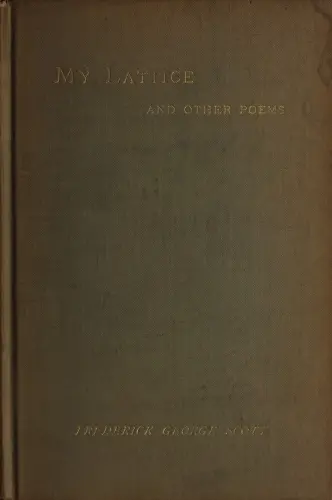
My Lattice, and Other Poems
Frederick George Scott
THE CLASSIC COLLECTION · 1922
"The Great War As I Saw It" by Frederick George Scott is a historical account written in the early 20th century. This memoir offers a personal perspective on the First World War, specifically focusing on the experiences of the author as a chaplain with the First Canadian Division. The book aims to convey both the grandeur and the tragedy of the sacrifices made by soldiers during the war, while providing insights into the camaraderie and challenges faced by those involved. At the start of the book, Scott describes his emotions and thoughts leading up to his decision to volunteer for the war, highlighting the initial excitement mixed with apprehension. He recounts events such as his departure from Quebec, the preparations at Valcartier, and the collective spirit of the Canadian soldiers as they prepare to leave for Europe. His reflections capture the profound sense of duty felt by him and his comrades as they confront the realities of war, setting the tone for a moving narrative that balances personal anecdotes with broader themes of bravery, loss, and the impact of conflict on human lives.
Introduction adapted from the source catalogue; source summaries may be automatically generated.
Free to read · English · 137,539 words · No account needed
MAKE TIME FOR A GOOD BOOK
On by default. Untick to stop anonymous reading totals. Each page counts after 10 seconds in view. How this works.
Anonymous counting is on unless you have switched it off.
I had been asked to look up the grave of a young officer of a Scottish battalion, who had been killed in the July advance. I rode over to Mametz and saw all that historic fighting ground. The village was a heap of ruins, but from out of a cellar came a smartly-dressed lieutenant, who told me that he had the great privilege and honour of being the Town Major of Mametz. We laughed as we surveyed his very smelly and unattractive little kingdom. I found the grave, and near it were several crosses over the last resting places of some of our Canadian Dragoons, who had been in the great advance. All that region was one of waste and lonely country-side, blown bare by the tempest of war.
It was during our last visit to Albert that the 4th Division arrived to take over the line from us. I had the great joy, therefore, of having my second son near me for six days. His battalion, the (p. 147) 87th, was camped on a piece of high ground to the right of "Tara Hill," and from my window I could see the officers and men walking about in their lines. It was a great privilege to have his battalion so near me, for I had many friends among all ranks.
The Sunday before I left I had service for them and a celebration of the Holy Communion, after which one of the sergeants came and was baptized. Our Divisional Headquarters left Albert for good on October 17th. We made our way to our abode at Canaples. We only stayed there two days and then went on to Bernaville and Frohen Le Grand, spending a night in each place, and on Sunday arrived at the Chateau of Le Cauroy, which we were afterwards to make our headquarters in the last year of the war. I was billetted in a filthy little room in a sort of farm building and passed one of the most dreary days I have ever known. It was rainy and cold, and every one was tired and ill-humoured. I had a strange feeling of gloom about me which I could not shake off, so I went over to the Cure's house at the end of the avenue and asked him if I might come in and sit beside the fire in his kitchen. He was very kind, and it was quite nice to have someone to talk to who was not in the war. We were able to understand each other pretty well, and he gave me an insight into the feelings of the French. On the next morning, the weather had cleared and the A.D.M.S. motored me to our new halting place at Roellencourt, where I was given a billet in the Cure's house. He was a dear old man and received me very kindly, and gave me a comfortable room overlooking his garden. Downstairs his aged and invalid mother sat in her chair, tended kindly by her son and daughter. Roellencourt was a pleasant place on the St. Pol Road, and quite a number of our men were billeted there. I went to St. Pol to lunch at the hotel and spent the day buying some souvenirs. On my return in the afternoon I made my way to the Cure's house, where I found my room neatly arranged for me. Suddenly I heard a knock at the door, and there stood the old man with a letter in his hand. I thought he looked somewhat strange. He handed me the letter, and then taking my hand, he said to me in French, "My brother, have courage, it is very sad." At once the truth flashed upon me and I said, "My son is dead." He shook my hand, and said again, "Have courage, my brother." I went downstairs later on and found his old mother sitting in her chair with the tears streaming down her cheeks. I shall never cease to be grateful to those kind, simple people for their sympathy at that (p. 148) time. The next morning the General sent me in his car to Albert, and Colonel Ironside took me up to the chalk-pit where the 87th were resting. They had suffered very heavy losses, and I heard the account of my son's death. On the morning of October 21st, he was leading his company and another to the attack on Regina Trench. They had advanced, as the barrage lifted, and he was kneeling in a shell hole looking at his watch waiting for the moment to charge again, when a machine gun opened fire and he was hit in the head and killed instantly. As he still kept kneeling looking at his watch, no one knew that anything had happened. The barrage lifted again behind the German trench; still he gave no sign. The Germans stood up and turned their machine-guns on our men. Then the officer next in command went over to see what had happened, and, finding my son dead, gave the order to advance. Suffering heavy casualties, the men charged with determination and took the trench, completely routing the enemy. When the battalion was relieved the dead had to be left unburied, but several men volunteered to go and get my son's body. This I would not hear of, for the fighting was still severe, and I did not believe in living men risking their lives to bring out the dead. I looked far over into the murky distance, where I saw long ridges of brown land, now wet with a drizzling rain, and thought how gloriously consecrated was that soil, and how worthy to be the last resting place of those who had died for their country. Resolving to come back later on when things were quieter, and make my final search, I bid good-bye to the officers and men of the battalion and was motored back to my Headquarters.
Your reading position is saved on this browser. Take it to another device with a library code. Reading pages adapt to text, rather than matching a printed edition.
Frederick George Scott
BEHIND THE BOOK
This eBook is for the use of anyone anywhere in the United States and most other parts of the world at no cost and with almost no restrictions whatsoever. You may copy it, give it away or re-use it under the terms of the Project Gutenberg License included with this eBook or online at www.gutenberg.org. If you are not located in the United States, you will have to check the laws of the country where you are located before using this eBook. Read the source licence.
The original source file, including credits and licence, is retained by this library. Request an original-format copy at no charge. Please include the book title and Project Gutenberg identifier #19857.
KEEP YOUR CURIOSITY GOING
Cécile Tormay

Moritz Busch
John L. Ransom
Frances Wright
Cécile Tormay

Mabel Potter Daggett