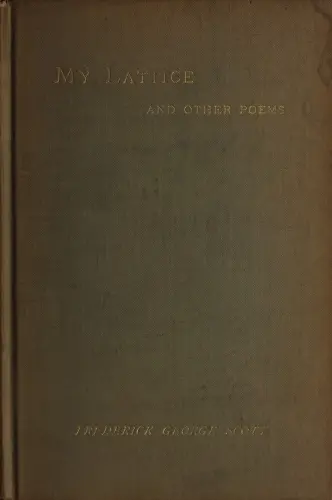
My Lattice, and Other Poems
Frederick George Scott
THE CLASSIC COLLECTION · 1922
"The Great War As I Saw It" by Frederick George Scott is a historical account written in the early 20th century. This memoir offers a personal perspective on the First World War, specifically focusing on the experiences of the author as a chaplain with the First Canadian Division. The book aims to convey both the grandeur and the tragedy of the sacrifices made by soldiers during the war, while providing insights into the camaraderie and challenges faced by those involved. At the start of the book, Scott describes his emotions and thoughts leading up to his decision to volunteer for the war, highlighting the initial excitement mixed with apprehension. He recounts events such as his departure from Quebec, the preparations at Valcartier, and the collective spirit of the Canadian soldiers as they prepare to leave for Europe. His reflections capture the profound sense of duty felt by him and his comrades as they confront the realities of war, setting the tone for a moving narrative that balances personal anecdotes with broader themes of bravery, loss, and the impact of conflict on human lives.
Introduction adapted from the source catalogue; source summaries may be automatically generated.
Free to read · English · 137,539 words · No account needed
MAKE TIME FOR A GOOD BOOK
On by default. Untick to stop anonymous reading totals. Each page counts after 10 seconds in view. How this works.
Anonymous counting is on unless you have switched it off.
One night a young German was brought in. He was perfectly conscious, but was reported to be seriously wounded. He was laid out on one of the tables and when his torn uniform was ripped off, we found he had been hit by shrapnel and had ten or twelve wounds in his body and limbs. I never saw anyone more brave. He was a beautifully developed man, with very white skin, and on the grey blanket looked like a marble statue, marked here and there by red, bleeding wounds. He never gave a sign by sound or movement of what he was suffering; but his white face showed the approach of death. He was tended carefully, and then carried over to a quiet corner in the room. I went over to him, and pointing to my collar said, "Pasteur." I knelt beside him and started the Lord's Prayer in German, which he finished adding some other prayer. I gave him the benediction and made the sign of the cross on his forehead, for the sign of the cross belongs to the universal language of men. Then the dying, friendless enemy, who had made expiation in his blood for the sins of his guilty nation, drew his hand from under the blanket and taking mine said, "Thank you." They carried him off to an ambulance, but I was told he would probably die long before he got to his destination.
On the 26th of September I spent the night in a dressing station in the sunken road near Courcelette. I had walked from Pozieres down to the railway track, where in the dark I met a company of the Canadian Cyclist Corps, who were being used as stretcher bearers. We went in single file along the railway and then across the fields which were being shelled. At last we came to the dressing station. Beside the entrance, was a little shelter covered with corrugated iron, and there were laid a number of wounded, while some were lying on stretchers in the open road. Among these were several German prisoners and the bodies of dead men. The dressing station had once been the dugout of an enemy battery and its openings, therefore, were on the side of the road facing the Germans, who knew its location exactly. When I went down into it I found it crowded with men who were being tended by the doctor and his staff. It had three openings to the road. One of them had had a direct hit that night, and mid the debris which blocked it were the fragments of a human body. The Germans gave the place no (p. 143) rest, and all along the road shells were falling, and bits would clatter upon the corrugated iron which roofed the shelter by the wayside. There was no room in the dugout for any but those who were being actually treated by the doctor, so the wounded had to wait up above till they could be borne off by the bearer parties. It was a trying experience for them, and it was hard to make them forget the danger they were in. I found a young officer lying in the road, who was badly hit in the leg. I had prayers with him and at his request I gave him the Holy Communion. On the stretcher next to him, lay the body of a dead man wrapped in a blanket. After I had finished the service, the officer asked for some water. I went down and got him a mouthful very strongly flavoured with petrol from the tin in which it was carried. He took it gladly, but, just as I had finished giving him the drink, a shell burst and there was a loud crack by his side. "Oh," he cried, "they have got my other leg." I took my electric torch, and, allowing only a small streak of light to shine through my fingers, I made an examination of the stretcher, and there I found against it a shattered rum jar which had just been hit by a large piece of shell. The thing had saved him from another wound, and I told him that he owed his salvation to a rum jar. He was quite relieved to find that his good leg had not been hit. I got the bearer party to take him off as soon as possible down the long path across the fields which led to the light railway, where he could be put on a truck. Once while I was talking to the men in the shelter, a shell burst by the side of the road and ignited a pile of German ammunition. At once there were explosions, a weird red light lit up the whole place, and volumes of red smoke rolled off into the starlit sky. To my surprise, from a ditch on the other side of the road, a company of Highlanders emerged and ran further away from the danger of the exploding shells. It was one of the most theatrical sights I have ever seen. With the lurid light and the broken road in the foreground, and the hurrying figures carrying their rifles, it was just like a scene on the stage.
Your reading position is saved on this browser. Take it to another device with a library code. Reading pages adapt to text, rather than matching a printed edition.
Frederick George Scott
BEHIND THE BOOK
This eBook is for the use of anyone anywhere in the United States and most other parts of the world at no cost and with almost no restrictions whatsoever. You may copy it, give it away or re-use it under the terms of the Project Gutenberg License included with this eBook or online at www.gutenberg.org. If you are not located in the United States, you will have to check the laws of the country where you are located before using this eBook. Read the source licence.
The original source file, including credits and licence, is retained by this library. Request an original-format copy at no charge. Please include the book title and Project Gutenberg identifier #19857.
KEEP YOUR CURIOSITY GOING
Cécile Tormay

Moritz Busch
John L. Ransom
Frances Wright
Cécile Tormay

Mabel Potter Daggett