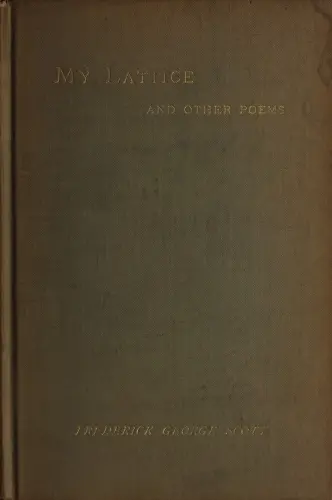
My Lattice, and Other Poems
Frederick George Scott
THE CLASSIC COLLECTION · 1922
"The Great War As I Saw It" by Frederick George Scott is a historical account written in the early 20th century. This memoir offers a personal perspective on the First World War, specifically focusing on the experiences of the author as a chaplain with the First Canadian Division. The book aims to convey both the grandeur and the tragedy of the sacrifices made by soldiers during the war, while providing insights into the camaraderie and challenges faced by those involved. At the start of the book, Scott describes his emotions and thoughts leading up to his decision to volunteer for the war, highlighting the initial excitement mixed with apprehension. He recounts events such as his departure from Quebec, the preparations at Valcartier, and the collective spirit of the Canadian soldiers as they prepare to leave for Europe. His reflections capture the profound sense of duty felt by him and his comrades as they confront the realities of war, setting the tone for a moving narrative that balances personal anecdotes with broader themes of bravery, loss, and the impact of conflict on human lives.
Introduction adapted from the source catalogue; source summaries may be automatically generated.
Free to read · English · 137,539 words · No account needed
MAKE TIME FOR A GOOD BOOK
On by default. Untick to stop anonymous reading totals. Each page counts after 10 seconds in view. How this works.
Anonymous counting is on unless you have switched it off.
Mont des Cats hospital was a most delightful temporary home. There was a large ward full of young officers, who were more or less ill (p. 129) or damaged. In another part of the building were wards for the men. From the O.C. downwards everyone in the C.C.S. was the soul of kindness, and the beautiful buildings with their pleasant grounds gave a peculiar charm to the life. My room was not far from the chapel, and every night at two a.m. I could hear the old monks chanting their offices. Most of the monks had been conscripted and were fighting in the French army; only a few of the older ones remained. But by day and night at stated intervals the volume of their prayer and praise rose up above the noise of war, just as it had risen through the centuries of the past. There were beautiful gardens which the monks tended carefully, and also many grape vines on the walls. We used to watch the silent old men doing their daily work and making signs to one another instead of speaking. In the evening I would make my way up the spiral staircase to the west-end gallery, which looked down upon the chapel. The red altar lamp cast a dim light in the sacred building, and every now and then in the stillness I could hear, like the roar of a distant sea, the sound of shells falling at the front. The mysterious silence of the lofty building, with the far off reverberations of war thrilling it now and then, was a solace to the soul.
A smaller chapel in the monastery, with a well-appointed altar, was allotted by the monks to the chaplain for his services. While I was at Mont des Cats we heard of the death of Lord Kitchener. The news came to the Army with the force of a stunning blow; but thank God, the British character is hardened and strengthened by adversity, and while we all felt his loss keenly and looked forward to the future with anxiety, the determination to go on to victory was made stronger by the catastrophe. As the chaplain of the hospital was away at the time, I held a memorial service in the large refectory. Following upon the death of Lord Kitchener came another disaster. The Germans in the beginning of June launched a fierce attack upon the 3rd Division, causing many casualties and capturing many prisoners. General Mercer was killed, and a brigadier was wounded and taken prisoner. To make matters worse, we heard of the battle of Jutland, the first report of which was certainly disconcerting. We gathered from it that our navy had suffered a great reverse. The death of Lord Kitchener, the naval reverse, and the fierce attack on our front, following one another in such a short space of time, called for great steadiness of nerve and coolness of head. I felt that the hospital was no place for me (p. 130) when Canadians were meeting reverses at the front, especially as the First Division was ordered to recapture the lost trenches. I telephoned to my good friend, Colonel Brutenell, the C.O. of the Motor Machine-Gun Brigade, and asked him to send me a side-car to take me forward. He had always in the past shown me much kindness in supplying me with means of locomotion. Colonel Brutenell was an old country Frenchman with the most courteous manners. When I first discovered that he was the possessor of side-cars, I used to obtain them by going over to him and saying, "Colonel, if you will give me a side-car I will recite you one of my poems." He was too polite at first to decline to enter into the bargain, but, as time went on, I found that the price I offered began to lose its value, and sometimes the side-cars were not forthcoming. It then became necessary to change my plan of campaign, so I hit upon another device. I used to walk into the orderly room and say in a raucous voice, "Colonel, if you don't give me a side-car I will recite one of my poems." I found that in the long run this was the most effectual method. On the present occasion, therefore, the side-car was sent to me, and I made my way to Wippenhoek and from thence up to the dressing station at Vlamertinghe. Here our wounded were pouring in. Once again Canada was reddening the soil of the Salient with her best blood. It was indeed an anxious time. That evening, however, a telegram was received by the O.C. of the Ambulance saying that the British fleet had sunk twenty or thirty German vessels, and implying that what we had thought was a naval reverse was really a magnificent naval victory. I do not know who sent the telegram, or on what foundation in fact it was based. I think that somebody in authority considered it would be well to cheer up our men with a piece of good news. At any rate all who were at the dressing station believed it, and I determined to carry a copy of the telegram with me up to the men in the line. I started off on one of the ambulances for Railway Dugouts. Those ambulance journeys through the town of Ypres after midnight were things to be remembered. The desolate ruins of the city stood up black and grim. The road was crowded with men, lorries, ambulances, transports and motorcycles. Every now and then the scene of desolation would be lit up by gun flashes. Occasionally the crash of a shell would shake the already sorely smitten city. I can never cease to admire the pluck of those ambulance drivers, who night after night, backwards and forwards, threaded their way in the (p. 131) darkness through the ghost-haunted streets. One night when the enemy's guns were particularly active, I was being driven by a young boy only eighteen years of age. Sitting beside him on the front seat, I told him how much I admired his nerve and coolness. He turned to me quite simply and said that he was not afraid. He just put himself in God's hands and didn't worry. When he came afterwards to Headquarters and drove our side-car he never minded where he went or how far towards the front he took it. I do not know where he is in Canada, but I know that Canada will be the better for having such a boy as one of her citizens.
Your reading position is saved on this browser. Take it to another device with a library code. Reading pages adapt to text, rather than matching a printed edition.
Frederick George Scott
BEHIND THE BOOK
This eBook is for the use of anyone anywhere in the United States and most other parts of the world at no cost and with almost no restrictions whatsoever. You may copy it, give it away or re-use it under the terms of the Project Gutenberg License included with this eBook or online at www.gutenberg.org. If you are not located in the United States, you will have to check the laws of the country where you are located before using this eBook. Read the source licence.
The original source file, including credits and licence, is retained by this library. Request an original-format copy at no charge. Please include the book title and Project Gutenberg identifier #19857.
KEEP YOUR CURIOSITY GOING
Cécile Tormay

Moritz Busch
John L. Ransom
Frances Wright
Cécile Tormay

Mabel Potter Daggett