THE CLASSIC COLLECTION✦Froth: A NovelCLASSIC FREE BOOKS
Froth: A Novel
Armando Palacio Valdés
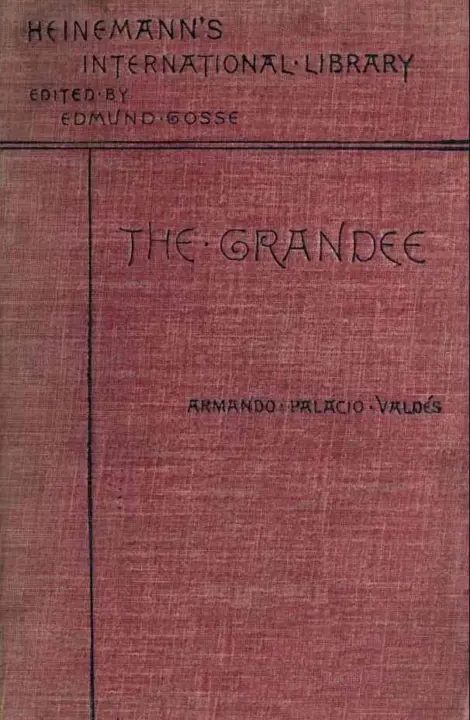
THE CLASSIC COLLECTION · 1894
"The Grandee" by Armando Palacio Valdés is a novel written in the late 19th century. The story is set in a provincial city in Spain, focusing on the life and dynamics within a noble household, particularly that of the protagonist Don Pedro Quiñones de Leon, an aging grandee struggling with his sense of dignity in a changing society. The narrative explores themes of societal hierarchy, pride, and personal turmoil against the backdrop of local customs and the intricacies of family relationships. At the start of "The Grandee," the atmospheric setting of Lancia is established through a wintry night, with elements that reflect the town's old-world charm and the quirks of its inhabitants. We meet Don Pedro Quiñones, who navigates the challenges of his aristocratic status despite facing paralysis and the burden of maintaining respectability. His interactions with guests during a social gathering reveal a tapestry of relationships intertwined with humor, social expectations, and unfulfilled desires, setting the stage for deeper explorations of the characters' motivations and conflicts as the story unfolds. The text hints at underlying tensions, notably regarding Don Pedro's strained marriage to Amalia, and foreshadows the complexities and darker themes that will be explored further in the narrative.
Introduction adapted from the source catalogue; source summaries may be automatically generated.
Free to read · English · 95,134 words · No account needed
MAKE TIME FOR A GOOD BOOK
On by default. Untick to stop anonymous reading totals. Each page counts after 10 seconds in view. How this works.
Anonymous counting is on unless you have switched it off.
The Pensioner became suddenly serious and his moustache went up in horror at his daughter's sally, but he was immediately calmed at seeing that the captain, instead of being offended, only returned a loving smile, and like all the rest treated it as a joke.
"She is not the only one who has had such bad taste," said Carmelita, with marked insinuation, delighted at the chance of making such a clever hit.
"And who was this lieutenant? Some useless puppy, like we have here?" continued Emilia, with the same taking levity.
"Gently, gently, Emilia!" returned Paco. "Paniagua was lieutenant of the third regiment of infantry of Flanders, and a very brave man."
"No, dear, no," interposed Nuncita, "to put the matter right, he was of
the Royal Guard."
"Was he not an archer?"
"No, dear heart, I say he was of the Royal Guard."
Don Cristobal hid his amusement under a fit of coughing, and Manuel Antonio and the young people laughed heartily.
"Paniagua was a very remarkable man," continued Paco. "He was endowed with a decision of character befitting soldiers. The day that he arrived, he saw Nuncia at the window in the morning, and in the evening he managed to give her, in the portico of San Rafael after nones, a letter of declaration which ran thus:
"'Senorita, in confusion and fear and doubting if in your kind condescension you will pardon my boldness, I confess that my only joy is in loving you.'"
"Oh! you rogue! what a memory you have!" exclaimed Nuncita, now fairly
overcome.
The fact was, Paco, to whom, after many entreaties, "the child" had shown the letters she had kept of Paniagua's, learnt the original document by heart and recited it everywhere to the great delight of his friends.
"He was what may be called a resolute man. The character of a person is shown like that. How different to the soldiers of the present day, who before proposing to a girl, dangle about for a whole year and then delay saying: 'Child, when shall we go to church?'"
These words were uttered with a look at the corner, where Emilita and the captain were sitting. The latter took the remark and became serious, and the girl tried to look unconscious although grateful in her heart to Paco for giving the hint; whilst the Pensioner twisted his moustache with a trembling hand, fearing that Nunez would take offence, but glad with the hope that these opportune allusions would bring him to the point.
Tired of conversation, the young people proposed a game of forfeits. It is a game which wide-awake men always turn to their own advantage.
Your reading position is saved on this browser. Take it to another device with a library code. Reading pages adapt to text, rather than matching a printed edition.
Armando Palacio Valdés
Armando Palacio Valdés
Armando Palacio Valdés
Armando Palacio Valdés
BEHIND THE BOOK
This eBook is for the use of anyone anywhere in the United States and most other parts of the world at no cost and with almost no restrictions whatsoever. You may copy it, give it away or re-use it under the terms of the Project Gutenberg License included with this eBook or online at www.gutenberg.org. If you are not located in the United States, you will have to check the laws of the country where you are located before using this eBook. Read the source licence.
The original source file, including credits and licence, is retained by this library. Request an original-format copy at no charge. Please include the book title and Project Gutenberg identifier #31056.
KEEP YOUR CURIOSITY GOING
Coulson Kernahan

Maurice Baring
Frances Wright
Cécile Tormay

Frederic Jesup Stimson

W. H. P. (William Henry Pope) Jarvis