
Lucinda
Anthony Hope
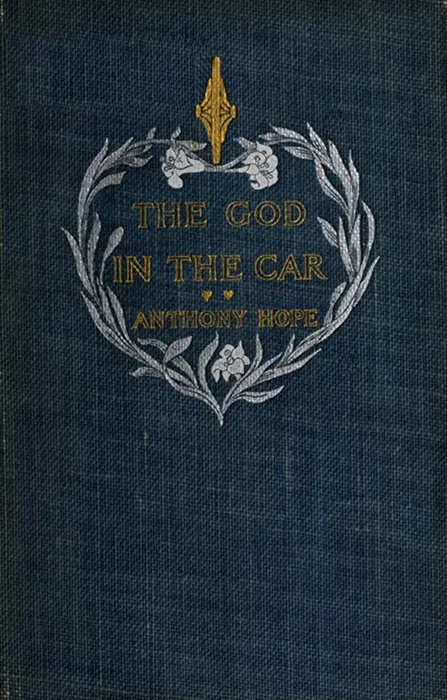
THE CLASSIC COLLECTION · 1894
"The God in the Car: A Novel" by Anthony Hope is a fictional work written in the late 19th century. The story appears to delve into the lives of several socialites navigating relationships and business affairs, with a central character named Willie Ruston who is involved in a new venture concerning the African territory of Omofaga. The narrative seems to oscillate between personal dynamics and the challenging financial schemes of that era, including the challenges posed by competing interests. The opening of the novel introduces a lively social gathering where Miss Ferrars is seeking to identify a man of intrigue, Foster Belford, while exchanging witty banter with Lord Semingham. Social hierarchies and the dynamics of friendship and flirtation are caricatured through the conversations, particularly spotlighting the character of Mrs. Dennison, who is depicted as thoughtful and somewhat troubled by her past connections, especially with Ruston. As the characters engage in discussions about business and memories, the tone hints at underlying tensions tying their personal lives to the larger economic ambitions surrounding Ruston’s endeavors in Omofaga, setting the stage for further clashes between social expectation and personal ambition.
Introduction adapted from the source catalogue; source summaries may be automatically generated.
Free to read · English · 69,737 words · No account needed
MAKE TIME FOR A GOOD BOOK
On by default. Untick to stop anonymous reading totals. Each page counts after 10 seconds in view. How this works.
Anonymous counting is on unless you have switched it off.
Evan admitted that there was more, and, in obedience to some skilful guidance, he revealed what there was more--what beyond mere offended dignity--between himself and Mr. Ruston. He had to complain of no lack of interest on the part of his listener. Mrs. Dennison questioned him closely as to his grounds for anticipating Ruston's rivalry. The idea was evidently quite new to her; and Evan was glad to detect her reluctance to accept it--she must think as he did about Willie Ruston. The tangible evidence appeared on examination reassuringly small, and Evan, by a strange conversion, found himself driven to defend his apprehensions by insisting on just that power of attraction in his foe which he had begun by denying altogether. But that, Mrs. Dennison objected, only showed, even if it existed, that Marjory might like Ruston, not that Ruston would return her liking. On the whole Mrs. Dennison comforted him, and, dismissing Ruston from the discussion, said with a smile,
"So you're thinking of settling down already, are you?"
"I say, Mrs. Dennison, you've always been awfully good to me; I wonder if you'd help me in this?"
"How could I help you?"
"Oh, lots of ways. Well, for instance, old Lady Valentine doesn't ask me there often. You see, I haven't got any money."
"Poor boy! Of course you haven't. Nice young men never have any money."
"So I don't get many chances of seeing her."
"And I might arrange meetings for you? That's how I could help? Now, why
should I help?"
Evan was encouraged by this last question, put in his friend's doubtfully-serious doubtfully-playful manner.
"It needn't," he said, in a tone rather more timid than young Sir Walter would have expected, "make any difference to our friendship, need it? If it meant that----"
The sentence was left in expressive incompleteness.
Mrs. Dennison wanted to laugh; but why should she hurt his feelings? He was a pleasant boy, and, in spite of his vanity, really a clever one. He had been a little spoilt; that was all. She turned her laugh in another direction.
"Berthe Cormack would tell you that it would be sure to intensify it," she said. "Seriously, I shan't hate you for marrying, and I don't suppose Marjory will hate me."
"Then" (Mrs. Dennison had to smile at that little word), "you'll help
me?"
"Perhaps," said Mrs. Dennison, allowing her smile to become manifest.
"You won't be against me?"
"Perhaps not."
"Good-bye," said Evan, pressing her hand.
He had enjoyed himself very much, and Mrs. Dennison was glad that she had been good-natured, and had not laughed.
"Good-bye, and I hope you'll be very happy, if you succeed.
And--Evan--don't kill Mr. Ruston!"
Your reading position is saved on this browser. Take it to another device with a library code. Reading pages adapt to text, rather than matching a printed edition.
Anthony Hope

Anthony Hope

Anthony Hope

Anthony Hope
BEHIND THE BOOK
This eBook is for the use of anyone anywhere in the United States and most other parts of the world at no cost and with almost no restrictions whatsoever. You may copy it, give it away or re-use it under the terms of the Project Gutenberg License included with this eBook or online at www.gutenberg.org. If you are not located in the United States, you will have to check the laws of the country where you are located before using this eBook. Read the source licence.
The original source file, including credits and licence, is retained by this library. Request an original-format copy at no charge. Please include the book title and Project Gutenberg identifier #40583.
KEEP YOUR CURIOSITY GOING
Coulson Kernahan

Maurice Baring
Frances Wright
Cécile Tormay

Frederic Jesup Stimson

W. H. P. (William Henry Pope) Jarvis