
Europe and elsewhere
Mark Twain
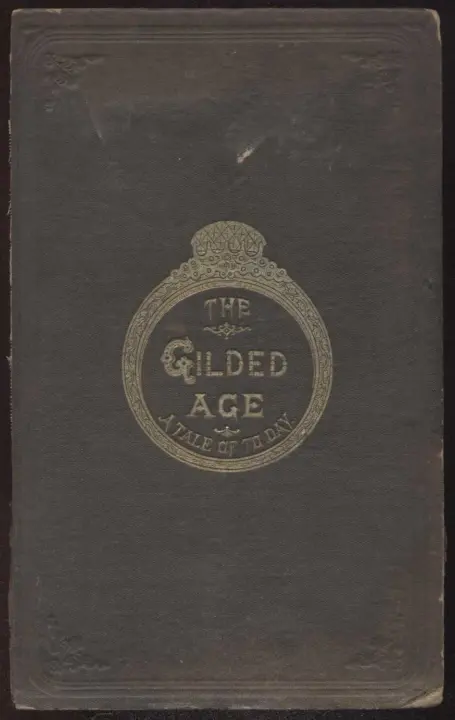
THE CLASSIC COLLECTION · 1873
"The Gilded Age: A Tale of Today" by Mark Twain and Charles Dudley Warner is a satirical novel published in 1873. It follows a poor rural family's attempts to strike it rich by selling their vast Tennessee land, while their adopted daughter Laura becomes a Washington lobbyist seeking congressional support. Meanwhile, two young men pursue fortune through land speculation. The novel skewers the greed, materialism, and political corruption of post-Civil War America—so effectively that it named an entire era of American history.
Introduction adapted from the source catalogue; source summaries may be automatically generated.
Free to read · English · 158,492 words · No account needed
MAKE TIME FOR A GOOD BOOK
On by default. Untick to stop anonymous reading totals. Each page counts after 10 seconds in view. How this works.
Anonymous counting is on unless you have switched it off.
Philip Sterling was on his way to Ilium, in the state of Pennsylvania. Ilium was the railway station nearest to the tract of wild land which Mr. Bolton had commissioned him to examine.
On the last day of the journey as the railway train Philip was on was leaving a large city, a lady timidly entered the drawing-room car, and hesitatingly took a chair that was at the moment unoccupied. Philip saw from the window that a gentleman had put her upon the car just as it was starting. In a few moments the conductor entered, and without waiting an explanation, said roughly to the lady,
“Now you can't sit there. That seat's taken. Go into the other car.”
“I did not intend to take the seat,” said the lady rising, “I only sat down a moment till the conductor should come and give me a seat.”
“There aint any. Car's full. You'll have to leave.”
“But, sir,” said the lady, appealingly, “I thought--”
“Can't help what you thought--you must go into the other car.”
“The train is going very fast, let me stand here till we stop.”
“The lady can have my seat,” cried Philip, springing up.
The conductor turned towards Philip, and coolly and deliberately surveyed him from head to foot, with contempt in every line of his face, turned his back upon him without a word, and said to the lady,
“Come, I've got no time to talk. You must go now.”
The lady, entirely disconcerted by such rudeness, and frightened, moved towards the door, opened it and stepped out. The train was swinging along at a rapid rate, jarring from side to side; the step was a long one between the cars and there was no protecting grating. The lady attempted it, but lost her balance, in the wind and the motion of the car, and fell! She would inevitably have gone down under the wheels, if Philip, who had swiftly followed her, had not caught her arm and drawn her up. He then assisted her across, found her a seat, received her bewildered thanks, and returned to his car.
The conductor was still there, taking his tickets, and growling
something about imposition. Philip marched up to him, and burst out
with,
“You are a brute, an infernal brute, to treat a woman that way.”
“Perhaps you'd like to make a fuss about it,” sneered the conductor.
Philip's reply was a blow, given so suddenly and planted so squarely in the conductor's face, that it sent him reeling over a fat passenger, who was looking up in mild wonder that any one should dare to dispute with a conductor, and against the side of the car.
Your reading position is saved on this browser. Take it to another device with a library code. Reading pages adapt to text, rather than matching a printed edition.
BEHIND THE BOOK
This eBook is for the use of anyone anywhere in the United States and most other parts of the world at no cost and with almost no restrictions whatsoever. You may copy it, give it away or re-use it under the terms of the Project Gutenberg License included with this eBook or online at www.gutenberg.org. If you are not located in the United States, you will have to check the laws of the country where you are located before using this eBook. Read the source licence.
The original source file, including credits and licence, is retained by this library. Request an original-format copy at no charge. Please include the book title and Project Gutenberg identifier #3178.
KEEP YOUR CURIOSITY GOING
Coulson Kernahan

Maurice Baring
Frances Wright
Cécile Tormay

Frederic Jesup Stimson

W. H. P. (William Henry Pope) Jarvis


