Europe and elsewhere
Mark Twain
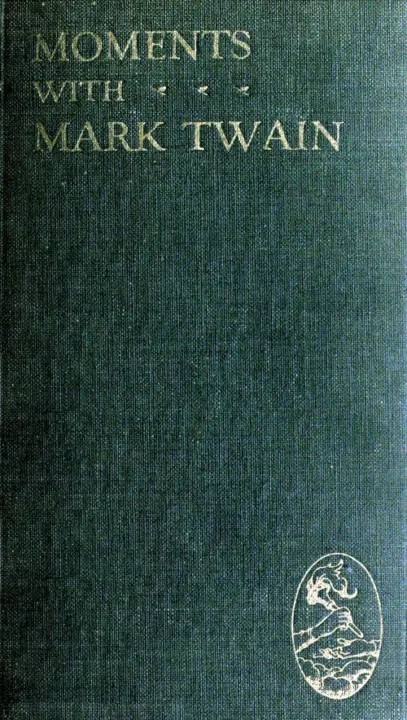
THE CLASSIC COLLECTION · 1907
"Moments with Mark Twain" by Mark Twain is a collection of selected writings compiled by Albert Bigelow Paine, likely published in the early 20th century. This anthology aims to showcase more than just the humor for which Twain is famous, presenting his thoughtful observations and reflections on various aspects of life and society. The selections are organized chronologically to highlight Twain’s literary evolution and the development of his unique voice. The opening portion introduces Twain's witty commentary through a selection of pieces, including answers to correspondents and anecdotes about his experiences editing an agricultural paper. In these initial pages, Twain employs humor to critique societal habits, the absurdity of moral statistics, and the quirks of his fellow citizens. For example, one segment includes an amusing exchange regarding the ridiculous notion that turnips should be shaken from trees. The writing is characterized by Twain's signature playful language and sharp wit, engaging the reader with a blend of humor and insightful critique right from the start.
Introduction adapted from the source catalogue; source summaries may be automatically generated.
Free to read · English · 62,751 words · No account needed
MAKE TIME FOR A GOOD BOOK
On by default. Untick to stop anonymous reading totals. Each page counts after 10 seconds in view. How this works.
Anonymous counting is on unless you have switched it off.
“So far as I remember, I have never seen an Author’s Preface which had any purpose but one—to furnish reasons for the publication of the book. Prefaces wear many disguises, call themselves by various names, and pretend to come on various businesses, but I think that upon examination we are quite sure to find that their errand is always the same: they are there to apologize for the book; in other words, furnish reasons for its publication. This often insures brevity.”
Accepting the above as gospel (as necessarily we must, in this book,) one is only required here to furnish a few more or less plausible excuses for its existence. Very well, then, we can think of two:
First: To prove to those who have read Mark Twain sparingly, or know him mainly from hearsay, that he was something more than a mere fun-maker.
Second: To provide for those who have read largely of his work something of its essence, as it were—put up in a form which may be found convenient when one has not time, or inclination, to search the volumes.
These are the excuses—now, an added word as to method: The examples have been arranged chronologically, so that the reader, following them in order, may note the author’s evolution—the development of his humor, his observation, his philosophy and his literary style. They have been selected with some care, in the hope that those who know the author best may consider him fairly represented.
Feeling now that this little volume is sufficiently explained, the compiler begs to offer it, without further extenuation, to all who do honor to the memory of our foremost laughing philosopher.
MOMENTS WITH MARK TWAIN ❖
“Moral Statistician.”—I don’t want any of your statistics; I took your whole batch and lit my pipe with it. I hate your kind of people. You are always ciphering out how much a man’s health is injured, and how much his intellect is impaired, and how many pitiful dollars and cents he wastes in the course of ninety-two years’ indulgence in the fatal practice of smoking; and in the equally fatal practice of drinking coffee; and in playing billiards occasionally; and in taking a glass of wine at dinner, etc., etc., etc. And you are always figuring out how many women have been burned to death because of the dangerous fashion of wearing expansive hoops, etc., etc., etc. You never see more than one side of the question. You are blind to the fact that most old men in America smoke, and drink coffee, although, according to your theory, they ought to have died young; and that hearty old Englishmen drink wine and survive it, and portly old Dutchmen both drink and smoke freely, and yet grow older and fatter all the time. And you never try to find out how much solid comfort, relaxation, and enjoyment a man derives from smoking in the course of a lifetime (which is worth ten times the money he would save by letting it alone), nor the appalling aggregate of happiness lost in a lifetime by your kind of people from not smoking. Of course you can save money by denying yourself all those little vicious enjoyments for fifty years; but then what can you do with it? What use can you put it to? Money can’t save your infinitesimal soul. All the use that money can be put to is to purchase comfort and enjoyment in this life; therefore, as you are an enemy to comfort and enjoyment, where is the use of accumulating cash? It won’t do for you to say that you can use it to better purpose in furnishing a good table, and in charities, and in supporting tract societies, because you know yourself that you people who have no petty vices are never known to give away a cent, and that you stint yourselves so in the matter of food that you are always feeble and hungry. And you never dare to laugh in the daytime for fear some poor wretch, seeing you in a good humor, will try to borrow a dollar of you; and in church you are always down on your knees, with your eyes buried in the cushion, when the contribution box comes around; and you never give the revenue officers a full statement of your income. Now you know all these things yourself, don’t you? Very well, then, what is the use of your stringing out your miserable lives to a lean and withered old age? What is the use of your saving money that is so utterly worthless to you? In a word, why don’t you go off somewhere and die, and not be always trying to seduce people into becoming as “ornery” and unloveable as you are yourselves, by your villainous “moral statistics”? Now I don’t approve of dissipation, and I don’t indulge in it, either; but I haven’t a particle of confidence in a man who has no redeeming petty vices, and so I don’t want to hear from you any more. I think you are the very same man who read me a long lecture last week about the degrading vice of smoking cigars, and then came back, in my absence, with your reprehensible fireproof gloves on, and carried off my beautiful parlor stove.
Your reading position is saved on this browser. Take it to another device with a library code. Reading pages adapt to text, rather than matching a printed edition.
BEHIND THE BOOK
This eBook is for the use of anyone anywhere in the United States and most other parts of the world at no cost and with almost no restrictions whatsoever. You may copy it, give it away or re-use it under the terms of the Project Gutenberg License included with this eBook or online at www.gutenberg.org. If you are not located in the United States, you will have to check the laws of the country where you are located before using this eBook. Read the source licence.
The original source file, including credits and licence, is retained by this library. Request an original-format copy at no charge. Please include the book title and Project Gutenberg identifier #61338.
KEEP YOUR CURIOSITY GOING

David Patterson (Spirit) Hatch

David Patterson (Spirit) Hatch

David Patterson (Spirit) Hatch

Ralph Waldo Emerson

Maurice Baring

Oscar Wilde & James McNeill Whistler