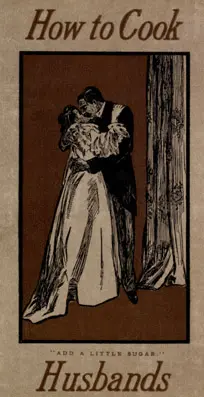
How to Cook Husbands
Elizabeth Strong Worthington
THE CLASSIC COLLECTION · 1900
"The Gentle Art of Cooking Wives" by Elizabeth Strong Worthington is a fictional work likely written in the late 19th century. The book unfolds with a playful satire on the social dynamics and expectations surrounding marriage and domestic life, particularly focusing on the roles of women as wives. The narrative captures a group of young women discussing the notion of "cooking" wives, a metaphorical exploration of how they might be prepared for and served in the institution of marriage, with humor and sharp wit. The opening portion introduces a lively gathering of young women as they navigate topics of their day, including the whimsical discussion of how to "cook" wives, inspired by an article they have heard of. Characters like Hilda, Prudence, and Nannie engage in spirited banter while contemplating their place in society, revealing their hopes, frustrations, and varying perspectives on love and relationships. Amidst the comic exchanges, we meet Nannie Branscome, a girl grappling with her identity and societal expectations, who likens her situation to seemingly absurd culinary metaphors. The blend of humor and a critical look at gender roles sets a compelling tone, inviting readers to ponder the complexities of marriage and individuality in a society rife with expectations.
Introduction adapted from the source catalogue; source summaries may be automatically generated.
Free to read · English · 38,915 words · No account needed
MAKE TIME FOR A GOOD BOOK
On by default. Untick to stop anonymous reading totals. Each page counts after 10 seconds in view. How this works.
Anonymous counting is on unless you have switched it off.
Steve had hardly more than had time to change his clothes, which fortunately had received all the damage in the recent scrimmage, when he saw Nannie hurrying down the road. She was half running, half walking, and her face was so radiantly happy that Steve went out to learn the good tidings she evidently bore. So eager was she to impart her news that she called out before he reached her:
"It's happened! It's happened! It's all over! and it's so little--and the dearest--oh, Steve----"
She could say no more, for her words were cut short just here and her excitement found vent in a happy sob.
"Why, my dear," said Steve, taking her gently by the arm and leading
her toward the house.
But Nannie resisted:
"No, no," she cried. "I'm going right back, I only came home for you. You must go right over. Randolph is wild. Oh, it's so dear and sweet! Just like a rose! I could smother it with kisses!"
She would hardly let him go for his hat, and all the way over she dragged him along, insisting upon greater speed and chattering in an excited, happy way that was perfectly new and perfectly delightful to Steve.
Randolph was on the lookout for them, and his excitement was no less
than Nannie's.
"You must see the pretty little baby, old man," he said after an
impetuous hand-shaking.
"Why, yes, do let me see it."
"Don't say it," exclaimed Nannie. "It's a little girl."
"Well, my dear--really--you forgot to mention which it was."
Just then Randolph entered with a bundle of shawls, which he
reverently and delightedly opened.
All at once his face changed and a look of blank dismay effaced his
happy, expectant expression.
"W--why, where is she?" he stammered.
"Randolph Chance!" blazed Nannie, snatching the bundle from him, "I could slap you! You've got her upside down!"
"Oh!" groaned Randolph. "Will it kill her?"
"It may!" said Nannie fiercely. "You've no business with her! Holding her heels up! Poor little thing."
And she laid her face on the tiny human doll and cooed to it, and soothed it, while the father stood there--big, helpless, remorseful, solicitous, and tender.
"Let me take her," said Steve quietly, holding out his hands.
Nannie's first impulse was to say "No" and to press the baby closer to her, but something in Steve's face arrested the word she would have spoken, and she placed the precious little charge in his arms.
"I declare, old man, one would think you had had a dozen at least!" said Randolph, looking on admiringly.
"It's the first very young child I ever held," said Steve.
Your reading position is saved on this browser. Take it to another device with a library code. Reading pages adapt to text, rather than matching a printed edition.
Elizabeth Strong Worthington
BEHIND THE BOOK
This eBook is for the use of anyone anywhere in the United States and most other parts of the world at no cost and with almost no restrictions whatsoever. You may copy it, give it away or re-use it under the terms of the Project Gutenberg License included with this eBook or online at www.gutenberg.org. If you are not located in the United States, you will have to check the laws of the country where you are located before using this eBook. Read the source licence.
The original source file, including credits and licence, is retained by this library. Request an original-format copy at no charge. Please include the book title and Project Gutenberg identifier #26187.
KEEP YOUR CURIOSITY GOING
Coulson Kernahan

Maurice Baring
Frances Wright
Cécile Tormay

Frederic Jesup Stimson

W. H. P. (William Henry Pope) Jarvis