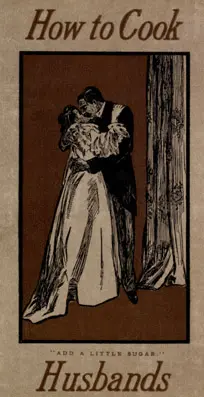
How to Cook Husbands
Elizabeth Strong Worthington
THE CLASSIC COLLECTION · 1900
"The Gentle Art of Cooking Wives" by Elizabeth Strong Worthington is a fictional work likely written in the late 19th century. The book unfolds with a playful satire on the social dynamics and expectations surrounding marriage and domestic life, particularly focusing on the roles of women as wives. The narrative captures a group of young women discussing the notion of "cooking" wives, a metaphorical exploration of how they might be prepared for and served in the institution of marriage, with humor and sharp wit. The opening portion introduces a lively gathering of young women as they navigate topics of their day, including the whimsical discussion of how to "cook" wives, inspired by an article they have heard of. Characters like Hilda, Prudence, and Nannie engage in spirited banter while contemplating their place in society, revealing their hopes, frustrations, and varying perspectives on love and relationships. Amidst the comic exchanges, we meet Nannie Branscome, a girl grappling with her identity and societal expectations, who likens her situation to seemingly absurd culinary metaphors. The blend of humor and a critical look at gender roles sets a compelling tone, inviting readers to ponder the complexities of marriage and individuality in a society rife with expectations.
Introduction adapted from the source catalogue; source summaries may be automatically generated.
Free to read · English · 38,915 words · No account needed
MAKE TIME FOR A GOOD BOOK
On by default. Untick to stop anonymous reading totals. Each page counts after 10 seconds in view. How this works.
Anonymous counting is on unless you have switched it off.
A lover's ecstasy is ofttimes cut short by the reflection that he has yet to face that awful bugbear--the old folk. There is something terrible about age, it would seem, not only to its possessor, but even to those who must encounter it second hand, and Steve was not without his qualms. Although in his wooing he had not for one moment lost his gentle self-possession, he had entirely forgotten about the ordeal of an interview with Nannie's guardians until she reminded him by saying with an impish chuckle:
"Won't Aunt Frances be happy when she hears of this!"
"Is she anxious that you should marry?" asked Steve with some wonder.
Nannie looked at him with wide eyes for a moment. It seemed hardly possible that one could be so dull of comprehension, and yet there was no doubting Steve's grave, earnest expression.
"Yes," was her only reply, but inwardly she was convulsed with laughter as she looked ahead and in thought rapidly sketched a scene.
And so Steve walked up to his task with but a faint conception of its
magnitude.
"I have called, Mrs. Lamont," he said in his easy, gentlemanly way, "to ask for the hand of your niece. Nannie and I have had a little talk about it and understand each other, I think, and now we await your consent."
"You surely don't expect my consent," said Mrs. Lamont.
Steve's shyness and gentleness seemed to return to him.
"I really," he said hesitatingly, "had not thought of any reason why
we should not have it."
"Mr. Loveland--well, this is intensely trying to me. You've no idea, I am sure, how I dislike to be so plain; but can you not understand that you are hardly a suitable match for Nannie? You are very poor, I believe."
"Why, no," said Steve gently.
He had a good position on a daily paper and his mother's little property had been disposed of to advantage, so that he had several thousand in bank now. To him, with his small needs and quiet tastes, this seemed like wealth.
"Oh, why will you force me to such brutal plainness!" exclaimed Mrs. Lamont impatiently. "Really this interview will make me ill."
"It may indeed," said Steve.
He had no thought of sarcasm.
"Mr. Loveland, this is a business matter. We must understand each other. You have property, I suppose?"
"Not now; it was sold."
"What do you own, may I ask? Oh, isn't it fearful to have to talk so! But I must lead you to see things clearly."
Your reading position is saved on this browser. Take it to another device with a library code. Reading pages adapt to text, rather than matching a printed edition.
Elizabeth Strong Worthington
BEHIND THE BOOK
This eBook is for the use of anyone anywhere in the United States and most other parts of the world at no cost and with almost no restrictions whatsoever. You may copy it, give it away or re-use it under the terms of the Project Gutenberg License included with this eBook or online at www.gutenberg.org. If you are not located in the United States, you will have to check the laws of the country where you are located before using this eBook. Read the source licence.
The original source file, including credits and licence, is retained by this library. Request an original-format copy at no charge. Please include the book title and Project Gutenberg identifier #26187.
KEEP YOUR CURIOSITY GOING
Coulson Kernahan

Maurice Baring
Frances Wright
Cécile Tormay

Frederic Jesup Stimson

W. H. P. (William Henry Pope) Jarvis