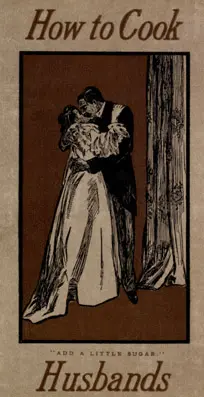
How to Cook Husbands
Elizabeth Strong Worthington
THE CLASSIC COLLECTION · 1900
"The Gentle Art of Cooking Wives" by Elizabeth Strong Worthington is a fictional work likely written in the late 19th century. The book unfolds with a playful satire on the social dynamics and expectations surrounding marriage and domestic life, particularly focusing on the roles of women as wives. The narrative captures a group of young women discussing the notion of "cooking" wives, a metaphorical exploration of how they might be prepared for and served in the institution of marriage, with humor and sharp wit. The opening portion introduces a lively gathering of young women as they navigate topics of their day, including the whimsical discussion of how to "cook" wives, inspired by an article they have heard of. Characters like Hilda, Prudence, and Nannie engage in spirited banter while contemplating their place in society, revealing their hopes, frustrations, and varying perspectives on love and relationships. Amidst the comic exchanges, we meet Nannie Branscome, a girl grappling with her identity and societal expectations, who likens her situation to seemingly absurd culinary metaphors. The blend of humor and a critical look at gender roles sets a compelling tone, inviting readers to ponder the complexities of marriage and individuality in a society rife with expectations.
Introduction adapted from the source catalogue; source summaries may be automatically generated.
Free to read · English · 38,915 words · No account needed
MAKE TIME FOR A GOOD BOOK
On by default. Untick to stop anonymous reading totals. Each page counts after 10 seconds in view. How this works.
Anonymous counting is on unless you have switched it off.
One morning Nannie was out in the garden, not at work as she should have been (she left all that to Steve), but walking around in a sort of lordly way, after the fashion of many idlers in this world who without scruple appropriate the results of industry.
She had often noted an old codger whose place backed up on hers, but had never held any converse with him. This morning, however, he seemed inclined to break the ice, as it were, for as she strutted about he leaned on the fence and said cheerily:
"Good-morning, neighbor."
Nannie gave one glance at his old broad-brimmed straw hat and rusty overalls, and then said with a certain winning sauciness all her own:
"Good-morning, old Hayseed."
The man laughed. He had a rotund, jovial countenance, which even his smoked glasses could not plunge into gloom. His every feature had an upward turn, and there was something strong and good about the face that made one feel that his heart also curved upward.
"So ye're gard'nin', be yer?" he remarked by way of introduction.
"No, I ain't," said Nannie curtly. "Steve gardens, and you know it.
You've seen him bent like a bow over these beds ever since we came
here."
"Yes, that's so."
"And I've held myself as straight as an arrow."
"Now thet's so, too," and the old man laughed. "Ye're cute, yer air."
"I can see right ahead of me. I don't wear smoked glasses," said Nannie with a pretty little grimace.
"There's a deal goes on ahind smoked glasses sometimes," said the old
fellow with a laugh.
"How do you keep house?" asked Nannie with an abrupt change of subject. "You haven't any wife or daughter."
"I don't keep it; jest trust it. Don't turn no key nor nothin' on it, an' I ain't never knowed it to stray outside ther yard. Ther's a heap in hevin' faith in things."
Nannie's face grew thoughtful.
"Yer kin 'most b'lieve a man inter bein' honest, an' I reckon it acts ther same on wimmin, though they be a leetle different."
Nannie looked up from under her curls with a glance half inquiring,
half defiant.
"When wimmin's young they be like a colt--it's hard ter keep 'em stiddy. When they git older they be somethin' like a mule--it's hard ter start 'em up now an' agin."
"I guess men are the same. They belong to the same stock--all the world's akin, you know," said Nannie mischievously.
"All the world's akin, eh?" said the old man slowly, turning this thought over in his mind. "Well, now, mebbe thet's so, but if it is ther's a deal of difference atween ther cousins."
Your reading position is saved on this browser. Take it to another device with a library code. Reading pages adapt to text, rather than matching a printed edition.
Elizabeth Strong Worthington
BEHIND THE BOOK
This eBook is for the use of anyone anywhere in the United States and most other parts of the world at no cost and with almost no restrictions whatsoever. You may copy it, give it away or re-use it under the terms of the Project Gutenberg License included with this eBook or online at www.gutenberg.org. If you are not located in the United States, you will have to check the laws of the country where you are located before using this eBook. Read the source licence.
The original source file, including credits and licence, is retained by this library. Request an original-format copy at no charge. Please include the book title and Project Gutenberg identifier #26187.
KEEP YOUR CURIOSITY GOING
Coulson Kernahan

Maurice Baring
Frances Wright
Cécile Tormay

Frederic Jesup Stimson

W. H. P. (William Henry Pope) Jarvis