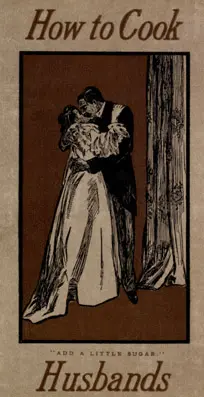
How to Cook Husbands
Elizabeth Strong Worthington
THE CLASSIC COLLECTION · 1900
"The Gentle Art of Cooking Wives" by Elizabeth Strong Worthington is a fictional work likely written in the late 19th century. The book unfolds with a playful satire on the social dynamics and expectations surrounding marriage and domestic life, particularly focusing on the roles of women as wives. The narrative captures a group of young women discussing the notion of "cooking" wives, a metaphorical exploration of how they might be prepared for and served in the institution of marriage, with humor and sharp wit. The opening portion introduces a lively gathering of young women as they navigate topics of their day, including the whimsical discussion of how to "cook" wives, inspired by an article they have heard of. Characters like Hilda, Prudence, and Nannie engage in spirited banter while contemplating their place in society, revealing their hopes, frustrations, and varying perspectives on love and relationships. Amidst the comic exchanges, we meet Nannie Branscome, a girl grappling with her identity and societal expectations, who likens her situation to seemingly absurd culinary metaphors. The blend of humor and a critical look at gender roles sets a compelling tone, inviting readers to ponder the complexities of marriage and individuality in a society rife with expectations.
Introduction adapted from the source catalogue; source summaries may be automatically generated.
Free to read · English · 38,915 words · No account needed
MAKE TIME FOR A GOOD BOOK
On by default. Untick to stop anonymous reading totals. Each page counts after 10 seconds in view. How this works.
Anonymous counting is on unless you have switched it off.
"He came to a bad end, as all such creatures do," said Nannie in a
terrible voice.
At this point Jim's interest outran his pride, and he swung open the door so that he could hear better.
"What became of him?" persisted Mamie.
"He received a sound trouncing," said Nannie.
Just at this juncture of affairs she caught sight of Mr. Earnest's eyes peering at her above his paper. Had they been filled with tears or dark with remorse she might have relented, but, shocking to relate, they were fairly twinkling with merriment, and Nannie perceived that she was amusing her auditor hugely, instead of reading him a terrible lesson, and in her anger she all but lost control of herself.
"Wasn't anything else done to him?" asked Jim in a rather disappointed
tone.
"Yes," said Nannie, glaring at Mr. Earnest in a fierce, defiant
manner.
"Oh, that's enough to do to him," pleaded little Mamie.
"No, it isn't," said Jim. "He ate up the rabbits."
"Maybe he didn't eat the rabbits," urged tender-hearted Mamie.
"No, he didn't eat the rabbits. A weasel did that," said Nannie, her awful gaze still fixed on Mr. Earnest's laughing eyes. "But he had been ugly to his family, and that's the worst, the meanest thing a man--a cat can do, and Providence caught him in a trap to punish him."
"What else was done to him?" persisted Jim.
"He was hung," said Nannie, and she almost smacked her lips with
savage relish.
"Oh!" said Jim, and he condescended to enter the parlor and plant himself in front of Nannie. "Then what else was done with him?" reiterated this young avenging fury.
"I don't like this story," said Mamie.
"I do!" said Jim. "It's most bester than Indians."
Nannie was going to say that was all, but just then she caught sight of those mocking eyes again, and in a sudden fury she added:
"He was drawn and quartered."
"Oh!" gasped Jim, while Mamie began to weep.
Just then a roar of laughter ensued from behind the newspaper, and Nannie, whose every nerve was taut, leaped from her chair.
The newspaper fell, and the two chief actors in this drama confronted one another, one of them convulsed with laughter and the other with flashing, defiant eyes and tightly pursed mouth.
"And after that--" urged Jim. "Go on, Miss Nannie. Oh, this is a bully story! It's bestest than Indians!"
"After that," said Nannie, turning squarely on Mr. Earnest, "after that he was sent to the penitentiary for life, and everybody said 'Good enough!' 'Served him right, nasty, mean, horrid old thing!'" and away she went, slamming the front door behind her.
Your reading position is saved on this browser. Take it to another device with a library code. Reading pages adapt to text, rather than matching a printed edition.
Elizabeth Strong Worthington
BEHIND THE BOOK
This eBook is for the use of anyone anywhere in the United States and most other parts of the world at no cost and with almost no restrictions whatsoever. You may copy it, give it away or re-use it under the terms of the Project Gutenberg License included with this eBook or online at www.gutenberg.org. If you are not located in the United States, you will have to check the laws of the country where you are located before using this eBook. Read the source licence.
The original source file, including credits and licence, is retained by this library. Request an original-format copy at no charge. Please include the book title and Project Gutenberg identifier #26187.
KEEP YOUR CURIOSITY GOING
Coulson Kernahan

Maurice Baring
Frances Wright
Cécile Tormay

Frederic Jesup Stimson

W. H. P. (William Henry Pope) Jarvis