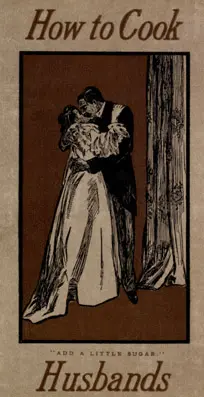
How to Cook Husbands
Elizabeth Strong Worthington
THE CLASSIC COLLECTION · 1900
"The Gentle Art of Cooking Wives" by Elizabeth Strong Worthington is a fictional work likely written in the late 19th century. The book unfolds with a playful satire on the social dynamics and expectations surrounding marriage and domestic life, particularly focusing on the roles of women as wives. The narrative captures a group of young women discussing the notion of "cooking" wives, a metaphorical exploration of how they might be prepared for and served in the institution of marriage, with humor and sharp wit. The opening portion introduces a lively gathering of young women as they navigate topics of their day, including the whimsical discussion of how to "cook" wives, inspired by an article they have heard of. Characters like Hilda, Prudence, and Nannie engage in spirited banter while contemplating their place in society, revealing their hopes, frustrations, and varying perspectives on love and relationships. Amidst the comic exchanges, we meet Nannie Branscome, a girl grappling with her identity and societal expectations, who likens her situation to seemingly absurd culinary metaphors. The blend of humor and a critical look at gender roles sets a compelling tone, inviting readers to ponder the complexities of marriage and individuality in a society rife with expectations.
Introduction adapted from the source catalogue; source summaries may be automatically generated.
Free to read · English · 38,915 words · No account needed
MAKE TIME FOR A GOOD BOOK
On by default. Untick to stop anonymous reading totals. Each page counts after 10 seconds in view. How this works.
Anonymous counting is on unless you have switched it off.
She was depending on this for preserving, and she wanted to ask why he failed, but did not quite dare.
"Can you bring it to-morrow?" she inquired after an awkward pause.
"I don't know," he said gruffly.
Again she hesitated. She was very gentle and naturally timid, and his treatment had increased the latter tendency. At last she mustered strength to say:
"I need it very much."
There was no reply, and directly she left the room.
Now, not one iota of this domestic scene was lost upon Nannie. From the day she had listened to that story told by Constance Chance to her young friend (Mrs. Earnest's oldest child) she had been looking about her sharply. The first direction of eyes newly opened is outward. We see our neighbors--see that instead of performing their part like men they are skulking through life--men as churls, snarling, or it may be stalking, automaton fashion; men as sticks, walking, and we hasten to correct their errors. Our own correction comes afterward, if at all, for as the poet has told us, it were easier to tell twenty what were good to be done than to be one of the twenty to do it.
Nannie fastened her eyes upon Mr. Earnest, but as he was now absorbed in his paper he lost the benefit of her fierce glances.
"Why don't you tell?" urged Mamie, who did not relish this
interruption to her story.
"Well, once there lived a horrid pig."
"Why, that's not it," said the child pettishly. "It's a kitty."
"No, it's a pig," reiterated Nannie with emphasis. "A horrid, selfish
pig!"
"I don't like that," pouted Mamie. "You begin about a kitty, and just as I'm getting interested in her you go off on a pig."
"Well, then, once there was a big, horrid cat."
"You said a dear little kitty," cried Mamie.
"He was a dear little kitty once, I suppose, but he grew up to be a big selfish, glowering, tortoise-shell tomcat."
"Was there any mama kitty?" asked Mamie, who yearned for a gentle
element in the story.
"Yes, and she was lovely, so unselfish and kind, but the big, ugly one
bullied her all the time till she was afraid to call her soul her
own."
"Did they have any teeny weeny kitties?" asked Mamie.
"Yes, three of them. The oldest was very sweet and the next was rather good sometimes, but showed signs of being horrid like the big one when he grew up, and the littlest of all was very cunning and good."
"Did they have a little house?"
Your reading position is saved on this browser. Take it to another device with a library code. Reading pages adapt to text, rather than matching a printed edition.
Elizabeth Strong Worthington
BEHIND THE BOOK
This eBook is for the use of anyone anywhere in the United States and most other parts of the world at no cost and with almost no restrictions whatsoever. You may copy it, give it away or re-use it under the terms of the Project Gutenberg License included with this eBook or online at www.gutenberg.org. If you are not located in the United States, you will have to check the laws of the country where you are located before using this eBook. Read the source licence.
The original source file, including credits and licence, is retained by this library. Request an original-format copy at no charge. Please include the book title and Project Gutenberg identifier #26187.
KEEP YOUR CURIOSITY GOING
Coulson Kernahan

Maurice Baring
Frances Wright
Cécile Tormay

Frederic Jesup Stimson

W. H. P. (William Henry Pope) Jarvis