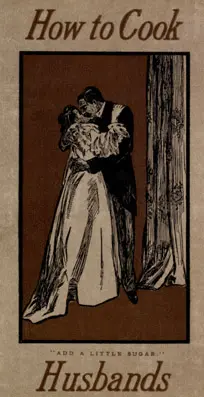
How to Cook Husbands
Elizabeth Strong Worthington
THE CLASSIC COLLECTION · 1900
"The Gentle Art of Cooking Wives" by Elizabeth Strong Worthington is a fictional work likely written in the late 19th century. The book unfolds with a playful satire on the social dynamics and expectations surrounding marriage and domestic life, particularly focusing on the roles of women as wives. The narrative captures a group of young women discussing the notion of "cooking" wives, a metaphorical exploration of how they might be prepared for and served in the institution of marriage, with humor and sharp wit. The opening portion introduces a lively gathering of young women as they navigate topics of their day, including the whimsical discussion of how to "cook" wives, inspired by an article they have heard of. Characters like Hilda, Prudence, and Nannie engage in spirited banter while contemplating their place in society, revealing their hopes, frustrations, and varying perspectives on love and relationships. Amidst the comic exchanges, we meet Nannie Branscome, a girl grappling with her identity and societal expectations, who likens her situation to seemingly absurd culinary metaphors. The blend of humor and a critical look at gender roles sets a compelling tone, inviting readers to ponder the complexities of marriage and individuality in a society rife with expectations.
Introduction adapted from the source catalogue; source summaries may be automatically generated.
Free to read · English · 38,915 words · No account needed
MAKE TIME FOR A GOOD BOOK
On by default. Untick to stop anonymous reading totals. Each page counts after 10 seconds in view. How this works.
Anonymous counting is on unless you have switched it off.
"Set a pail of food forninst her now, Miss Nannie, an' she'll run to the cow-yard," called Bridget.
This ruse proved successful. As soon as she saw the food the delighted Sarah kicked up her heels and, flourishing her head in such a manner that it seemed to comprehend everything in its wide swath, ran into the cow-yard, where Nannie skillfully lassoed her and tied her to the fence just as she plunged her nose into the pail.
Meanwhile Bridget, terrified by these lively humors, had started toward the house, and her desire for speed exceeding her physical ability, she soon measured her length upon the ground, where she lay, roaring lustily, under the impression that the enemy was upon her.
"What are you howling for, you old goose?" shouted Nannie.
"It's the cow!" screamed Bridget. "Take her off! Oh, howly Mither! I'm
kilt entirely."
"The cow is half a mile from you!" laughed Nannie. "She didn't even
look toward you."
"Shure I felt her horns go into me back, an' as the saints live in glory, I see thim come out at me brist."
"Well, I wish I could see you come out at the cow-yard with that milk
pail."
Bridget picked up her pieces, put herself together, and discontentedly ambled toward the cow-yard, averring that in spite of all Nannie might say, she knew she had a hole an inch wide in her left lung; she could feel the wind whistle through it.
"There's nothing the matter with your lungs," said Nannie, "as all the neighborhood knows by this time."
With a long, solemn countenance and a tear in each eye, Bridget
approached Sarah Maria, who was breakfasting in a hasty, unhygienic
manner.
"It's me life I take in me hand," murmured Bridget.
"Drop your life and take your pail instead, or are you going to milk into your apron?" said Nannie imperiously.
"Oh, me pail! Shure the head of me is turned intirely, bad cess to
that cow! or I believe there's a hole through it, loike there is in me
lung."
"Your head turned!" said Nannie scornfully. "I should say it was--turned inside out and emptied entirely."
But Bridget was wooing Mrs. Maria now.
"Aisy, now! Aisy, I say!" she muttered as she cautiously lowered
herself onto the milking stool.
But by some mysterious law of opposites, as she went down the pail went up. Sarah Maria never ceased munching for a moment, but Nannie, who was fixedly regarding her and trying to calculate how much longer her breakfast would last, heard the crash, and looking around saw the pail on its way upward.
Your reading position is saved on this browser. Take it to another device with a library code. Reading pages adapt to text, rather than matching a printed edition.
Elizabeth Strong Worthington
BEHIND THE BOOK
This eBook is for the use of anyone anywhere in the United States and most other parts of the world at no cost and with almost no restrictions whatsoever. You may copy it, give it away or re-use it under the terms of the Project Gutenberg License included with this eBook or online at www.gutenberg.org. If you are not located in the United States, you will have to check the laws of the country where you are located before using this eBook. Read the source licence.
The original source file, including credits and licence, is retained by this library. Request an original-format copy at no charge. Please include the book title and Project Gutenberg identifier #26187.
KEEP YOUR CURIOSITY GOING
Coulson Kernahan

Maurice Baring
Frances Wright
Cécile Tormay

Frederic Jesup Stimson

W. H. P. (William Henry Pope) Jarvis