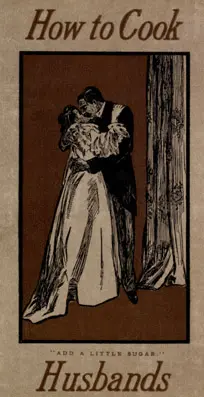
How to Cook Husbands
Elizabeth Strong Worthington
THE CLASSIC COLLECTION · 1900
"The Gentle Art of Cooking Wives" by Elizabeth Strong Worthington is a fictional work likely written in the late 19th century. The book unfolds with a playful satire on the social dynamics and expectations surrounding marriage and domestic life, particularly focusing on the roles of women as wives. The narrative captures a group of young women discussing the notion of "cooking" wives, a metaphorical exploration of how they might be prepared for and served in the institution of marriage, with humor and sharp wit. The opening portion introduces a lively gathering of young women as they navigate topics of their day, including the whimsical discussion of how to "cook" wives, inspired by an article they have heard of. Characters like Hilda, Prudence, and Nannie engage in spirited banter while contemplating their place in society, revealing their hopes, frustrations, and varying perspectives on love and relationships. Amidst the comic exchanges, we meet Nannie Branscome, a girl grappling with her identity and societal expectations, who likens her situation to seemingly absurd culinary metaphors. The blend of humor and a critical look at gender roles sets a compelling tone, inviting readers to ponder the complexities of marriage and individuality in a society rife with expectations.
Introduction adapted from the source catalogue; source summaries may be automatically generated.
Free to read · English · 38,915 words · No account needed
MAKE TIME FOR A GOOD BOOK
On by default. Untick to stop anonymous reading totals. Each page counts after 10 seconds in view. How this works.
Anonymous counting is on unless you have switched it off.
"A settlement," said Nannie promptly. "I'm the only niece of poor but
impecunious relatives, and they expect me to do my best and marry
well."
"Goodness, child!" exclaimed Hilda, "I hope you don't tell the brutal, cold-blooded truth in society!"
"Why, no, that isn't it," said Puddy. "We are going out to have a good
time."
"Oh, you slaves and bondwomen!" exclaimed Evelyn. "You don't know what a good time means. I must be off. Adieu, seneschals." And with a pitying smile she left them.
She was a handsome, spirited-looking girl, with a queenly carriage. As she went out of the house Constance Leigh came by, and the two walked off together.
"There's a pair of them," Hilda remarked.
"Awfully nice girls," said Nannie.
"Oh, yes, but they're rabid. Constance Leigh is as independent as a March hare, and Evelyn is perfectly fierce for reforms now."
"What, a socialist?" asked Prudence.
"No, not exactly, but she gathers the most awful class of people about her, and fairly bristles with indignation if one ventures to criticise them."
"What do you mean--criminals?" asked Prudence.
"You'd think so if you chanced to run into one of them. Why, last Sunday evening she had an inebriate up to tea with her; next Sunday she expects a wife-beater, or choker, or something of that sort, and the other day, when I was coming out from a call on her, I met a black-browed, desperately wicked-looking man--as big as a mountain. I know he was a murderer or something. I never was so frightened in my life. Why, I took to my heels and ran the length of the street. I presume he was after me, but I didn't dare look behind."
"You needn't have worried, Hilda," said Prudence. "You know big men
never run after you."
It was a notorious fact that most of Hilda's admirers were about half
her size.
"Oh, yes. That holds good in society, but I don't know what might
obtain in criminal circles."
"Hilda, did your villain carry a cane and wear glasses?"
"I was too frightened to notice, but I believe he flourished a stout stick of some sort, and I do remember a wicked gleam about his eyes--might have been spectacles."
The girls burst out laughing.
"Why, it's Professor Thing-a-my-Bob, or Dry-as-Dust, or somebody or other, from Washington. He's her fiance."
"Well, I don't care if he is," persisted Hilda. "He's a wicked-looking
villain."
"Oh!" screamed the girls, and then Prudence added, with mock
solemnity:
"Any one who could talk slightingly of a genuine college professor
would speak disrespectfully of the equator or be sassy to the
dictionary."
Your reading position is saved on this browser. Take it to another device with a library code. Reading pages adapt to text, rather than matching a printed edition.
Elizabeth Strong Worthington
BEHIND THE BOOK
This eBook is for the use of anyone anywhere in the United States and most other parts of the world at no cost and with almost no restrictions whatsoever. You may copy it, give it away or re-use it under the terms of the Project Gutenberg License included with this eBook or online at www.gutenberg.org. If you are not located in the United States, you will have to check the laws of the country where you are located before using this eBook. Read the source licence.
The original source file, including credits and licence, is retained by this library. Request an original-format copy at no charge. Please include the book title and Project Gutenberg identifier #26187.
KEEP YOUR CURIOSITY GOING
Coulson Kernahan

Maurice Baring
Frances Wright
Cécile Tormay

Frederic Jesup Stimson

W. H. P. (William Henry Pope) Jarvis