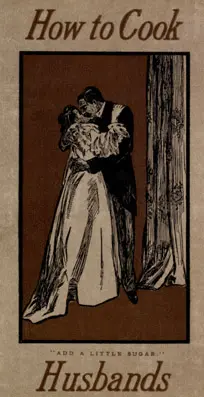
How to Cook Husbands
Elizabeth Strong Worthington
THE CLASSIC COLLECTION · 1900
"The Gentle Art of Cooking Wives" by Elizabeth Strong Worthington is a fictional work likely written in the late 19th century. The book unfolds with a playful satire on the social dynamics and expectations surrounding marriage and domestic life, particularly focusing on the roles of women as wives. The narrative captures a group of young women discussing the notion of "cooking" wives, a metaphorical exploration of how they might be prepared for and served in the institution of marriage, with humor and sharp wit. The opening portion introduces a lively gathering of young women as they navigate topics of their day, including the whimsical discussion of how to "cook" wives, inspired by an article they have heard of. Characters like Hilda, Prudence, and Nannie engage in spirited banter while contemplating their place in society, revealing their hopes, frustrations, and varying perspectives on love and relationships. Amidst the comic exchanges, we meet Nannie Branscome, a girl grappling with her identity and societal expectations, who likens her situation to seemingly absurd culinary metaphors. The blend of humor and a critical look at gender roles sets a compelling tone, inviting readers to ponder the complexities of marriage and individuality in a society rife with expectations.
Introduction adapted from the source catalogue; source summaries may be automatically generated.
Free to read · English · 38,915 words · No account needed
MAKE TIME FOR A GOOD BOOK
On by default. Untick to stop anonymous reading totals. Each page counts after 10 seconds in view. How this works.
Anonymous counting is on unless you have switched it off.
Now, this breaking Steve from off his natural tree and grafting him upon an alien bough occasioned some changes. From being cheerful, slow, and gentle he suddenly became anxious, hasty, and at times dictatorial.
"You must have a garden," one of his neighbors said.
Steve went to work like a galley slave upon his spare days, and dug,
and raked, and planted.
"You must keep bees," said another of the neighbors.
Steve bought two hives at once.
"You must keep chickens," said another neighbor, a sort of two-edged woman, who dwelt over across the swamp and whose scolding voice could be heard for miles.
So Steve bought thirteen hens and a rooster.
"You must have a cow," said a fourth neighbor, and he promptly sold Steve a cantankerous beast that wanted to rival him in authority, and indeed for a time ran the place.
"You must have a cat," said an old woman who wanted to get rid of an unamiable Thomas, and Steve brought him home in a sack caterwauling all the way.
"You must get a dog," said a man who had a bull terrier for sale.
"I've got one!" bawled Steve--the man was deaf.
"Bull terrier?"
"No, Scotch! and he's all I want!" and Steve closed the front door
with needless vigor.
"What did you buy those nasty hens for?" asked Nannie, who did not
like chickens.
"Oh, they'll give us something good to eat. It will be so nice to go out every morning and bring in some new-laid eggs for breakfast. You'll like to do that, Nannie."
"I guess you'd better," she said with a peculiar look.
So the next morning Steve tiptoed out, through the wet grass, to the hen-house, in his dressing-gown and slippers, he was so eager to pluck this new fruit.
He came in empty-handed, but cheerful.
"We could hardly expect them to lay the first day; they have got to
get their bearings."
Every morning before breakfast Steve took this little walk. There was soon a well-beaten track between the back door and the hen-house. He always returned empty-handed, and Nannie watched with an impish smile from an upper window.
One morning she came upon him in the act of taking off a white
door-knob.
"What are you doing?" she demanded.
He looked guilty, but answered with a fair show of spirit:
"I'm going to put this in one of the nests. You see, they must think a hen has been there and laid it."
Nannie burst into a laugh.
"Well, I wouldn't waste time eating the eggs of hens that would be such fools as to think any poor old chicken had laid that door-knob!"
Your reading position is saved on this browser. Take it to another device with a library code. Reading pages adapt to text, rather than matching a printed edition.
Elizabeth Strong Worthington
BEHIND THE BOOK
This eBook is for the use of anyone anywhere in the United States and most other parts of the world at no cost and with almost no restrictions whatsoever. You may copy it, give it away or re-use it under the terms of the Project Gutenberg License included with this eBook or online at www.gutenberg.org. If you are not located in the United States, you will have to check the laws of the country where you are located before using this eBook. Read the source licence.
The original source file, including credits and licence, is retained by this library. Request an original-format copy at no charge. Please include the book title and Project Gutenberg identifier #26187.
KEEP YOUR CURIOSITY GOING
Coulson Kernahan

Maurice Baring
Frances Wright
Cécile Tormay

Frederic Jesup Stimson

W. H. P. (William Henry Pope) Jarvis