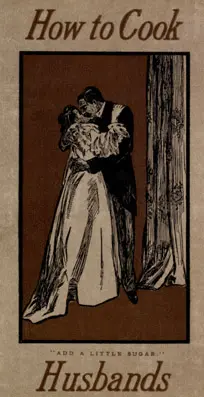
How to Cook Husbands
Elizabeth Strong Worthington
THE CLASSIC COLLECTION · 1900
"The Gentle Art of Cooking Wives" by Elizabeth Strong Worthington is a fictional work likely written in the late 19th century. The book unfolds with a playful satire on the social dynamics and expectations surrounding marriage and domestic life, particularly focusing on the roles of women as wives. The narrative captures a group of young women discussing the notion of "cooking" wives, a metaphorical exploration of how they might be prepared for and served in the institution of marriage, with humor and sharp wit. The opening portion introduces a lively gathering of young women as they navigate topics of their day, including the whimsical discussion of how to "cook" wives, inspired by an article they have heard of. Characters like Hilda, Prudence, and Nannie engage in spirited banter while contemplating their place in society, revealing their hopes, frustrations, and varying perspectives on love and relationships. Amidst the comic exchanges, we meet Nannie Branscome, a girl grappling with her identity and societal expectations, who likens her situation to seemingly absurd culinary metaphors. The blend of humor and a critical look at gender roles sets a compelling tone, inviting readers to ponder the complexities of marriage and individuality in a society rife with expectations.
Introduction adapted from the source catalogue; source summaries may be automatically generated.
Free to read · English · 38,915 words · No account needed
MAKE TIME FOR A GOOD BOOK
On by default. Untick to stop anonymous reading totals. Each page counts after 10 seconds in view. How this works.
Anonymous counting is on unless you have switched it off.
"No. I am going to explore this creek for a little distance, and you can get ready while I'm gone."
"But suppose my shoes and stockings have floated down the stream? What
then?"
Steve was dismayed, but he maintained his quiet air.
"Suppose," persisted Nannie.
Just then Steve caught a glimpse of a tiny shoe at the foot of a near
tree.
"And suppose," he said, "they have not, but are awaiting their owner
over yonder?"
Nannie laughed and looked around and Steve walked on.
When he returned she was ready, and they set off together toward town.
"Were you really lost?" asked Steve.
"Yes. I've been wandering around for at least two hours."
"How came you to go out there?" he asked.
"I was expected to go somewhere else," she answered with one of her
elfin looks.
Steve was silent. Mentally he was wondering if this was the mainspring of conduct in all women. He thought very likely it was. Mary often asked his advice and then always took her own way, and it was invariably opposite to the course he had indicated.
They had not gone much further, when, happening to look around for something, Nannie caught a glimpse of her dress skirt and saw that it was creased and stained with mud.
"There now! I've just ruined my gown!" she exclaimed, and then burst
into passionate tears.
"Miss Branscome! don't!" said Steve, who was fairly startled out of his usual quiet into something akin to excitement. "Don't! I beg of you. Nannie! don't cry, my dear!"
He failed to notice how he had spoken; so did she, apparently.
"We can make it all right, I know," he continued, but for a time she
refused to be comforted.
"You would cry too, I guess, if you were in my place and would get such an awful scolding at home."
"No doubt I would," assented Steve in deep distress.
"I wish I were dead and buried under a landslide," sobbed Nannie.
In the depth of her sorrow she wanted to delve deep into mother
earth.
"Oh, no. Don't wish that! What should we do without you?" said Steve
earnestly.
"Oh, you needn't to worry," replied Nannie pettishly, the violence of her grief having spent itself. "Nothing so good as that is going to happen. I shall live to get home and have my head taken off, and stalk around as a torso ever afterward."
"Now do let me see if I can't set things to rights," said Steve. "You've no idea how handy I am in such matters."
Your reading position is saved on this browser. Take it to another device with a library code. Reading pages adapt to text, rather than matching a printed edition.
Elizabeth Strong Worthington
BEHIND THE BOOK
This eBook is for the use of anyone anywhere in the United States and most other parts of the world at no cost and with almost no restrictions whatsoever. You may copy it, give it away or re-use it under the terms of the Project Gutenberg License included with this eBook or online at www.gutenberg.org. If you are not located in the United States, you will have to check the laws of the country where you are located before using this eBook. Read the source licence.
The original source file, including credits and licence, is retained by this library. Request an original-format copy at no charge. Please include the book title and Project Gutenberg identifier #26187.
KEEP YOUR CURIOSITY GOING
Coulson Kernahan

Maurice Baring
Frances Wright
Cécile Tormay

Frederic Jesup Stimson

W. H. P. (William Henry Pope) Jarvis