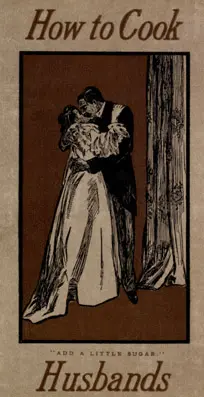
How to Cook Husbands
Elizabeth Strong Worthington
THE CLASSIC COLLECTION · 1900
"The Gentle Art of Cooking Wives" by Elizabeth Strong Worthington is a fictional work likely written in the late 19th century. The book unfolds with a playful satire on the social dynamics and expectations surrounding marriage and domestic life, particularly focusing on the roles of women as wives. The narrative captures a group of young women discussing the notion of "cooking" wives, a metaphorical exploration of how they might be prepared for and served in the institution of marriage, with humor and sharp wit. The opening portion introduces a lively gathering of young women as they navigate topics of their day, including the whimsical discussion of how to "cook" wives, inspired by an article they have heard of. Characters like Hilda, Prudence, and Nannie engage in spirited banter while contemplating their place in society, revealing their hopes, frustrations, and varying perspectives on love and relationships. Amidst the comic exchanges, we meet Nannie Branscome, a girl grappling with her identity and societal expectations, who likens her situation to seemingly absurd culinary metaphors. The blend of humor and a critical look at gender roles sets a compelling tone, inviting readers to ponder the complexities of marriage and individuality in a society rife with expectations.
Introduction adapted from the source catalogue; source summaries may be automatically generated.
Free to read · English · 38,915 words · No account needed
MAKE TIME FOR A GOOD BOOK
On by default. Untick to stop anonymous reading totals. Each page counts after 10 seconds in view. How this works.
Anonymous counting is on unless you have switched it off.
"I've been puzzling my brains to think how I can bring this about," he said to Constance one day. "I've already hinted at it to Steve, but he don't take. I know he wants to meet you, but he's such a retiring fellow--not really bashful, but like a clam in his shell."
"Don't distress yourself, I beg of you," said Constance with a mischievous smile. "Mr. Loveland and I have already met and are now the best of friends."
Randolph stared at her in open-mouthed amazement.
"Where?" he managed to ask.
"Right here in this parlor. I must tell you about it--it was most beautiful. His card took me by surprise, but I supposed you had brought him. When I came downstairs there he was, looking altogether different from your descriptions."
"Well, I like that!" said Randolph. "Do you mean to impeach my
statements?"
"Altogether better," persisted Constance. "Yes, he is taller and has a most interesting face. He came forward to greet me without a particle of embarrassment, and there was something so manly and simple, and withal so high-bred in his every movement, that I was charmed. I know he must come of a fine family."
"Oh, he does. He had a line of ancestors a mile long aboard the Mayflower. A cousin of his was telling me. He never said a word. He never talks."
"Ah!" said Constance with an arch smile. "He talked that evening, I assure you, and to good effect. He had but a few moments to stay, but he made every moment tell. For one thing, he assured me, with a most winning smile, that he should feel constrained to rise in church and forbid the banns unless I promised to adopt him as a brother."
Randolph's eyes and mouth opened again.
"Perhaps you'd better adopt him as something still nearer!" he said,
with a pretense of anger.
"Now that you mention it," Constance replied in a confidential tone, "I came very near doing so. The only reason I did not was that he forgot to ask me."
Randolph broke into a laugh. Then he added in a puzzled tone:
"Well, it beats everything! In all the ten years I've known him I've never heard him say as much as that!"
"I can't repeat all he said----" Constance began again.
"What!" Randolph cried with another semblance of jealousy.
"No, because it lay in his manner; that gentle, affectionate, yet manly manner--indescribable! perfectly indescribable!"
"It's the same to everybody," said Randolph, "and everybody loves him. I never knew another such fellow. It's past belief the way he wins people. And he says nothing, too."
Your reading position is saved on this browser. Take it to another device with a library code. Reading pages adapt to text, rather than matching a printed edition.
Elizabeth Strong Worthington
BEHIND THE BOOK
This eBook is for the use of anyone anywhere in the United States and most other parts of the world at no cost and with almost no restrictions whatsoever. You may copy it, give it away or re-use it under the terms of the Project Gutenberg License included with this eBook or online at www.gutenberg.org. If you are not located in the United States, you will have to check the laws of the country where you are located before using this eBook. Read the source licence.
The original source file, including credits and licence, is retained by this library. Request an original-format copy at no charge. Please include the book title and Project Gutenberg identifier #26187.
KEEP YOUR CURIOSITY GOING
Coulson Kernahan

Maurice Baring
Frances Wright
Cécile Tormay

Frederic Jesup Stimson

W. H. P. (William Henry Pope) Jarvis