
Last letters from the living dead man
David Patterson (Spirit) Hatch
THE CLASSIC COLLECTION · 1918
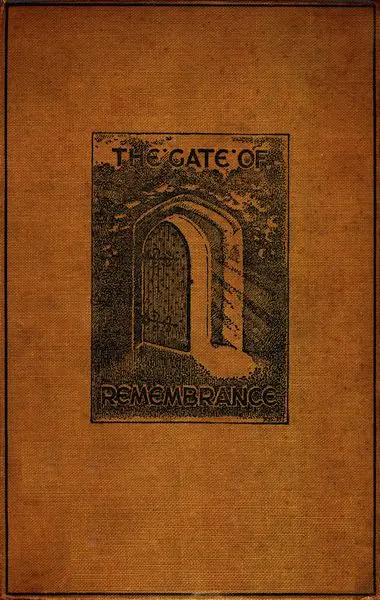
"The Gate of Remembrance" by Frederick Bligh Bond is an archaeological investigation combined with a psychological study written in the early 20th century. This work recounts the discovery of the Edgar Chapel at Glastonbury Abbey, exploring the intersection of automated writing and historical fact through the lens of spiritual inquiry. The book offers insights into both the history of the Abbey and the methodology employed by the author in retrieving lost architectural knowledge. The opening of the book establishes the historical significance of Glastonbury Abbey as a site of early Christian faith and scholarship, navigating through its tumultuous past marked by the dissolution of monasteries and the loss of religious relics. It introduces readers to Bond's collaboration with a friend, John Alleyne, as they employ automatic writing to unlock memories related to the Abbey's construction and subsequent transformations. This method aims to bridge the gap between modern understanding and ancient wisdom, suggesting that the residue of past spiritual energies still holds valuable insights for contemporary exploration of lost histories.
Introduction adapted from the source catalogue; source summaries may be automatically generated.
Free to read · English · 44,428 words · No account needed
MAKE TIME FOR A GOOD BOOK
On by default. Untick to stop anonymous reading totals. Each page counts after 10 seconds in view. How this works.
Anonymous counting is on unless you have switched it off.
Vallera di, Domenico, 146
Vault, sepulchral, under High Altar, 65
under halls, 66, 67, 68
under central tower and nave, 41
under stairs of St. Mary's (Galilee), 41
Vaulting (volt), quadripartite, 35
multipartite, 35, 38
fans (old style) at east end of Quire, 38
panelled, in Edgar Chapel (fans), 43, 57
fans in claustrum north side of nave, 119
with gilt roundels, 120
barrel section (to chantry chapel), 57
cracked, under central tower, 121, 122
Italian pattern, to Loretto Chapel, 126, 141, 146
Vecchi, Francesco (di Torcello), 154
Vesica Piscis (sacred symbol, containing the double equilateral triangle, found in plan of St. Mary's Chapel), 150 (Fig. 13), 151 ref.
Vestibule (Italian), to Loretto Chapel (the cloister open to the north
wind), 146, 151
Vineyards, the Abbey, 146
Virga (a yard), 36, 37
Virgin, ancient statue of (at back of altar-screen), 57 and Child in canopied niche over High Altar, 65
Virginis, Cava (apse, or recess of circular form in the east wall of the Loretto Chapel, as indicated by script), 128-140, 143
Walls at an angle, 40, 41, 44, 51, 59, 64 (Figs. 5, 6, and Plate II.)
Warner quoted, 7, 11, 74
plan of older Lady Chapel, 51, 52
Watchers, the, 93
Watergate, 146-147
Wattlework (Saxon), 63, 65
Ways, the Four, 147
Well of Abbey, filled, 95
chamber in court, 94
Wells, Bishop of, 46, 87
chapel at, 44
Cathedral cited, 44, 88
Wells Lady Chapel, 73
Whiting (Whyttinge), Abbot, 4, 35, 37, 55 (signature), 57, 65, 70,
72, 101
Wild, plan by, 13, 16, 40
Willis, Professor, quoted, 7-12, 15, 16
plan by, 9 (Fig. 1)
of retro-chapel, 51, 53
Window, great east; 57;
originally straight, 47;
with balcony under, 65;
lengthened and rebuilt, 58
great west, with gallery under, 88
Window, transomed, in Edgar Chapel, 37
six, in Great Hall, 90, 91
Window, marked with cross (old shrine of Edgar), 44
Windows, three, in apse of Edgar Chapel, 57
three, in claustrum chapel, north side nave
Wolsey, Cardinal, 91, 101
Wyrcestre, William, quoted, 14, 69
reviewed, 13, 14
Yseuguilt (Yseult), Princess, 103
Zodiac (in the floor of St. Mary's Chapel), 147
A series of Seven Musical Impressions for
the Pianoforte, by the English composer
based upon episodes in the life of Johannes,
the monk of Glastonbury, as given in the
well-known book of the same name, being
"MAGNUS ALBUM," No. 37
Published by SWAN & CO., 312, REGENT STREET,
LONDON, W.
May be had of all Music-sellers
Price 2s. net
First edition, February, 1918
Second edition, July, 1918
Third edition, March, 1920
Transcriber's Notes.
Obvious typographical errors have been silently corrected.
Hyphenation has been standardised, but other variations in spelling, punctuation and accents remain as in the original
For the sake of clarity, the advert for The (musical) Gate of Remembrance has been has been moved from the beginning to the end.
The "Table of Veridical Passages" and "Table of Data and Constructive Argument" are three column double page spreads in the original, linking Script, Existing Data and Working Hypothesis. These sections are now sequential to conform with width restrictions.
Footnote 6 refers to a non-existent flyleaf.
Italics are represented thus italics and bold thus =bold=.
Your reading position is saved on this browser. Take it to another device with a library code. Reading pages adapt to text, rather than matching a printed edition.
BEHIND THE BOOK
This eBook is for the use of anyone anywhere in the United States and most other parts of the world at no cost and with almost no restrictions whatsoever. You may copy it, give it away or re-use it under the terms of the Project Gutenberg License included with this eBook or online at www.gutenberg.org. If you are not located in the United States, you will have to check the laws of the country where you are located before using this eBook. Read the source licence.
The original source file, including credits and licence, is retained by this library. Request an original-format copy at no charge. Please include the book title and Project Gutenberg identifier #48568.
KEEP YOUR CURIOSITY GOING
David Patterson (Spirit) Hatch

David Patterson (Spirit) Hatch

David Patterson (Spirit) Hatch
Cécile Tormay

Moritz Busch
John L. Ransom