
Last letters from the living dead man
David Patterson (Spirit) Hatch
THE CLASSIC COLLECTION · 1918
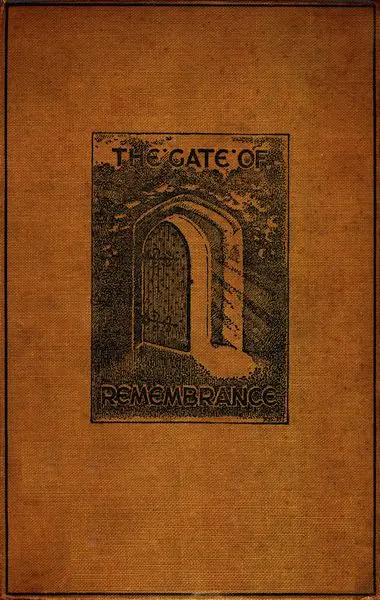
"The Gate of Remembrance" by Frederick Bligh Bond is an archaeological investigation combined with a psychological study written in the early 20th century. This work recounts the discovery of the Edgar Chapel at Glastonbury Abbey, exploring the intersection of automated writing and historical fact through the lens of spiritual inquiry. The book offers insights into both the history of the Abbey and the methodology employed by the author in retrieving lost architectural knowledge. The opening of the book establishes the historical significance of Glastonbury Abbey as a site of early Christian faith and scholarship, navigating through its tumultuous past marked by the dissolution of monasteries and the loss of religious relics. It introduces readers to Bond's collaboration with a friend, John Alleyne, as they employ automatic writing to unlock memories related to the Abbey's construction and subsequent transformations. This method aims to bridge the gap between modern understanding and ancient wisdom, suggesting that the residue of past spiritual energies still holds valuable insights for contemporary exploration of lost histories.
Introduction adapted from the source catalogue; source summaries may be automatically generated.
Free to read · English · 44,428 words · No account needed
MAKE TIME FOR A GOOD BOOK
On by default. Untick to stop anonymous reading totals. Each page counts after 10 seconds in view. How this works.
Anonymous counting is on unless you have switched it off.
Malmesbury, William of, on sacred symbols, 148
Mark, Chapel of St. (in Padua), 146 ref.
Marmore, Joseph of, 33 ref.
Martyr's grave (Whiting's), 65
Martyri, 35. (Not known to whom this refers, unless to one of the two Edmunds, both of whom were assassinated. King Edgar died a natural death.)
Maudlin Gate, 146-147
Measures (sacred), 147, 148, 150, 151 ref.
Melchin, Book of, 33 ref.
Memory, cosmic, 20
universal (in script), 97
Merlins, the British, 87
Michael, Chapel of St. (since discovered), 97
Monington, Abbot: lengthened Quire about 1334, 58
modified retro-quire and chapel, 50
Multipartite vaulting (Whiting's work), 35, 38
New Hall, 68
North porch, 125, 146
passage through, 125
Organs on screen and in chapels, 88, 89
Padstow (Cornwall), 103
Padua, Bere's journey to, 120, 121, 143
Francesco de, 145, 154, 166
Chapel of St. Mark in, 146, 166
Panellae (panels), 43
in east window, 57
in Quire, 59
Parapets of Loretto Chapel, 133, II. e, f; 135, II. g; 137, b
Parker, James, quoted, 10
Parlour, Monks', 68
Passages, secret, 53, 63, 66
Passage, timber, to Saxon Church, 56
paved, in inner court, 95
Passus (paces), 68, 69 (a) Mediæval, of 1 foot 7·44 inches (or 1·62 feet) (b) Romano-British, of 2 feet 4-1/4 inches circa NOTE.--The Greek and Roman foot, on which the last is founded, appears in these islands in early monuments such as Stonehenge, as well as in mediæval work. It varies from about 11·52 to 11·74 inches (see Flinders Petrie's Inductive Metrology, p. 109 for English mediæval units; p. 118, Stonehenge (11·54 inches); p. 138, Rome and Mediæval England (11·52 to 11·74 inches); also synoptic table, p. 142a; England 11·6, England, Italy, and Roman Colonies, 11·525 to 11·68 inches).
Patellae (plaques), in Loretto Chapel, 135, II. h
Phædrus (Phocis), voyage of, 103
Pilgrims' processions, 88, 91 Way, 125
Pillars over buttresses (Loretto Chapel), 135, h
Polygonal apse, plan published before discovery, 61
foundations discovered, 62, 64 (Fig. 6)
Ponds of abbey, 146
Portus introitus (door in east wall of Edgar Chapel), 35, 53 (door to Loretto Chapel), 126 (west door); 129, I. e, g; 133, II. d; 139, III. e, f
Priests' houses, 146
Prior's Chapel, 147
Lodgings, 66, 67
Processional path and doors, 56, 58, 65
Radulphus (Ralph), FitzStephen, chancellor, and builder of the Abbey Church, 91, 106, 108 FitzHamon (Norman knight, temp. Turstin, 1089 circa), 108
Rebus of Abbot Bere, 100
Refectorium, 67, 68
cellars of, 66
misericorde, 96
Reginaldus (ob. 1214), 46, 58
Bishop of Wells (twelfth century), 46
Relics, where kept, 144
Ribs of vault to Loretto, carved with fruit and flowers, 141, b; 142
Richard de Tantonia (architect of Edgar Chapel), 67
Robert (anno 1334), 48
Rolf, Monachus, 35, 38
Saint Andrew, Chapel of, 51
guild of, 100
Bridget, 46
Benedict (or Benignus), 98
Church of, 100
Edgar (King), 35, 44
John's Gate, 127, 144
Mary, Chapel of (see Chapel), 41, 51, 56, etc.
Michael in the graveyard (burial place of Johannes), 97
Patrick, 46
Thomas of Canterbury (site of his Chapel), 114
Schola, the (the Abbey School), 68
Screen, the great (on which was the Quire Organ), 89
behind altar and reredos, 65
Screens in Guest Hall, 90, 91
Script, notes on, 26
errors in, 26-30, 68, 69
"Latin" in, 31
Scriptorium of Abbey, 68
Somerset, Lord, 66
Somerton, Eanwulf, Earl of, 106
Squares (symbolic) in sacred geometry on floor of Lady Chapel, 148, 150 general system of in plan of monastery, 148a (Fig. 12)
Your reading position is saved on this browser. Take it to another device with a library code. Reading pages adapt to text, rather than matching a printed edition.
BEHIND THE BOOK
This eBook is for the use of anyone anywhere in the United States and most other parts of the world at no cost and with almost no restrictions whatsoever. You may copy it, give it away or re-use it under the terms of the Project Gutenberg License included with this eBook or online at www.gutenberg.org. If you are not located in the United States, you will have to check the laws of the country where you are located before using this eBook. Read the source licence.
The original source file, including credits and licence, is retained by this library. Request an original-format copy at no charge. Please include the book title and Project Gutenberg identifier #48568.
KEEP YOUR CURIOSITY GOING
David Patterson (Spirit) Hatch

David Patterson (Spirit) Hatch

David Patterson (Spirit) Hatch
Cécile Tormay

Moritz Busch
John L. Ransom