THE CLASSIC COLLECTION✦An outlaw’s diary: the CommuneCLASSIC FREE BOOKS
An outlaw’s diary: the Commune
Cécile Tormay
THE CLASSIC COLLECTION · 1917
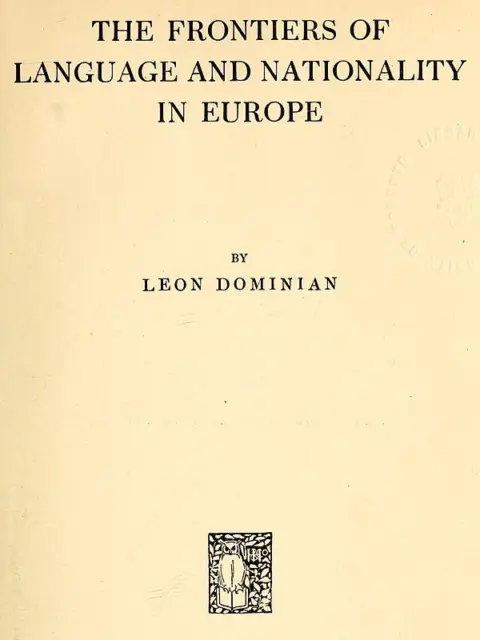
"The Frontiers of Language and Nationality in Europe" by Leon Dominian is a scientific publication written in the early 20th century. The book explores the intricate relationships between language distribution and national borders in Europe, emphasizing how geography has influenced the formation of linguistic and national identities. It offers insights into how language acts as a unifying factor within nationalities, while also addressing the impact of historical migrations and territorial disputes. At the start of the book, Dominian sets the stage by articulating the connection between language and territory. He discusses the historical evolution of human settlement and how different languages arise from specific geographical contexts, influencing human identity and culture. This opening section highlights the duality of language as both a marker of national and racial identity, presenting the idea that contemporary European boundaries have been shaped by a multitude of factors, including physical landscape and demographic changes. The preface and introduction establish the context for the subsequent analysis of linguistic frontiers, setting a scholarly tone and indicating the relevance of these themes in ongoing discussions about nationality and geopolitics in post-World War I Europe.
Introduction adapted from the source catalogue; source summaries may be automatically generated.
Free to read · English · 123,180 words · No account needed
MAKE TIME FOR A GOOD BOOK
On by default. Untick to stop anonymous reading totals. Each page counts after 10 seconds in view. How this works.
Anonymous counting is on unless you have switched it off.
[246] About forty towns and villages are held by the Druzes in the southern Lebanon. In the Anti-Lebanon districts they people eighty villages and share possession of about two hundred with their Christian kinsmen, the Maronites.
[247] Hakem was a Fatimite caliph of Egypt, who ruled in the early eleventh century. He incurred the hatred of his subjects by causing the incarnation of God in himself to be preached in Cairo by Darasi, his chaplain. Both became so unpopular that they were forced to escape from the capital to the Lebanon, where they succeeded in imposing their doctrines on the mountaineers. The name Druze is believed to be derived from Darasi.
[248] In recent years the Maronites have submitted to the authority of the Vatican. In return certain privileges, such as that of retention of Syriac liturgy, have been accorded to them. They constitute a veritable theocracy, all tribal and community affairs being handled by the clergy.
[249] The French military expedition to the Lebanon, undertaken in 1860, was caused by the massacre of over 12,000 Maronites by the Druzes in that year.
[250] This group comprises about 90,000 souls in Syria and 40,000
in Mesopotamia.
[251] E. Aubin: La Perse d’aujourd’hui, Paris, 1908, p. 418.
[252] The Elephantine papyri discovered on the island of Elephantine in southern Egypt between 1903 and 1906 contain Aramaic texts of great historical value.
[253] O. Procksch: Die Völker Altpalästinas, Leipzig, 1914, p. 30.
[254] At the end of the pre-Islamic period the region west of the Euphrates to the eastern slopes of the Lebanon mountains was known to the Arabs as “Beit Aramyeh,” or the land of the Arameans.
[255] H. Lammens: Le Massif du Gebal et les Yezidis de Syrie, Mélanges Faculté Orient. Univ. Beyrouth, 1907, pp. 366-407.
[256] W. B. Heard: Notes on Yezidis, Journ. Anthrop. Inst., Vol.
41, pp. 200-219.
[257] A. P. Stanley: Lectures on the History of the Eastern Church,
New York, 1909, p. 58.
[258] H. Trotter: Geogr. Journ., Vol. 35, No. 4, 1910, p. 378.
[259] F. J. Bliss: The Religions of Modern Syria and Palestine, New
York, 1912.
[260] The figures for Armenians and Greeks require revision in view of the systematic efforts of the Turks to extirpate these two peoples. The massacres of the entire Greek population of villages of the Ægean coasts and atrocities of a most inhuman character perpetrated on the Armenians of inland communities have largely depleted the ranks of these two Christian subject groups.
[261] Hellenes, or subjects of the King of Greece, number about
20,000.
[262] Figures supplied by Dr. W. W. Rockwell, Editor of the American Committee for Armenian and Syrian Relief. See Rockwell: Pitiful Plight, second ed., pp. 66.
[263] Abbreviations; R. C.: Roman Catholic Uniats, “Chaldeans.” R. C. s.: Roman Catholic Uniats, “Syrian Catholics.” J.: Jacobites. N.: Nestorians, “Assyrian Christians.” P.: Protestants.
Your reading position is saved on this browser. Take it to another device with a library code. Reading pages adapt to text, rather than matching a printed edition.
BEHIND THE BOOK
This eBook is for the use of anyone anywhere in the United States and most other parts of the world at no cost and with almost no restrictions whatsoever. You may copy it, give it away or re-use it under the terms of the Project Gutenberg License included with this eBook or online at www.gutenberg.org. If you are not located in the United States, you will have to check the laws of the country where you are located before using this eBook. Read the source licence.
The original source file, including credits and licence, is retained by this library. Request an original-format copy at no charge. Please include the book title and Project Gutenberg identifier #58205.
KEEP YOUR CURIOSITY GOING
Cécile Tormay

Moritz Busch
John L. Ransom
Frances Wright
Cécile Tormay

Mabel Potter Daggett