THE CLASSIC COLLECTION✦An outlaw’s diary: the CommuneCLASSIC FREE BOOKS
An outlaw’s diary: the Commune
Cécile Tormay
THE CLASSIC COLLECTION · 1917
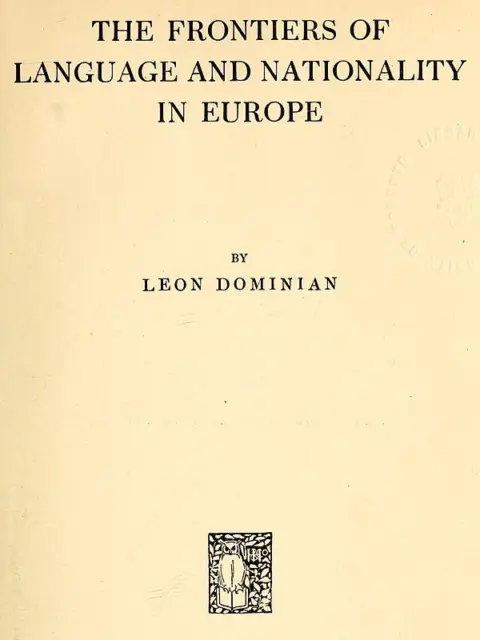
"The Frontiers of Language and Nationality in Europe" by Leon Dominian is a scientific publication written in the early 20th century. The book explores the intricate relationships between language distribution and national borders in Europe, emphasizing how geography has influenced the formation of linguistic and national identities. It offers insights into how language acts as a unifying factor within nationalities, while also addressing the impact of historical migrations and territorial disputes. At the start of the book, Dominian sets the stage by articulating the connection between language and territory. He discusses the historical evolution of human settlement and how different languages arise from specific geographical contexts, influencing human identity and culture. This opening section highlights the duality of language as both a marker of national and racial identity, presenting the idea that contemporary European boundaries have been shaped by a multitude of factors, including physical landscape and demographic changes. The preface and introduction establish the context for the subsequent analysis of linguistic frontiers, setting a scholarly tone and indicating the relevance of these themes in ongoing discussions about nationality and geopolitics in post-World War I Europe.
Introduction adapted from the source catalogue; source summaries may be automatically generated.
Free to read · English · 123,180 words · No account needed
MAKE TIME FOR A GOOD BOOK
On by default. Untick to stop anonymous reading totals. Each page counts after 10 seconds in view. How this works.
Anonymous counting is on unless you have switched it off.
Tyari 5,000 Tkhuma 2,500 Baz 800 Tal 700 Diz 600 Jilu 2,500 Berwar (Qudshanis included) 900 Lewan (west of Julamerk) 300 Serai (45 miles east of Van) 300 Eleven villages around Serai 400 Norduz (on Van-Julamerk road) 200 Albak (near Bashkala) 300 Gawar 400 Six villages in Nerwan & Rekan 200 Shemsdinan & Bar Bhishu (estimated) 200 ------ Total families 15,300 15,300 ------ Grand total 27,242
Total individuals at six to a family 163,452
[214] Fully one-third of Armenian consists of words of Persian stock. Some Armenian philologists point to the existence of a small remnant of highly ancient words which cannot be traced to Aryan forms and which probably represent the survival of a language indigenous to the Armenian highlands.
[215] H. R. Hall: The Ancient History of the Near East, London,
1913, pp. 31-79.
[216] R. Dussaud: Les civilisations préhelléniques dans le bassin de la Mer Egée, Paris, 1914, pp. 414-455.
[217] D. G. Hogarth: The Nearer East, New York, 1902, p. 102.
[218] D. G. Hogarth: Ionia and the Near East, Oxford, 1909; J. L. Myres: Greek Lands and the Greek People, Oxford, 1910.
[219] In many of these Anatolian communities Greek is written with
Turkish characters.
[220] G. de Jerphanion: La région d’Urgub (Cappadoce), La Géogr., Vol. 30, No. 1, July 15, 1914, pp. 1-11.
[221] In the Levant they are called Mezzo-Mezzos.
[222] J. Garstang: The Land of the Hittites, London, 1910, p. 318.
[223] Many Moslem immigrants from eastern Europe are also found in Asia Minor. Bosnians, Albanians, Pomaks and, in general, members of every Mohammedan community in the Balkan peninsula consider Asia Minor as a favorable land in which to settle.
[224] R. Leonhard: Paphlagonia, Berlin, 1915, pp. 359-373; J. W. Crowfoot: Survivals among the Kappadokian Kizilbash (Bektash), Journ. Anthrop. Inst., Vol. 30, 1900, pp. 305-320.
[225] The distribution of Kizilbash villages in the Yechil Irmak valley is shown in G. de Jerphanion’s Carte du Bassin du Yéchil Irmak, 1:200,000, Paris, 1914.
[226] J. G. Frazer: The Golden Bough, the Magic Art and the Evolution of Kings, London, 1911, Vol. 2, p. 126, footnote 2.
[227] H. F. B. Lynch: Armenia, London, 1901, Vol. 2, p. 430.
[228] Earl Percy: Highlands of Asiatic Turkey, London, 1901, pp.
89-90.
[229] C. Wilson: Handbook for Travelers in Asia Minor, Transcaucasia, Persia, etc., London, 1911, p. 68.
[230] The gipsies of Syria are known by the name of Nawar, or Zotts.
[231] Cf. inset on accompanying map entitled “Part of Asiatic Turkey showing Distribution of Peoples.”
Your reading position is saved on this browser. Take it to another device with a library code. Reading pages adapt to text, rather than matching a printed edition.
BEHIND THE BOOK
This eBook is for the use of anyone anywhere in the United States and most other parts of the world at no cost and with almost no restrictions whatsoever. You may copy it, give it away or re-use it under the terms of the Project Gutenberg License included with this eBook or online at www.gutenberg.org. If you are not located in the United States, you will have to check the laws of the country where you are located before using this eBook. Read the source licence.
The original source file, including credits and licence, is retained by this library. Request an original-format copy at no charge. Please include the book title and Project Gutenberg identifier #58205.
KEEP YOUR CURIOSITY GOING
Cécile Tormay

Moritz Busch
John L. Ransom
Frances Wright
Cécile Tormay

Mabel Potter Daggett