THE CLASSIC COLLECTION✦An outlaw’s diary: the CommuneCLASSIC FREE BOOKS
An outlaw’s diary: the Commune
Cécile Tormay
THE CLASSIC COLLECTION · 1917
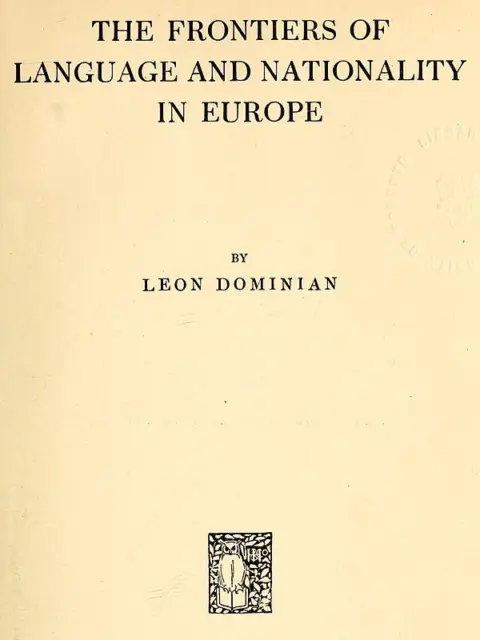
"The Frontiers of Language and Nationality in Europe" by Leon Dominian is a scientific publication written in the early 20th century. The book explores the intricate relationships between language distribution and national borders in Europe, emphasizing how geography has influenced the formation of linguistic and national identities. It offers insights into how language acts as a unifying factor within nationalities, while also addressing the impact of historical migrations and territorial disputes. At the start of the book, Dominian sets the stage by articulating the connection between language and territory. He discusses the historical evolution of human settlement and how different languages arise from specific geographical contexts, influencing human identity and culture. This opening section highlights the duality of language as both a marker of national and racial identity, presenting the idea that contemporary European boundaries have been shaped by a multitude of factors, including physical landscape and demographic changes. The preface and introduction establish the context for the subsequent analysis of linguistic frontiers, setting a scholarly tone and indicating the relevance of these themes in ongoing discussions about nationality and geopolitics in post-World War I Europe.
Introduction adapted from the source catalogue; source summaries may be automatically generated.
Free to read · English · 123,180 words · No account needed
MAKE TIME FOR A GOOD BOOK
On by default. Untick to stop anonymous reading totals. Each page counts after 10 seconds in view. How this works.
Anonymous counting is on unless you have switched it off.
[232] The Mexican parallel is too striking to be omitted here. The southern end of the plateau of Anahuac, on which the waters of Lake Texcuco receded within historical times, is the center of the stage of Mexican history. Surrounding this open land numerous narrow valleys were peopled by independent tribes which eventually banded together under the leadership of the community living near the central body of water. This lake confederacy became Cortez’s most powerful opponent when the conquistadores undertook their memorable expedition. Cf. F. J. Payne: History of the New World Called America, Oxford, 1899, pp. 450-463.
[233] D. G. Hogarth: The Ancient East, New York, 1914, p. 74.
[234] Notably t is entirely eliminated from the third person
singular.
[235] Handbook for Travelers in Asia Minor, Transcaucasia, Persia,
etc., London, 1911, p. 75.
[236] Petermanns Mitt., Vol. 42, Jan. 1896, p. 8; and for details V. Cuinet: La Turquie d’Asie, Paris, 1891-94, Vols. 1-4.
[237] The Armenian population of Turkey is divided by creed into three distinct communities. The vast majority--probably about ninety per cent--belong to the Gregorian sect of Christianity. Adherents of the Roman Catholic faith are found chiefly in western Asia Minor. Protestant congregations have sprung up around the educational institutions maintained by British or American missionary societies. Let it be noted here that many Mohammedan communities in Armenia consist of Armenoid individuals whose membership in the fold of Islam is the result of forcible conversions since the rise of Ottoman power. The Dersimlis, who inhabit the region between the two main branches of the Euphrates, have the reputation of being crypto-Christians of Armenian blood. Moslems of Armenian origin are also known in the village of Karageben on the Tehalta river east of Divrik. In Russia the Armenians number a scant million souls. Half of this community is scattered in the valley of the Arax and in the Erivan province.
[238] F. von Luschan: The Early Inhabitants of Western Asia, Ann. Rept. Smithsonian Inst. for 1914, pp. 561-562.
[239] “Rarely of unusual stature ... complexion dark” is Wilson’s description. Handbook for Travelers in Asia Minor, Transcaucasia, Persia, etc., London, 1911, p. 64.
[240] Mark Sykes: The Kurdish Tribes of the Ottoman Empire, Journ. Anthrop. Inst., Vol. 38, 1908, pp. 451-486.
[241] B. Dickson: Journeys in Kurdistan, Geogr. Journ., Vol. 35,
No. 4, April 1910, p. 361.
[242] De Torcy: Notes sur la Syrie, La Géogr., Vol. 27, No. 3, March 15, 1913, pp. 161-197; No. 6, June 15, 1913, pp. 429-459.
[243] L. Gaston Leary: Syria, the Land of Lebanon, New York, 1913,
p. 10.
[244] R. Dussaud: Les Nossairis, Bibl. de l’École des Hautes Études, Sciences, Philosophie et Histoire, Paris, 1900, Vol. 129.
[245] J. Garstang: The Land of the Hittites, London, 1910, pp. 15,
16.
Your reading position is saved on this browser. Take it to another device with a library code. Reading pages adapt to text, rather than matching a printed edition.
BEHIND THE BOOK
This eBook is for the use of anyone anywhere in the United States and most other parts of the world at no cost and with almost no restrictions whatsoever. You may copy it, give it away or re-use it under the terms of the Project Gutenberg License included with this eBook or online at www.gutenberg.org. If you are not located in the United States, you will have to check the laws of the country where you are located before using this eBook. Read the source licence.
The original source file, including credits and licence, is retained by this library. Request an original-format copy at no charge. Please include the book title and Project Gutenberg identifier #58205.
KEEP YOUR CURIOSITY GOING
Cécile Tormay

Moritz Busch
John L. Ransom
Frances Wright
Cécile Tormay

Mabel Potter Daggett