THE CLASSIC COLLECTION✦Pierre and LuceCLASSIC FREE BOOKS
Pierre and Luce
Romain Rolland
THE CLASSIC COLLECTION · 1918
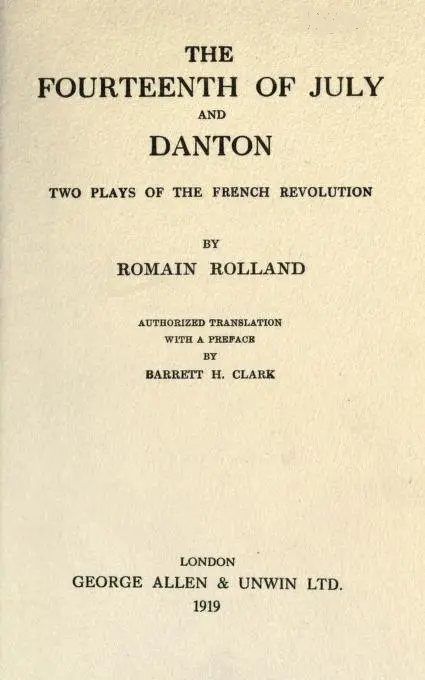
"The Fourteenth of July and Danton: Two Plays of the French Revolution" by Romain Rolland is a collection of historical plays written during the early 20th century. The work dramatizes significant events from the French Revolution, focusing on the interplay between individual heroes and the collective will of the people. The plays emphasize themes of liberty, social justice, and the moral truths behind revolutionary movements. The opening of "The Fourteenth of July" introduces the tense atmosphere in Paris leading up to the storming of the Bastille on July 14th, 1789. It captures the excitement and anxiety among various social classes as they react to the perceived threats from the monarchy. The dialogue features characters such as Camille Desmoulins and members of the crowd who discuss strategies and fears while urging each other to unite against the oppressive forces. The scene is laden with rich dialogue that reveals the characters' passions and the weight of societal expectations, setting the stage for the ensuing revolution. The focus on the "People" as a collective character emphasizes Rolland's aim to portray the revolution as a movement driven by the masses rather than just a few historical figures.
Introduction adapted from the source catalogue; source summaries may be automatically generated.
Free to read · English · 52,400 words · No account needed
MAKE TIME FOR A GOOD BOOK
On by default. Untick to stop anonymous reading totals. Each page counts after 10 seconds in view. How this works.
Anonymous counting is on unless you have switched it off.
VADIER [aside]. The hypocrite! He wants him, too! But we must
persuade him!
ROBESPIERRE. He was a great man. At least, he had the air of a great man, and at times he even seemed a good and virtuous man.
SAINT-JUST. Nothing so resembles virtue as a great crime.
VADIER [sarcastically]. You will deliver his funeral oration later on, Maximilien. But now let us bring down the beast.
SAINT-JUST. Vadier, you must respect death.
VADIER. But the little fellow is still alive.
SAINT-JUST. Danton is already doomed.
BILLAUD-VARENNE. Who will take it upon himself to accuse him?
VADIER. Saint-Just. The young man does it so well. Every sentence of his is as good as a stroke of the guillotine.
SAINT-JUST. It would give me great pleasure to attack the
monster.
ROBESPIERRE [getting papers, which he gives to SAINT-JUST]. Here are the notes, all ready for you.
VADIER [aside]. He has a whole portfolio like that for each of
his friends.
ROBESPIERRE. Let us not honor Danton by trying him alone: it
would attract too much attention.
BILLAUD-VARENNE. Let us overwhelm him in a general accusation.
VADIER. Whom shall we put with him, to fill out the menu?
SAINT-JUST. Every one who has tried to corrupt the cause of Liberty by means of money, evil example, or brains.
VADIER. Let us be clear. You're too vague.
ROBESPIERRE. Danton loved gold. Let him be buried with gold. Let us implicate him in the bank affair. Put him in with the embezzlers. He will find himself in company with his friend, his secretary, his Fabre d'Eglantine.
VADIER. Fabre, Chabot, the Jews, the Austrian bankers, the
Freys, and the Diederischens--good. We begin to have an imposing
list.
BILLAUD-VARENNE. It might be well to add Hérault, the friend of
the émigrés.
SAINT-JUST. Philippeaux, above all, the disorganizer of the
army, the destroyer of discipline.
ROBESPIERRE. Westermann, with his bloody sword, always ready for
an insurrection. Is that all?
VADIER. You forget dear Camille.
ROBESPIERRE. Wouldn't you prefer Bourbon, or Legendre, the mouthpieces of the enemy in the Assembly?
VADIER. No--Camille.
BILLAUD-VARENNE. Camille.
SAINT-JUST. Justice!
ROBESPIERRE. Take him.
SAINT-JUST. Good-by for the present. I must prepare my report. I shall strike them tomorrow at the Convention.
VADIER. No, no, young man. Your youthful imprudence is running away with you. Would you call Danton into court?
SAINT-JUST. Danton believes that no one will dare attack him face to face. I shall undeceive him.
VADIER. Your good intentions, my friend, are not enough. You
must have lungs deep enough to drown out the roarings of that
bull!
SAINT-JUST. Truth will overcome tempests.
ROBESPIERRE. We cannot expose the Republic in an open argument
like that.
Your reading position is saved on this browser. Take it to another device with a library code. Reading pages adapt to text, rather than matching a printed edition.
BEHIND THE BOOK
This eBook is for the use of anyone anywhere in the United States and most other parts of the world at no cost and with almost no restrictions whatsoever. You may copy it, give it away or re-use it under the terms of the Project Gutenberg License included with this eBook or online at www.gutenberg.org. If you are not located in the United States, you will have to check the laws of the country where you are located before using this eBook. Read the source licence.
The original source file, including credits and licence, is retained by this library. Request an original-format copy at no charge. Please include the book title and Project Gutenberg identifier #49438.
KEEP YOUR CURIOSITY GOING
Cécile Tormay

Moritz Busch
John L. Ransom
Frances Wright
Cécile Tormay

Mabel Potter Daggett