THE CLASSIC COLLECTION✦Pierre and LuceCLASSIC FREE BOOKS
Pierre and Luce
Romain Rolland
THE CLASSIC COLLECTION · 1918
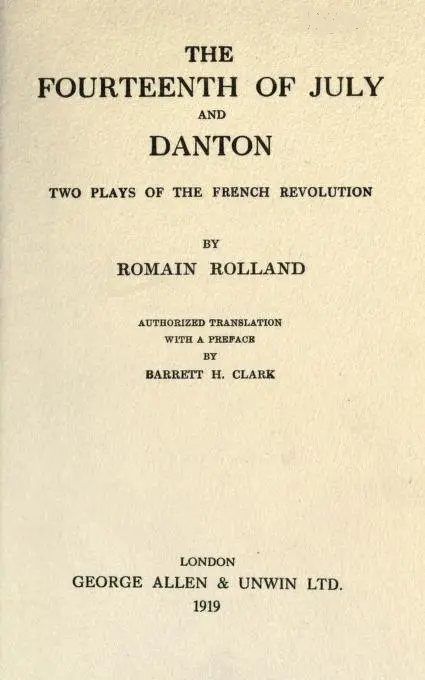
"The Fourteenth of July and Danton: Two Plays of the French Revolution" by Romain Rolland is a collection of historical plays written during the early 20th century. The work dramatizes significant events from the French Revolution, focusing on the interplay between individual heroes and the collective will of the people. The plays emphasize themes of liberty, social justice, and the moral truths behind revolutionary movements. The opening of "The Fourteenth of July" introduces the tense atmosphere in Paris leading up to the storming of the Bastille on July 14th, 1789. It captures the excitement and anxiety among various social classes as they react to the perceived threats from the monarchy. The dialogue features characters such as Camille Desmoulins and members of the crowd who discuss strategies and fears while urging each other to unite against the oppressive forces. The scene is laden with rich dialogue that reveals the characters' passions and the weight of societal expectations, setting the stage for the ensuing revolution. The focus on the "People" as a collective character emphasizes Rolland's aim to portray the revolution as a movement driven by the masses rather than just a few historical figures.
Introduction adapted from the source catalogue; source summaries may be automatically generated.
Free to read · English · 52,400 words · No account needed
MAKE TIME FOR A GOOD BOOK
On by default. Untick to stop anonymous reading totals. Each page counts after 10 seconds in view. How this works.
Anonymous counting is on unless you have switched it off.
SAINT-JUST. Let us calmly consider what the Republic owes to the conspirators. Let us not ask whether Danton is talented, but whether his talents serve the Republic. Where have these attacks of the past three months come from? Danton. Who inspired Philippeaux's letters against the Committee? Danton. Who dictates Desmoulins' pamphlets? Danton. Each number of the Vieux Cordelier is submitted to him; he corrects the manuscript in his own hand. If the river is poisoned, let us stop it at the source. Where is Danton's sincerity? Where is his bravery? What has he done the past year for the Republic?
ROBESPIERRE [pretending to be convinced, and speaking with a mixture of sincerity and hypocrisy]. It is true he never spoke for The Mountain when it was attacked.
SAINT-JUST. No, but he did for Dumouriez, and the generals who were his accomplices. The Jacobins defended him; you, too, Robespierre. But when you were accused, did he say a word?
ROBESPIERRE. No, and when he saw me deserted, a victim of the slanders of the Gironde, he said to his friends: "Since he wishes to ruin himself, let him! Let us not share his lot!" But do not drag me into the discussion.
BILLAUD-VARENNE. You yourself told me, Robespierre, that he did all he could to save the Girondins, and to strike Hanriot, who arrested the traitors.
ROBESPIERRE. That is true.
SAINT-JUST. And you told me, Robespierre, that he was base
enough to confess his embezzlements, and Fabre's--his
secretary--during his brief administration as Minister of
Justice.
ROBESPIERRE. I don't deny that.
SAINT-JUST. He was Lafayette's friend. Mirabeau bought him. He corresponded with Dumouriez and Wimpfen. He flattered Orléans. Every enemy of the Revolution was on familiar terms with him.
ROBESPIERRE. You must not exaggerate!
SAINT-JUST. You yourself told me. I should never have known
otherwise.
ROBESPIERRE. Of course, but--
BILLAUD-VARENNE [violently]. Do you deny it?
ROBESPIERRE. I cannot. Danton was an assiduous member of those Royalists gatherings, where Orléans himself mixed the punch. Fabre and Wimpfen, too, were present. They tried to bring the Deputies of the Mountain, to seduce and compromise them. But that was of no importance.
BILLAUD-VARENNE. On the contrary! It was high treason. Out and
out conspiracy!
ROBESPIERRE. I have just thought of a small detail. It seems that lately he boasted that if he were accused he would throw the blame on us for the Dauphin affair.
BILLAUD-VARENNE. The blackguard! Did he say that? And you defend
him?
ROBESPIERRE. Westermann just left this room. He threatened me
with Danton, and an uprising.
BILLAUD-VARENNE. And we sit here talking! The marauders are
still at large!
ROBESPIERRE. Do you want him?
SAINT-JUST. The nation wants him.
Your reading position is saved on this browser. Take it to another device with a library code. Reading pages adapt to text, rather than matching a printed edition.
BEHIND THE BOOK
This eBook is for the use of anyone anywhere in the United States and most other parts of the world at no cost and with almost no restrictions whatsoever. You may copy it, give it away or re-use it under the terms of the Project Gutenberg License included with this eBook or online at www.gutenberg.org. If you are not located in the United States, you will have to check the laws of the country where you are located before using this eBook. Read the source licence.
The original source file, including credits and licence, is retained by this library. Request an original-format copy at no charge. Please include the book title and Project Gutenberg identifier #49438.
KEEP YOUR CURIOSITY GOING
Cécile Tormay

Moritz Busch
John L. Ransom
Frances Wright
Cécile Tormay

Mabel Potter Daggett