THE CLASSIC COLLECTION✦Pierre and LuceCLASSIC FREE BOOKS
Pierre and Luce
Romain Rolland
THE CLASSIC COLLECTION · 1918
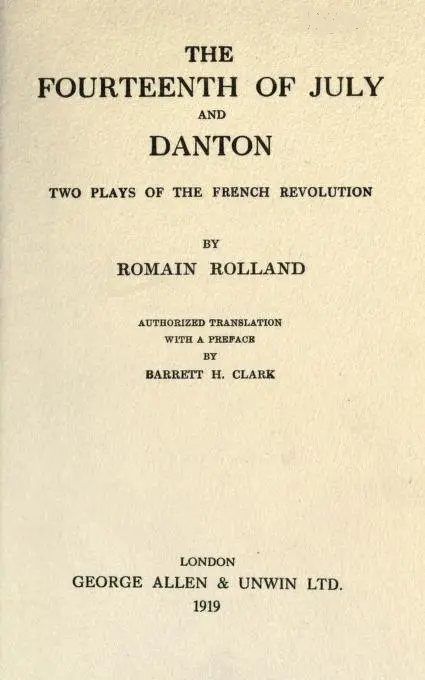
"The Fourteenth of July and Danton: Two Plays of the French Revolution" by Romain Rolland is a collection of historical plays written during the early 20th century. The work dramatizes significant events from the French Revolution, focusing on the interplay between individual heroes and the collective will of the people. The plays emphasize themes of liberty, social justice, and the moral truths behind revolutionary movements. The opening of "The Fourteenth of July" introduces the tense atmosphere in Paris leading up to the storming of the Bastille on July 14th, 1789. It captures the excitement and anxiety among various social classes as they react to the perceived threats from the monarchy. The dialogue features characters such as Camille Desmoulins and members of the crowd who discuss strategies and fears while urging each other to unite against the oppressive forces. The scene is laden with rich dialogue that reveals the characters' passions and the weight of societal expectations, setting the stage for the ensuing revolution. The focus on the "People" as a collective character emphasizes Rolland's aim to portray the revolution as a movement driven by the masses rather than just a few historical figures.
Introduction adapted from the source catalogue; source summaries may be automatically generated.
Free to read · English · 52,400 words · No account needed
MAKE TIME FOR A GOOD BOOK
On by default. Untick to stop anonymous reading totals. Each page counts after 10 seconds in view. How this works.
Anonymous counting is on unless you have switched it off.
The scene is a street in Paris, in the Faubourg Saint-Antoine. At the back, towering above the house-tops, stands the great bulk of the Bastille, the turrets of which, engulfed in the black night, soar up into the sky, and seem to strain higher and higher as dawn approaches. To the right, at the corner of a street, is LUCILE'S house. A convolvulus twines itself about the balcony support, and clambers along the wall. The street is lighted by candles, placed on the window-sills. Sounds from blacksmith shops--hammers pounding on forges, are heard, and from time to time the tocsin of a church, or occasionally a far-off musket-shot. Workingmen are constructing a barricade of wood and stone at the street corner, under LUCILE'S window.]
A MASON. Only a few more stones now.
A WORKINGMAN [with his bed on his back]. Here, use this. It's
my bed.
THE MASON. Are you sleeping here?
THE WORKINGMAN. I will before long, with a bullet in me.
THE MASON. You have a sense of humor.
THE WORKINGMAN. If the brigands pass here, we won't need
anything. Our beds are made elsewhere.
A CARPENTER. Help me stretch this cord.
AN APPRENTICE. What for?
THE CARPENTER. To trip the horses.
A PRINTER. Hey, Camuset?
ANOTHER. Yes?
THE PRINTER. Listen.
THE OTHER. What?
THE PRINTER. Don't you hear?
THE OTHER. I hear anvils. They're making pikes in all the
blacksmith shops.
THE PRINTER. No, not that. There--[He points to the ground.]
THE OTHER. There?
THE PRINTER. Yes, under the ground. [He lies down, with his ear
to the ground.]
THE OTHER. You're dreaming!
THE WORKINGMAN [lying down]. Sounds like mining.
THE OTHER. Good Lord, they're going to blow us up!
THE CARPENTER [incredulously]. Nonsense!
THE WORKINGMAN [still on the ground]. They've hidden millions
of pounds of powder there.
THE OTHER WORKINGMAN. That's why we can't find any.
THE CARPENTER. Do you think an army can go about underground
like rats?
THE WORKINGMAN [still on the ground]. They've got underground passages leading from the Bastille to Vincennes.
THE CARPENTER. Fairy tales!
THE OTHER WORKINGMAN [rising]. I'll have a look in the cellar,
anyway. Are you coming with me, Camuset? [They both go into a
house.]
THE CARPENTER [laughing]. In the cellar? Ha, ha! They're
looking for a pretext to wet their whistles! Now, let's finish
our work.
THE MASON [looking behind him as he works]. Good God!
THE CARPENTER. What's wrong?
THE MASON [looking toward the Bastille], That--that! Every time I look at that thing, it weighs down on my back--that Bastille! It catches in my throat.
THE CARPENTER. One looks under ground, and the other in the air. Don't look around; go on with your work.
Your reading position is saved on this browser. Take it to another device with a library code. Reading pages adapt to text, rather than matching a printed edition.
BEHIND THE BOOK
This eBook is for the use of anyone anywhere in the United States and most other parts of the world at no cost and with almost no restrictions whatsoever. You may copy it, give it away or re-use it under the terms of the Project Gutenberg License included with this eBook or online at www.gutenberg.org. If you are not located in the United States, you will have to check the laws of the country where you are located before using this eBook. Read the source licence.
The original source file, including credits and licence, is retained by this library. Request an original-format copy at no charge. Please include the book title and Project Gutenberg identifier #49438.
KEEP YOUR CURIOSITY GOING
Cécile Tormay

Moritz Busch
John L. Ransom
Frances Wright
Cécile Tormay

Mabel Potter Daggett