THE CLASSIC COLLECTION✦The Star of IndiaCLASSIC FREE BOOKS
The Star of India
Edward Sylvester Ellis
THE CLASSIC COLLECTION · 1870
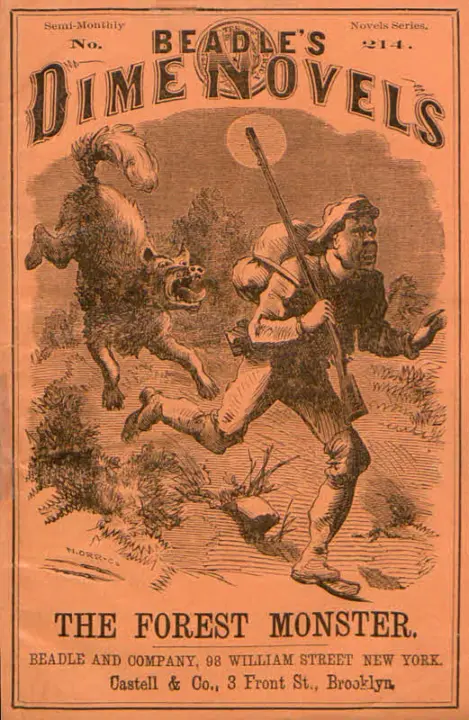
"The Forest Monster; or, Lamora, the Maid of the Canon" by Edward Sylvester Ellis is a novel written in the late 19th century. The story is set in the American West during an era when wilderness and native tribes presented both adventure and peril to settlers. The narrative introduces characters like Fred Hammond, a young adventurer, and Lamora, a mysterious woman who provides crucial warnings to an emigrant party threatened by Native American warriors. The opening of the book establishes an atmosphere of tension and suspense as an emigrant caravan encounters harsh weather and potential danger from an approaching Native American war party. The protagonist, Fred Hammond, becomes particularly uneasy as he senses a looming threat. His concerns are amplified when Lamora, a woman who declares her intention to help, arrives just in time to warn them of impending danger from a thousand Blackfeet warriors. As the night deepens, the caravan prepares to flee westward into the unknown, setting the stage for further adventures and the search for Lamora, whose own mysterious background intertwines with the tale of survival and romance that unfolds.
Introduction adapted from the source catalogue; source summaries may be automatically generated.
Free to read · English · 33,943 words · No account needed
MAKE TIME FOR A GOOD BOOK
On by default. Untick to stop anonymous reading totals. Each page counts after 10 seconds in view. How this works.
Anonymous counting is on unless you have switched it off.
“No,” she replied; “do not show yourself in the village. You know why?”
“No,” he answered, looking inquiringly at her.
“In the first place, they are always uneasy at the approach of strangers, and then, when it became known that you are the cause of my leaving them, some of the younger members might not feel so particularly Christian toward you.”
“I see; it shall be as you say. I will wait your own good time and pleasure, praying you to remember that the days will drag wearily until we turn our faces eastward.”
“I shall not be long.”
“Two or three days, I suppose, will be all-sufficient?”
“Perhaps so, but I can not say with certainty.”
“And there is no danger of your desiring to withdraw your consent; you can never be sorry for your promise.”
“Not so long as you do not forget yours.”
“Then it can never be,” was the ardent reply of Hammond, as he again pressed her to him, and imprinted a kiss upon her cheek.
She gently freed herself, and rising to her feet, stood calmly before him, looking lovingly and trustingly in his face.
“No,” she said, after a moment’s pause, “I do not think one of us ever will be sorry for this. You profess to love me, and I believe you, and I know, too, that you have the whole, undivided affection of Cecilia Alamant--that she is yours, now and forever!”
But there must be an end to all things, and the lovers became sensible that several hours had passed since they met, and it was now past noon. Lamora moved toward the path, Hammond still holding her hand and walking beside her.
“I do not know which is the prettiest, your Indian or your Christian name,” he remarked, as they walked slowly along.
“I am the most accustomed to the first, but I suppose I shall lose that
when I leave them.”
“It was that by which I first knew you, and I never wish to forget it. There will be a charm clinging to it which can never lose its fascination for me.”
“Well, you can call me by both,” she laughed; “one will suit me as well
as the other.”
“Lamora,” suddenly spoke up Hammond, “there are three white men near us; they are searching for gold. If they are successful we may all return to the States together.”
“That will be safer, I suppose.”
“They have been greatly alarmed by this strange--what shall I call it?--creature that makes his home near your village.”
“It has not harmed them?” she asked, with a peculiar expression.
Your reading position is saved on this browser. Take it to another device with a library code. Reading pages adapt to text, rather than matching a printed edition.
Edward Sylvester Ellis
Edward Sylvester Ellis
Edward Sylvester Ellis
Edward Sylvester Ellis
BEHIND THE BOOK
This eBook is for the use of anyone anywhere in the United States and most other parts of the world at no cost and with almost no restrictions whatsoever. You may copy it, give it away or re-use it under the terms of the Project Gutenberg License included with this eBook or online at www.gutenberg.org. If you are not located in the United States, you will have to check the laws of the country where you are located before using this eBook. Read the source licence.
The original source file, including credits and licence, is retained by this library. Request an original-format copy at no charge. Please include the book title and Project Gutenberg identifier #59147.
KEEP YOUR CURIOSITY GOING
Coulson Kernahan

Maurice Baring
Frances Wright
Cécile Tormay

Frederic Jesup Stimson

W. H. P. (William Henry Pope) Jarvis