THE CLASSIC COLLECTION✦The Star of IndiaCLASSIC FREE BOOKS
The Star of India
Edward Sylvester Ellis
THE CLASSIC COLLECTION · 1870
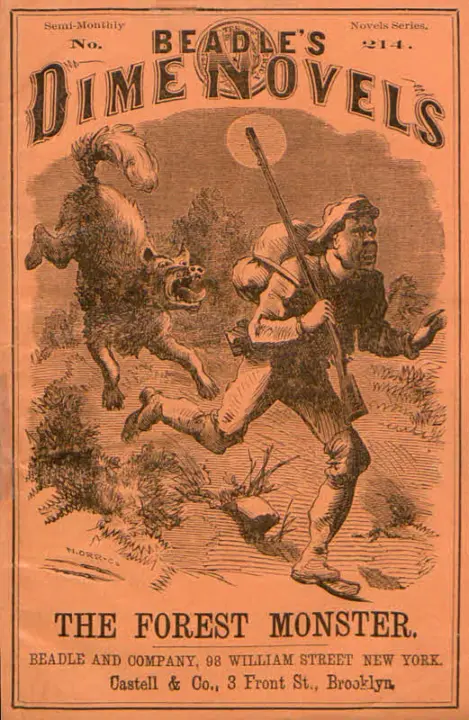
"The Forest Monster; or, Lamora, the Maid of the Canon" by Edward Sylvester Ellis is a novel written in the late 19th century. The story is set in the American West during an era when wilderness and native tribes presented both adventure and peril to settlers. The narrative introduces characters like Fred Hammond, a young adventurer, and Lamora, a mysterious woman who provides crucial warnings to an emigrant party threatened by Native American warriors. The opening of the book establishes an atmosphere of tension and suspense as an emigrant caravan encounters harsh weather and potential danger from an approaching Native American war party. The protagonist, Fred Hammond, becomes particularly uneasy as he senses a looming threat. His concerns are amplified when Lamora, a woman who declares her intention to help, arrives just in time to warn them of impending danger from a thousand Blackfeet warriors. As the night deepens, the caravan prepares to flee westward into the unknown, setting the stage for further adventures and the search for Lamora, whose own mysterious background intertwines with the tale of survival and romance that unfolds.
Introduction adapted from the source catalogue; source summaries may be automatically generated.
Free to read · English · 33,943 words · No account needed
MAKE TIME FOR A GOOD BOOK
On by default. Untick to stop anonymous reading totals. Each page counts after 10 seconds in view. How this works.
Anonymous counting is on unless you have switched it off.
“Yes, Lamora,” said he, sitting upright, and drawing her to him, “you must go home with me; you must be my wife; you will find nothing but kindness awaiting you; you will have the heart of your lover forever. You must; you shall go.”
The beautiful head, with its wealth of black hair, was now resting unresistingly upon his shoulder. He gently raised it, and imprinted a kiss upon the warm cheek.
“Answer me, Lamora,” he said, in the gentlest of voices, “do you love me, or do you feel indifferent toward me?”
“I love you; I can not help it!”
“Heaven bless you! who wants you to help it?” exclaimed the delighted Hammond, as he rained his kisses, and she smiled through her tears, and showed how perfect her happiness was, in confessing her love.
“Lamora, will you be mine? Will you go home with me?”
She looked at him unflinchingly in the face, and a seraphic light seemed to suffuse her eyes and countenance as she answered:
“Yes, I will go to your home with you and be yours.”
“Ah! who on earth does not envy me!” exclaimed the overjoyed lover. “You are mine; your promise is given. You feel no regrets?”
“No; none at all,” she answered, with the same bewitching sweetness.
“I thank Providence for this,” said Hammond, fervently. “You have intrusted your happiness into my hands, and never, no, never shall you regret it.”
Ah! they were happy moments to both. It was “love’s young dream,” in all its measureless hight and depth; their cup was pressed down and running over.
They talked and chatted, and billed and cooed, and replighted and revowed, as only young lovers can in the fulness of their hearts, and when an hour or two had slipped by in this delightful manner, then they began to discuss the matter practically.
“Will you leave your friends, without acquainting them of your
determination?” he inquired.
“No; that would be cruel; they would never cease hunting and searching for me, and it would break Kipwan’s heart.”
“Will you tell him all?”
“Yes.”
“Do you suppose he will object or attempt to dissuade you?”
“He is too good a man to attempt either. He will feel sorrowful, and so shall I, at the separation from those who have been such friends to me all my life--but he will wish me good-speed upon my journey.”
“He must be a good man indeed, and I should like to go into the village and take him by the hand,” said Hammond, who felt just then that he could take any one in the world by the hand.
Your reading position is saved on this browser. Take it to another device with a library code. Reading pages adapt to text, rather than matching a printed edition.
Edward Sylvester Ellis
Edward Sylvester Ellis
Edward Sylvester Ellis
Edward Sylvester Ellis
BEHIND THE BOOK
This eBook is for the use of anyone anywhere in the United States and most other parts of the world at no cost and with almost no restrictions whatsoever. You may copy it, give it away or re-use it under the terms of the Project Gutenberg License included with this eBook or online at www.gutenberg.org. If you are not located in the United States, you will have to check the laws of the country where you are located before using this eBook. Read the source licence.
The original source file, including credits and licence, is retained by this library. Request an original-format copy at no charge. Please include the book title and Project Gutenberg identifier #59147.
KEEP YOUR CURIOSITY GOING
Coulson Kernahan

Maurice Baring
Frances Wright
Cécile Tormay

Frederic Jesup Stimson

W. H. P. (William Henry Pope) Jarvis