THE CLASSIC COLLECTION✦The Star of IndiaCLASSIC FREE BOOKS
The Star of India
Edward Sylvester Ellis
THE CLASSIC COLLECTION · 1870
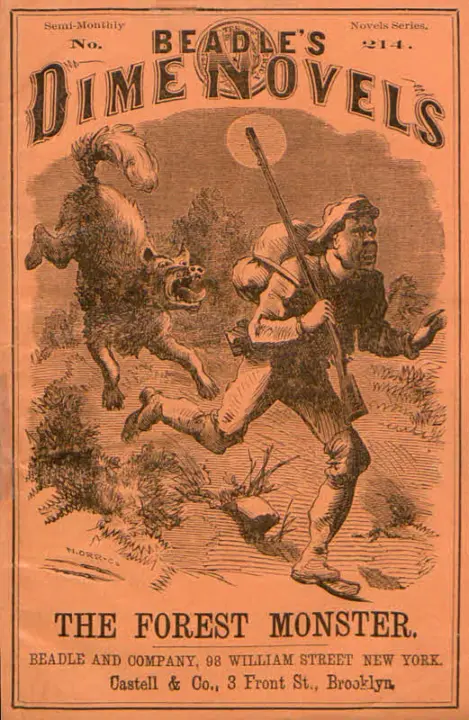
"The Forest Monster; or, Lamora, the Maid of the Canon" by Edward Sylvester Ellis is a novel written in the late 19th century. The story is set in the American West during an era when wilderness and native tribes presented both adventure and peril to settlers. The narrative introduces characters like Fred Hammond, a young adventurer, and Lamora, a mysterious woman who provides crucial warnings to an emigrant party threatened by Native American warriors. The opening of the book establishes an atmosphere of tension and suspense as an emigrant caravan encounters harsh weather and potential danger from an approaching Native American war party. The protagonist, Fred Hammond, becomes particularly uneasy as he senses a looming threat. His concerns are amplified when Lamora, a woman who declares her intention to help, arrives just in time to warn them of impending danger from a thousand Blackfeet warriors. As the night deepens, the caravan prepares to flee westward into the unknown, setting the stage for further adventures and the search for Lamora, whose own mysterious background intertwines with the tale of survival and romance that unfolds.
Introduction adapted from the source catalogue; source summaries may be automatically generated.
Free to read · English · 33,943 words · No account needed
MAKE TIME FOR A GOOD BOOK
On by default. Untick to stop anonymous reading totals. Each page counts after 10 seconds in view. How this works.
Anonymous counting is on unless you have switched it off.
“Now,” said Fred Hammond, after they had safely reëntered their own cavern home, “you have made your fortune, and I suppose are ready to start homeward to-morrow.”
A general assent followed, and Black Tom added that, on account of the Blackfeet, it was to their interest to get away without a moment’s unnecessary delay.
“I will be here early in the forenoon with my lady, ready to accompany you. You will wait for me?”
“Yas; of course.”
And the next moment Hammond had disappeared in the darkness.
It was only fairly daylight when our hero climbed a small tree, near the base of a spur of the Black Hills, that commanded a view of the Meagan village. Carefully concealing himself from view, he made a waving motion of a branch in his hand, repeated it several times, intently watching the result, and then descended to the ground and impatiently awaited the coming of Lamora.
Only a few minutes had elapsed, when a light step was heard, and the beautiful girl stepped timidly to view before him.
The delighted lover rushed toward her and clasped her in his arms.
“My own loved one!” he exclaimed, as he kissed the white forehead and pink cheeks, “are you ready to go with me?”
“Yes,” was the faint, but immediate reply.
“We are all prepared, and only await your coming.”
After some affectionate love-passages, they began to discuss their course of action in a sensible, practical manner.
Love had triumphed; Lamora had resolved to leave her Indian associations forever, and make her home with Hammond as his wife. That which would have been inexpressibly sad at any other time, now caused her scarcely a regret; nay, she was anxious and almost impatient to leave Kipwan, her adopted father, and the savages who had treated her with such kind tenderness ever since her childhood.
When Hammond stated the preparations that had been made for their departure in a few hours eastward, she was somewhat surprised, but not displeased. She needed some time herself to get ready, and so, bidding him good-by for the present, she hastily returned to the village.
She was trembling and excited, for this day marked an era in her life; but mingling with and permeating this feeling of uneasiness, was a sweet, happy anticipation as she looked at the future.
The meaning of her departure was made known only to Kipwan and his family. These, as a matter of course, were deeply affected, and the parting was painful in the highest degree to them. Yet, they interposed no murmur, but parted under the consciousness that in a few more years they would be united forever.
Your reading position is saved on this browser. Take it to another device with a library code. Reading pages adapt to text, rather than matching a printed edition.
Edward Sylvester Ellis
Edward Sylvester Ellis
Edward Sylvester Ellis
Edward Sylvester Ellis
BEHIND THE BOOK
This eBook is for the use of anyone anywhere in the United States and most other parts of the world at no cost and with almost no restrictions whatsoever. You may copy it, give it away or re-use it under the terms of the Project Gutenberg License included with this eBook or online at www.gutenberg.org. If you are not located in the United States, you will have to check the laws of the country where you are located before using this eBook. Read the source licence.
The original source file, including credits and licence, is retained by this library. Request an original-format copy at no charge. Please include the book title and Project Gutenberg identifier #59147.
KEEP YOUR CURIOSITY GOING
Coulson Kernahan

Maurice Baring
Frances Wright
Cécile Tormay

Frederic Jesup Stimson

W. H. P. (William Henry Pope) Jarvis