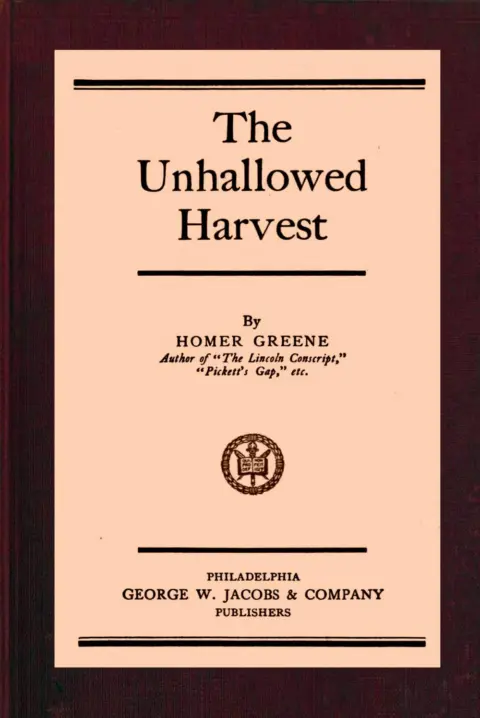
The unhallowed harvest
Homer Greene
THE CLASSIC COLLECTION · 1917
"The Flag" by Homer Greene is a novel written in the early 20th century. The story revolves around Penfield Butler, a fourteen-year-old boy living in the village of Chestnut Hill, where rivalries between local youth lead to playful yet intense conflicts. The narrative opens against a backdrop of snowy winter, highlighting Pen's interactions with family and friends as well as his involvement in a school initiative to raise money for an American flag. At the start of the book, we are introduced to Pen and his family, including his strict yet loving Aunt Millicent and his grandfather, Colonel Butler. The tension between the Hilltops and the Riverbeds, two boyhood factions, is evident as excitement grows for a more significant "battle" involving snowball fights. As the story unfolds, Pen's determination to see off his grandfather on a train is interrupted by an accident during coasting, which inadvertently leads to rivalry and competition for the flag being the centerpiece of their conflicts. The opening chapters set the stage for a tale of youthful conflict, camaraderie, and the exploration of patriotism, setting up deeper themes of honor and self-reflection.
Introduction adapted from the source catalogue; source summaries may be automatically generated.
Free to read · English · 57,191 words · No account needed
MAKE TIME FOR A GOOD BOOK
On by default. Untick to stop anonymous reading totals. Each page counts after 10 seconds in view. How this works.
Anonymous counting is on unless you have switched it off.
Pen shook his head deprecatingly, but he did not at once reply. Impatient at the delay, which he ascribed to the modesty characteristic of the brave and successful soldier, the colonel began to make more definite inquiry.
"In what manner was the engagement opened, Penfield?"
And Pen replied:
"Well, you know we built a snow fort in the school-house lot; and they sneaked up the back road, and cut across lots where we couldn't see 'em, and jumped on us suddenly from the stone-wall."
"Strategy, my boy. Military strategy deserving of a good cause. And how did you meet the attack?"
"Why, we pulled ourselves together and went for 'em."
"Well? Well? What happened?"
The colonel was getting excited and impatient.
"Well, we fought 'em and drove 'em down to the front of the school-house, and then they opened the door and sneaked in, just as I told you, and locked us out."
"Ah! more strategy. The enemy had brains. But you should have laid
siege and starved him out."
"We did lay siege, grandfather."
"And did you starve him out?"
"No, they came out."
"And you renewed the attack?"
"Some of us did."
"Well, go on! go on! What happened? Don't compel me to drag the story out of you piecemeal, this way."
"Why, they--they played us another mean trick."
"What was the nature of it?"
"Well--you know that flag you gave the school?"
"Yes."
"They carried that flag ahead of 'em, Aleck Sands had it wrapped around him, and then--our fellows were afraid to fight."
"Strategy again. Military genius, indeed! But it strikes me, Penfield, that the strategy was a bit unworthy."
"I thought it was a low-down trick."
"Well--a--let us say that it was not the act of a brave and generous foe. The flag--the flag, Penfield, should be used for purposes of inspiration rather than protection. However, the enemy, having placed himself under the auspices and protection of the flag which should, in any event, be unassailable, I presume he marched away in safety and security?"
"Why, no--not exactly."
"Penfield, I trust that no one had the hardihood to assault the bearer
of his country's flag?"
"Grandfather, I couldn't help it. He made me mad."
"Don't tell me, sir, that you so far forgot yourself as to lead an
attack on the colors?"
"No, I didn't. I pitched into him alone. I had to lick him, flag or no
flag."
"Penfield, I'm astounded! I wouldn't have thought it of you. And what
happened, sir?"
"Why, we clinched and went down."
"But, the flag? the flag?"
"That went down too."
Your reading position is saved on this browser. Take it to another device with a library code. Reading pages adapt to text, rather than matching a printed edition.
Homer Greene
Homer Greene
Homer Greene
Homer Greene
BEHIND THE BOOK
This eBook is for the use of anyone anywhere in the United States and most other parts of the world at no cost and with almost no restrictions whatsoever. You may copy it, give it away or re-use it under the terms of the Project Gutenberg License included with this eBook or online at www.gutenberg.org. If you are not located in the United States, you will have to check the laws of the country where you are located before using this eBook. Read the source licence.
The original source file, including credits and licence, is retained by this library. Request an original-format copy at no charge. Please include the book title and Project Gutenberg identifier #25188.
KEEP YOUR CURIOSITY GOING
Coulson Kernahan

Maurice Baring
Frances Wright
Cécile Tormay

Frederic Jesup Stimson

W. H. P. (William Henry Pope) Jarvis