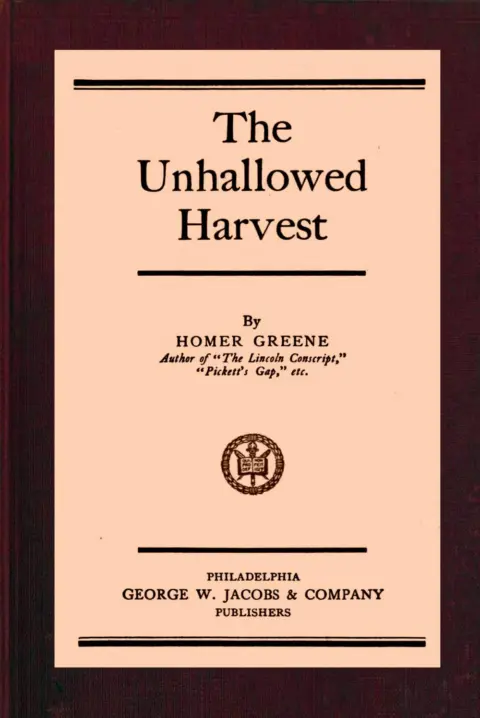
The unhallowed harvest
Homer Greene
THE CLASSIC COLLECTION · 1917
"The Flag" by Homer Greene is a novel written in the early 20th century. The story revolves around Penfield Butler, a fourteen-year-old boy living in the village of Chestnut Hill, where rivalries between local youth lead to playful yet intense conflicts. The narrative opens against a backdrop of snowy winter, highlighting Pen's interactions with family and friends as well as his involvement in a school initiative to raise money for an American flag. At the start of the book, we are introduced to Pen and his family, including his strict yet loving Aunt Millicent and his grandfather, Colonel Butler. The tension between the Hilltops and the Riverbeds, two boyhood factions, is evident as excitement grows for a more significant "battle" involving snowball fights. As the story unfolds, Pen's determination to see off his grandfather on a train is interrupted by an accident during coasting, which inadvertently leads to rivalry and competition for the flag being the centerpiece of their conflicts. The opening chapters set the stage for a tale of youthful conflict, camaraderie, and the exploration of patriotism, setting up deeper themes of honor and self-reflection.
Introduction adapted from the source catalogue; source summaries may be automatically generated.
Free to read · English · 57,191 words · No account needed
MAKE TIME FOR A GOOD BOOK
On by default. Untick to stop anonymous reading totals. Each page counts after 10 seconds in view. How this works.
Anonymous counting is on unless you have switched it off.
And Pen answered, frankly enough:
"I've been in a snowball fight, Aunt Milly."
"Well, I should say so!" she replied. "Your face is a perfect sight. Father, just look at Pen's face."
Colonel Butler adjusted his eye-glasses deliberately, and looked as he
was bidden to do.
"Some rather severe contusions," he remarked. "A bit painful,
Penfield?"
"Not so very," replied Pen, "I washed 'em off and put on some Pond's extract, and some court-plaster, and I guess they'll be all right."
The colonel was still looking at Pen's wounds, and smiling as he
looked.
"The nature of the injuries," he said, "indicates that the fighting must have been somewhat strenuous. But honorable scars, won on the field of battle, are something in which any man may take pardonable--"
"Father Richard Butler!" exclaimed Aunt Millicent. "Aren't you ashamed of yourself! Pen, let this be the last snowball fight you indulge in while you live in this house. Do you hear me?"
"Yes, Aunt Millicent. There won't be any more; not any more at all."
"I should hope not," she replied; "with such a looking face as you've
got."
Colonel Butler was temporarily subdued. Only the merry twinkle in his eyes, and the smile that hovered about the corners of his mouth, still attested the satisfaction he was feeling in his grandson's military prowess. He could not, however, restrain his curiosity until the end of the meal, and, at the risk of evoking another rebuke from his daughter, he inquired of Pen:
"A--Penfield, may I ask in which direction the tide of battle finally
turned?"
"I believe we licked 'em, grandfather," replied Pen. "We drove 'em into the school-house anyway."
"Not, I presume, before some severe preliminary fighting had taken
place?"
"There you go again, father!" exclaimed Aunt Millicent. "It's nothing but 'fighting, fighting,' from morning to night. What kind of a man do you think Pen will grow up to be, with such training as this?"
"A very useful, brave and patriotic citizen, I hope, my dear."
"Fiddlesticks!" It was Aunt Millicent's favorite ejaculation. But the colonel did not refer to the battle again at the table. It was not until after he had retired to the library, and had taken up his favorite position, his back to the fire, his eyes resting on the silken banner in the hall, that he plied Pen with further questions. His daughter not being in the room he felt that he might safely resume the subject of the fight.
"I would like a full report of the battle, Penfield," he said. "It appears to me that it is likely to go down as a most important event in the history of the school."
Your reading position is saved on this browser. Take it to another device with a library code. Reading pages adapt to text, rather than matching a printed edition.
Homer Greene
Homer Greene
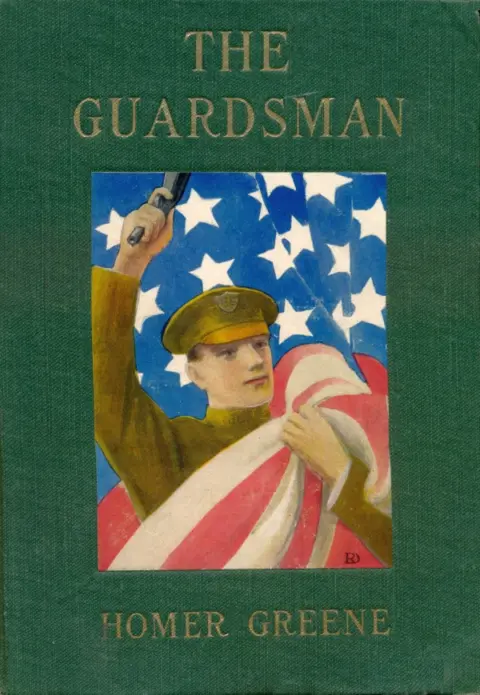
Homer Greene
Homer Greene
BEHIND THE BOOK
This eBook is for the use of anyone anywhere in the United States and most other parts of the world at no cost and with almost no restrictions whatsoever. You may copy it, give it away or re-use it under the terms of the Project Gutenberg License included with this eBook or online at www.gutenberg.org. If you are not located in the United States, you will have to check the laws of the country where you are located before using this eBook. Read the source licence.
The original source file, including credits and licence, is retained by this library. Request an original-format copy at no charge. Please include the book title and Project Gutenberg identifier #25188.
KEEP YOUR CURIOSITY GOING
Coulson Kernahan

Maurice Baring
Frances Wright
Cécile Tormay

Frederic Jesup Stimson

W. H. P. (William Henry Pope) Jarvis