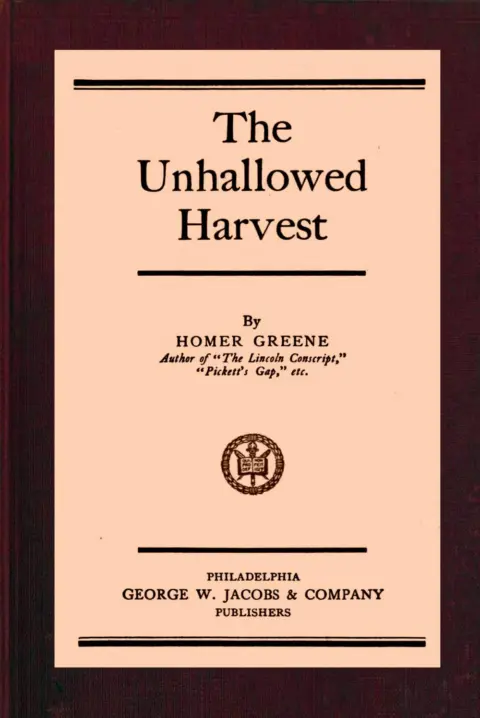
The unhallowed harvest
Homer Greene
THE CLASSIC COLLECTION · 1917
"The Flag" by Homer Greene is a novel written in the early 20th century. The story revolves around Penfield Butler, a fourteen-year-old boy living in the village of Chestnut Hill, where rivalries between local youth lead to playful yet intense conflicts. The narrative opens against a backdrop of snowy winter, highlighting Pen's interactions with family and friends as well as his involvement in a school initiative to raise money for an American flag. At the start of the book, we are introduced to Pen and his family, including his strict yet loving Aunt Millicent and his grandfather, Colonel Butler. The tension between the Hilltops and the Riverbeds, two boyhood factions, is evident as excitement grows for a more significant "battle" involving snowball fights. As the story unfolds, Pen's determination to see off his grandfather on a train is interrupted by an accident during coasting, which inadvertently leads to rivalry and competition for the flag being the centerpiece of their conflicts. The opening chapters set the stage for a tale of youthful conflict, camaraderie, and the exploration of patriotism, setting up deeper themes of honor and self-reflection.
Introduction adapted from the source catalogue; source summaries may be automatically generated.
Free to read · English · 57,191 words · No account needed
MAKE TIME FOR A GOOD BOOK
On by default. Untick to stop anonymous reading totals. Each page counts after 10 seconds in view. How this works.
Anonymous counting is on unless you have switched it off.
Colonel Butler left his place at the fire-side and crossed over to the table where Pen sat, in order that he might look directly down on him.
"Am I to understand," he said, "that the colors of my country have been wantonly trailed in the mire of the street?"
Under the intensity of that look, and the trembling severity of that voice, Pen wilted and shrank into the depths of his cushioned chair. He could only gasp:
"I'm afraid so, grandfather."
After that, for a full minute, there was silence in the room. When the colonel again spoke his voice was low and tremulous. It was evident that his patriotic nature had been deeply stirred.
"In what manner," he asked, "was the flag rescued and restored to its
proper place?"
And Pen answered truthfully:
"I don't know. I came away."
The boy was still sunk deep in his chair, his hands were desperately clutching the arms of it, and on his pale face the wounds and bruises stood out startlingly distinct.
In the colonel's breast grief and indignation were rapidly giving way
to wrath.
"And so," he added, his voice rising with every word, "you added insult to injury; and having forced the nation's banner to the earth, you deliberately turned your back on it and came away?"
Pen did not answer. He could not.
"I say," repeated the colonel, "you deliberately turned your back on
it, and came away?"
"Yes, sir."
Colonel Butler crossed back to the fire-place, and then he strode into the hall. He put on his hat and was struggling into his overcoat when his daughter came in from the dining-room and discovered him.
"Why, father!" she exclaimed, "where are you going?"
"I am going," he replied, "to perform a patriotic duty."
"Oh, don't go out again to-night," she pleaded. "You've had a hard
trip to-day, and you're tired. Let Pen do your errand. Pen, come
here!"
The boy came at her bidding. The colonel paused to consider.
"On second thought," he said, finally, "it may be better that I should not go in person. Penfield, you will go at once, wherever it may be necessary, and inquire as to the present condition and location of the American flag belonging to the Chestnut Hill school, and return and report to me."
"Yes, sir."
Pen put on his hat and coat, took his umbrella, and went out into the rain. Six blocks away he stopped at Elmer Cuddeback's door and rang the bell. Elmer himself came in answer to the ring.
"Come out on the porch a minute," said Pen. "I want to speak to you."
Elmer came out and closed the door behind him.
Your reading position is saved on this browser. Take it to another device with a library code. Reading pages adapt to text, rather than matching a printed edition.
Homer Greene
Homer Greene
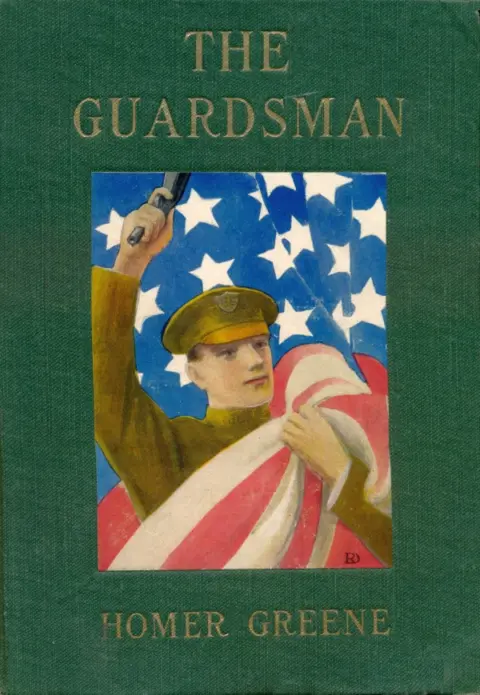
Homer Greene
Homer Greene
BEHIND THE BOOK
This eBook is for the use of anyone anywhere in the United States and most other parts of the world at no cost and with almost no restrictions whatsoever. You may copy it, give it away or re-use it under the terms of the Project Gutenberg License included with this eBook or online at www.gutenberg.org. If you are not located in the United States, you will have to check the laws of the country where you are located before using this eBook. Read the source licence.
The original source file, including credits and licence, is retained by this library. Request an original-format copy at no charge. Please include the book title and Project Gutenberg identifier #25188.
KEEP YOUR CURIOSITY GOING
Coulson Kernahan

Maurice Baring
Frances Wright
Cécile Tormay

Frederic Jesup Stimson

W. H. P. (William Henry Pope) Jarvis