THE CLASSIC COLLECTION✦Stories from the Faerie QueeneCLASSIC FREE BOOKS
Stories from the Faerie Queene
Mary Macleod & Edmund Spenser
THE CLASSIC COLLECTION · 1909
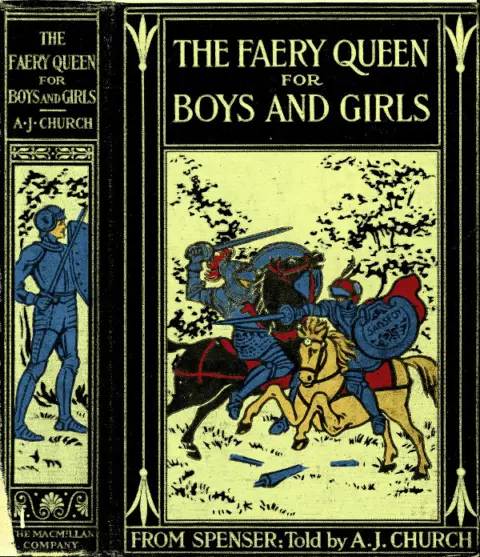
"The Faery Queen and Her Knights: Stories Retold from Edmund Spenser" by the Rev. Alfred J. Church is a collection of retellings and adaptations of classic tales written in the early 20th century. This compilation draws from Spenser's epic poem "The Faerie Queene," introducing readers to the noble knights who embark on adventurous quests, including the notable Red-Cross Knight, as they face trials of virtue, love, and bravery against dark forces. The opening portion introduces the Red-Cross Knight, a brave yet untested hero who is on a sacred mission to slay a Great Dragon and save the realm. Accompanied by the fair Lady Una, whose royal lineage has been oppressed by the Dragon, and a sad Dwarf bearing provisions, they navigate a mysterious wood filled with perils. Their journey quickly turns treacherous when they become lost and stumble upon the Den of Error, where a monstrous creature tests the Knight's valor. As tensions rise and challenges multiply, the themes of courage, the importance of faith, and the responsibility of a true knight begin to unfold, setting the stage for subsequent adventures in this enchanting retelling.
Introduction adapted from the source catalogue; source summaries may be automatically generated.
Free to read · English · 80,221 words · No account needed
MAKE TIME FOR A GOOD BOOK
On by default. Untick to stop anonymous reading totals. Each page counts after 10 seconds in view. How this works.
Anonymous counting is on unless you have switched it off.
When they had travelled a score of miles or so, they came to a castle which was built very high and strong. Thereupon the Dwarf cried out, “This is the place in which my good lord lies a prisoner, the thrall of the giant Orgoglio.” Thereupon the Prince Arthur alighted from his steed, and said to the Lady Una, “Stay here, madam, and await the issue of this day’s combat.” Then, at his bidding, the squire came near to the wall of the castle. He found the gates fast shut, with no warder to guard them, nor was there any to answer when he called. Then the squire took in his hand a bugle that he bore, that hung by his side with a chain of gold decked with gay tassels. It was a bugle of wondrous power; for three miles it could be heard, and there came out of space three answers to its blast, nor could anyone in whose heart there was aught of falsehood endure to hear it without dismay, nor could any bolt or bar, however stout they might be, withstand its summons. This bugle, then, Prince Arthur’s squire sounded before the giant’s castle. And it was shaken straightway from the foundation to the topmost towers, and the doors flew open of their own accord. The giant himself was much troubled at the sound, and came with staggering steps, as one smitten with a sudden fear, to see what it might mean. And after came the false Duessa, riding on a many-headed beast, with fiery tongues, for such a monster the giant had given her for her own.
Prince Arthur without delay addressed himself to the fight. Nor did the giant draw back, being persuaded that no mortal man could stand up against him and prevail. He thought, indeed, to slay him with a single blow, and lifted up his mighty club. But the Prince was wise and wary, and, lightly leaping aside, he escaped the stroke unhurt, for he thought it no shame to use his craft against brute strength. As for the club, so missing its aim, it sank deep into the earth, making a furrow a yard deep and more. The giant pulled at it amain, seeking to lift it for another stroke, but could not prevail, so fast was it buried. The knight, therefore, had him at a disadvantage, and smote him with his sword so deadly a stroke that it shore off his arm. Loud did he bellow with fear and pain, and Duessa, seeing her champion in sore distress, made the great beast on which she sat advance against the Knight. But now Prince Arthur’s squire, a gallant warrior, worthy of such a lord, stood forth and, with his single sword, barred the way. In high disdain to be hindered by so weak a foe Duessa yet again urged on the beast, but still the squire stood firm; he would not give place a single step lest the enemy should so gain an advantage against his lord. Then Duessa had recourse to her magic arts, for she took of the magic juices which she ever carried with her, and sprinkled them upon the youth, and quenched his courage and robbed him of his strength, so that he could neither see nor stand. So he fell all his length upon the earth, and the beast laid his deadly claws upon his neck, and would have crushed the life out of him. But the Knight, perceiving his evil plight, turned quickly from his own adversary, and addressed himself to the beast, for, indeed, it grieved him much that his faithful squire should have come into such peril of his life. So, lifting high the sword with which he had smitten the giant, he smote the beast upon one of its heads, making the blood pour out amain. But when the beast, writhing to and fro in its pain, would have shaken Duessa from her seat upon its back, and she cried out in her fear, the giant came to her help. He was, indeed, of no common nature, nor was he disabled by the wound which would have bereft all other creatures of strength. In the one hand which was left to him there dwelt the strength of the two, and now being free to use again his club of oak, he lifted it up high and dealt such a blow at Prince Arthur’s shield that it brought him to the ground. But now by this very stroke the Knight’s deliverance was wrought, for the covering was torn from the shield by its violence, and all its brightness was revealed. With so great a splendour did it blaze into the giant’s eyes that he dropped his arm and let fall the club with which he was ready to slay his adversary. The beast also was blinded by that brightness, and fell reft of its senses on the ground. Nor when Duessa cried aloud to the giant in her fear could he render effectual help. With stroke after stroke the Prince lopped from him limb after limb, till he lay dead upon the ground. And then this marvel came to pass. This creature which had seemed so vast seemed to vanish away. As for Duessa, she sprang from off the beast, and would have fled away upon her feet. But this the squire would not suffer, for, pursuing her with speedy feet, he laid hold of her and brought her back to the Prince to await his judgment.
Your reading position is saved on this browser. Take it to another device with a library code. Reading pages adapt to text, rather than matching a printed edition.
Mary Macleod & Edmund Spenser
Alfred John Church
Alfred John Church
Alfred John Church & Homer
BEHIND THE BOOK
This eBook is for the use of anyone anywhere in the United States and most other parts of the world at no cost and with almost no restrictions whatsoever. You may copy it, give it away or re-use it under the terms of the Project Gutenberg License included with this eBook or online at www.gutenberg.org. If you are not located in the United States, you will have to check the laws of the country where you are located before using this eBook. Read the source licence.
The original source file, including credits and licence, is retained by this library. Request an original-format copy at no charge. Please include the book title and Project Gutenberg identifier #55765.
KEEP YOUR CURIOSITY GOING
Coulson Kernahan

Maurice Baring
Frances Wright
Cécile Tormay
Francis Greenleaf Allinson & Anne C. E. (Anne Crosby Emery) Allinson

Frederic Jesup Stimson