THE CLASSIC COLLECTION✦Stories from the Faerie QueeneCLASSIC FREE BOOKS
Stories from the Faerie Queene
Mary Macleod & Edmund Spenser
THE CLASSIC COLLECTION · 1909
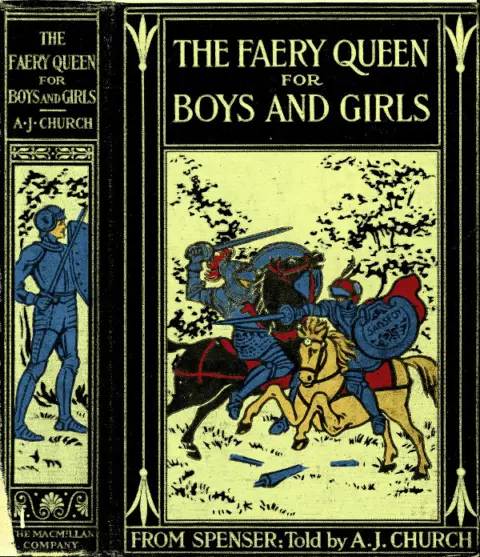
"The Faery Queen and Her Knights: Stories Retold from Edmund Spenser" by the Rev. Alfred J. Church is a collection of retellings and adaptations of classic tales written in the early 20th century. This compilation draws from Spenser's epic poem "The Faerie Queene," introducing readers to the noble knights who embark on adventurous quests, including the notable Red-Cross Knight, as they face trials of virtue, love, and bravery against dark forces. The opening portion introduces the Red-Cross Knight, a brave yet untested hero who is on a sacred mission to slay a Great Dragon and save the realm. Accompanied by the fair Lady Una, whose royal lineage has been oppressed by the Dragon, and a sad Dwarf bearing provisions, they navigate a mysterious wood filled with perils. Their journey quickly turns treacherous when they become lost and stumble upon the Den of Error, where a monstrous creature tests the Knight's valor. As tensions rise and challenges multiply, the themes of courage, the importance of faith, and the responsibility of a true knight begin to unfold, setting the stage for subsequent adventures in this enchanting retelling.
Introduction adapted from the source catalogue; source summaries may be automatically generated.
Free to read · English · 80,221 words · No account needed
MAKE TIME FOR A GOOD BOOK
On by default. Untick to stop anonymous reading totals. Each page counts after 10 seconds in view. How this works.
Anonymous counting is on unless you have switched it off.
The marriage of Sir Marinell and the fair Florimell having been duly celebrated with much rejoicing and great festivity, Sir Artegall set forth again upon his travels. On his way, which for a while lay by the seashore, he came upon two men who were wholly taken up with a great quarrel. They were brothers, as might clearly be seen by the likeness between them. Near them stood two fair dames who would fain have reconciled them; but the brothers took no heed of their words, whether they spoke gently or in threatening fashion. Between them stood a strong chest, bound about with bands of iron; it seemed to have been much battered, whether by the violence of the sea or by the chances of long travel from foreign parts. It was indeed for this that the two seemed to be contending, for now the one and now the other would lay his hands upon it; so did they well-nigh come to blows, but the two damsels had so far hindered them from coming to this extremity. Not the less were they bent on trying their cause by the sword. It seemed as if it could not be decided in any other fashion. But when they were on the point to do so, notwithstanding all that the damsels could say or do, then did Sir Artegall appear.
“Sirs,” said he, “are you content to tell me the cause of your strife?” To this the two gave a common consent.
“Sir,” said the elder—Bracidas was his name—“our father, who was a knight, Milesio by name, divided between us, by his testament, his estate, that is to say, two islands which you see yonder. One is but a little mount, but in years past it was fully as long and broad as that which you see on the other side of the bay. To me he bequeathed that island which you see to be so small; for the sea, as years have passed by, has wasted it, and in so doing has largely increased the other, for what the waves took away from my land they added unto his. There is also this to be told. I was betrothed to that fair lady who stands yonder, Philtera by name, and with her I was to receive a goodly dowry, so soon as we should be linked together in bonds of wedlock. My younger brother, whose name is Amidas, was betrothed to that other dame whom you see yonder, Lucy by name. She had but small dower, but much of that which is far better—to wit, goodness. Now when the lady Philtera saw that my lands had been greatly decayed and the lands of my brother not less increased, she deserted me and betook herself to my brother, who, that he might receive her, deserted his own betrothed, to wit, the fair Lucy. Thereupon this damsel, in her unhappiness, thinking it better to die than to suffer such a contumely and pain, threw herself into the sea. But while she floated among the waves, being, I take it, buoyed up by her clothing, she chanced upon this chest which you see. And now there befell her what has often befallen others in like case. She, who had thought death to be better than life, when she saw his terrors close at hand, changed her mind, and desired to live. Catching hold, therefore, of this chest, she clung to it, and after much tossing by the sea, was at last thrown upon my island, and I, chancing at that time to be walking on the shore, espied her; and she being by this time much spent with hunger and cold, and little able to help herself, I did, so to speak, save her from death. And she, being not a little grateful for this same help, bestowed upon me the dowry which fortune had given her, to wit the chest on which she had chanced, and what was far more precious, her own self. When we had opened the chest, we found in it a great store of treasure, and took it for our own use. But now this damsel, Philtera, maintains that this chest is hers by right, that she was bringing it from foreign lands that she might deliver it to her husband, and that she suffered shipwreck by the way. Whether this be so or no, I cannot say; but this I do maintain, that whatever by good fortune or by the ordering of God has been brought into my hands is verily mine, I not having in any wise contrived the same. My land he has, and also my betrothed, though of that I take no count, but my good luck he shall not have!”
Your reading position is saved on this browser. Take it to another device with a library code. Reading pages adapt to text, rather than matching a printed edition.
Mary Macleod & Edmund Spenser
Alfred John Church
Alfred John Church
Alfred John Church & Homer
BEHIND THE BOOK
This eBook is for the use of anyone anywhere in the United States and most other parts of the world at no cost and with almost no restrictions whatsoever. You may copy it, give it away or re-use it under the terms of the Project Gutenberg License included with this eBook or online at www.gutenberg.org. If you are not located in the United States, you will have to check the laws of the country where you are located before using this eBook. Read the source licence.
The original source file, including credits and licence, is retained by this library. Request an original-format copy at no charge. Please include the book title and Project Gutenberg identifier #55765.
KEEP YOUR CURIOSITY GOING
Coulson Kernahan

Maurice Baring
Frances Wright
Cécile Tormay
Francis Greenleaf Allinson & Anne C. E. (Anne Crosby Emery) Allinson

Frederic Jesup Stimson