THE CLASSIC COLLECTION✦Her countryCLASSIC FREE BOOKS
Her country
Mary Raymond Shipman Andrews
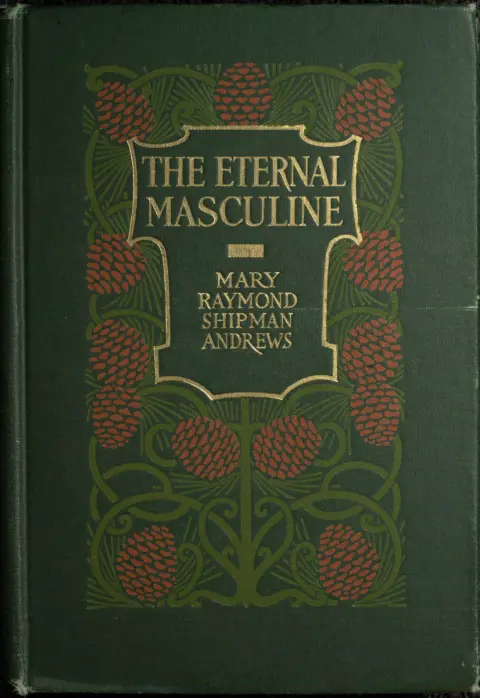
THE CLASSIC COLLECTION · 1913
"The Eternal Masculine: Stories of Men and Boys" by Mary Raymond Shipman Andrews is a collection of illustrated stories written in the early 20th century. The book explores themes of masculinity through the lens of various male characters, focusing on their youthful adventures and interactions, particularly in nature. It seems to delve into the contrasting experiences of young boys and older men as they navigate their identities and relationships in the context of the outdoors, friendship, and skill in activities like fishing. At the start of the book, readers are introduced to two boys, Jack and his guide, Josef, who are navigating a Canadian forest during a fishing trip. The narrative captures their camaraderie, with Jack showcasing both enthusiasm and curiosity as he observes and learns from Josef's expertise in woodcraft. As they journey to a spot known as Profanity Pool, they encounter challenges and engage in conversations that reveal their backgrounds and personalities. Through vivid descriptions of nature and dialogue, Andrews sets the stage for a deeper exploration of male friendships and the formative experiences of youth, emphasizing the joys and trials that accompany these relationships.
Introduction adapted from the source catalogue; source summaries may be automatically generated.
Free to read · English · 81,523 words · No account needed
MAKE TIME FOR A GOOD BOOK
On by default. Untick to stop anonymous reading totals. Each page counts after 10 seconds in view. How this works.
Anonymous counting is on unless you have switched it off.
“If the asylum people think the old ladies are going to make the child support them, they won’t send it,” objected Hill gloomily. “And it’s not etiquettical to sign your name ‘The Misses Bellingham.’ Ought to sign it their front names and no title.”
“But I don’t know their front names,” complained Carruthers.
“Might be Letitia and Mary,” suggested Duncan. “Make ’em that and have the letter sent in charge of Fitzhugh, else it will go straight to Letitia.”
“Why in charge of me?” Fitzhugh straightened suspiciously.
“Because you’ve been sitting there asleep, and haven’t helped a hair, and it’s time we made you,” his wife answered, with severity. “Georgy, put in a P. S., and say it’s more convenient, owing to the storms, to have an answer sent in charge of Letitia’s and Mary’s nephew, Cadet Theodore Fitzhugh,” he directed the author.
Carruthers scribbled obediently.
“Why the storms?” Hill ventured. “There aren’t any storms.”
“Oh, don’t be such a fuss!” said Duncan. “Of course there aren’t, but it prevents suspicion to give reasons, and they won’t investigate our weather.”
There was silence for a moment while the boys stood over Carruthers, an erect and stately young trio in their gray and gold, and contemplated his finished labors. Duncan and Fitzhugh, leaning on each other’s shoulders, nodded with satisfaction, and Carruthers grinned with modest pride.
“Good work, lad!” said Fitzhugh, and slapped the scribe.
But Hill put his lips together. “Now look here!” he said; “that
letter’s no good.”
“No good!” echoed Duncan and Fitzhugh, and Carruthers asked frowning:
“What do you mean?”
“Why, this”—Hill sat on the edge of the chair and put his elbows on the table aggressively—“it’s not businesslike. It’s drivel, and it’s too long. You ought to talk to the point and not put on frills.”
Carruthers threw down his pencil. “All right then—you do it.”
Duncan, the conservative, was wary. “Your letter’s a good one, I think, Georgy,” he said; “but we want the best possible. Hill might have something still better up his sleeve, and we’ll need the devil and all his works to worry us through this. Take some paper, Mountain-tops, and see if you can beat Georgy.”
Hill pulled the pad toward him, helped himself to the pencil, and wrote fiercely. Then, running his fingers through his thick black locks with an air, he read:
Your reading position is saved on this browser. Take it to another device with a library code. Reading pages adapt to text, rather than matching a printed edition.
Mary Raymond Shipman Andrews
Mary Raymond Shipman Andrews
Mary Raymond Shipman Andrews
Mary Raymond Shipman Andrews
BEHIND THE BOOK
This eBook is for the use of anyone anywhere in the United States and most other parts of the world at no cost and with almost no restrictions whatsoever. You may copy it, give it away or re-use it under the terms of the Project Gutenberg License included with this eBook or online at www.gutenberg.org. If you are not located in the United States, you will have to check the laws of the country where you are located before using this eBook. Read the source licence.
The original source file, including credits and licence, is retained by this library. Request an original-format copy at no charge. Please include the book title and Project Gutenberg identifier #71145.
KEEP YOUR CURIOSITY GOING
Coulson Kernahan

Maurice Baring
Frances Wright
Cécile Tormay

Frederic Jesup Stimson

W. H. P. (William Henry Pope) Jarvis