THE CLASSIC COLLECTION✦Her countryCLASSIC FREE BOOKS
Her country
Mary Raymond Shipman Andrews
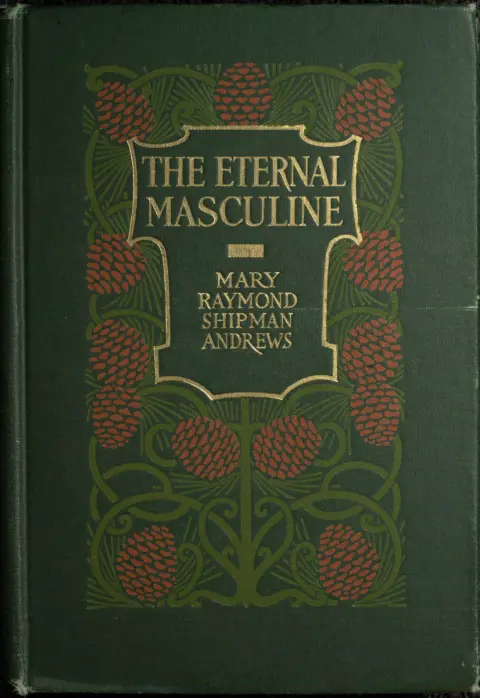
THE CLASSIC COLLECTION · 1913
"The Eternal Masculine: Stories of Men and Boys" by Mary Raymond Shipman Andrews is a collection of illustrated stories written in the early 20th century. The book explores themes of masculinity through the lens of various male characters, focusing on their youthful adventures and interactions, particularly in nature. It seems to delve into the contrasting experiences of young boys and older men as they navigate their identities and relationships in the context of the outdoors, friendship, and skill in activities like fishing. At the start of the book, readers are introduced to two boys, Jack and his guide, Josef, who are navigating a Canadian forest during a fishing trip. The narrative captures their camaraderie, with Jack showcasing both enthusiasm and curiosity as he observes and learns from Josef's expertise in woodcraft. As they journey to a spot known as Profanity Pool, they encounter challenges and engage in conversations that reveal their backgrounds and personalities. Through vivid descriptions of nature and dialogue, Andrews sets the stage for a deeper exploration of male friendships and the formative experiences of youth, emphasizing the joys and trials that accompany these relationships.
Introduction adapted from the source catalogue; source summaries may be automatically generated.
Free to read · English · 81,523 words · No account needed
MAKE TIME FOR A GOOD BOOK
On by default. Untick to stop anonymous reading totals. Each page counts after 10 seconds in view. How this works.
Anonymous counting is on unless you have switched it off.
“DEAR MADAM: My sister and I, being maiden ladies of thirty and
seventy years of age—”
“Gosh!” remarked Hill. “Sisters! Why didn’t you make them grandmother
and grandchild?”
“What?” Carruthers looked up annoyed. “What’s the trouble? Oh—well, that is far apart. I’ll join the dames.” He scratched a figure. “Fifty and fifty-one—that’s safe, isn’t it?”
“Go ahead,” was the consensus of opinion.
“Of fifty and fifty-one years of age, and being very lonely alone together, as we have neither of us ever succeeded in getting married—”
“Or seldom,” murmured Hill.
Carruthers glanced sternly at him.
“Desire to purchase or obtain by gift a sound, kind, and well-broken child, of about one year, light-colored preferred, with good wind and good eyes, and, if possible, no vices.”
“Send that to a horse exchange,” advised Jack Duncan.
“Tommy-rot!” said Carruthers politely, and went on.
“We would like to have such child sent to us for a week on approval, and guarantee to treat it with perfect kindness and hygiene. As reference for the integrity and spotlessness of our characters we are happy to name—”
“Who the deuce are we happy to name?” inquired Carruthers despondently. “That queers it.”
There was deep thought. “Here’s a name,” suggested Duncan. “It sounds like those two nice old ladies, the Misses Bellingham, who live down near Highland Falls. Just sign it their name and give the chaplain for reference.”
“The chaplain!” The boys gasped.
“Just the thing,” said Duncan confidently. “He’ll give them a rattling recommend, and he’s too much of a gentleman to tell them their characters are questioned. Besides, he’ll never think of it again after he mails the letter. I know the chaplain. He’s a good sort—he doesn’t fuss.”
“Proceed!” ordered the chorus.
Carruthers read aloud as he wrote:
“we are—happy to—name—that noble and uplifting—leader of—religious
thought—”
“The chaplain would swat you if he heard you call him that.”
“Hill,” said Carruthers, with irritation, “you’ve done nothing but criticise and kick. If you can write better, do it. As far as I can see there’s not a fault in this letter, so far. Now let me finish. Where was I? Oh—‘leader of religious thought.’ That’s enough about the chaplain.
“Anticipating news of our sweet charge, who will become, we hope, the support of our declining years, we remain,
“Sincerely yours in hope,
“Now, Hill, any more criticism?”
Your reading position is saved on this browser. Take it to another device with a library code. Reading pages adapt to text, rather than matching a printed edition.
Mary Raymond Shipman Andrews
Mary Raymond Shipman Andrews
Mary Raymond Shipman Andrews
Mary Raymond Shipman Andrews
BEHIND THE BOOK
This eBook is for the use of anyone anywhere in the United States and most other parts of the world at no cost and with almost no restrictions whatsoever. You may copy it, give it away or re-use it under the terms of the Project Gutenberg License included with this eBook or online at www.gutenberg.org. If you are not located in the United States, you will have to check the laws of the country where you are located before using this eBook. Read the source licence.
The original source file, including credits and licence, is retained by this library. Request an original-format copy at no charge. Please include the book title and Project Gutenberg identifier #71145.
KEEP YOUR CURIOSITY GOING
Coulson Kernahan

Maurice Baring
Frances Wright
Cécile Tormay

Frederic Jesup Stimson

W. H. P. (William Henry Pope) Jarvis