
Letters to a Friend, Written to Mrs. Ezra S. Carr, 1866-1879
John Muir
THE CLASSIC COLLECTION · 1902
"The Elements of Bacteriological Technique" by J. W. H. Eyre is a scientific publication written in the early 20th century. This comprehensive laboratory guide aims to equip medical, dental, and technical students with the foundation needed to conduct bacteriological research. The book covers a range of topics related to practical methods in bacteriology, including sterilization techniques, bacterial examination, and analysis methods, emphasizing the importance of personal instruction and practical application in a laboratory setting. At the start of the guide, Eyre lays out the essential laboratory regulations for handling infective materials, underscoring safety protocols designed to minimize infection risks. The opening portion also introduces the various types of glass apparatus commonly used in bacteriological work, explaining their selection and maintenance. This practical focus sets the stage for the detailed methodologies that follow, providing a solid foundation for readers who are keen to understand the intricacies of working with bacteria in a laboratory environment.
Introduction adapted from the source catalogue; source summaries may be automatically generated.
Free to read · English · 124,075 words · No account needed
MAKE TIME FOR A GOOD BOOK
On by default. Untick to stop anonymous reading totals. Each page counts after 10 seconds in view. How this works.
Anonymous counting is on unless you have switched it off.
Immediately the subculture tube from the 30-minute contact period have been inoculated, carry out a precisely similar experiment, in which five percentage strengths of Phenol, (e. g., 1.1, 1.0, 0.9, 0.75, 0.7) are arranged in the lower tier of the test-tube rack in place of the five strengths of Germicide-x.
Calculate the phenol coefficient by the following method:
(a) Divide the figure representing the percentage strength of the weakest lethal dilution of the carbolic acid control at the 2-1/2-minute contact period by the figure representing the percentage strength of the weakest lethal dilution of the x-disinfectant at the same period. The quotient = phenol coefficient at 2-1/2 minutes.
(b) Similarly obtain the phenol coefficient at 30 minutes contact
period.
(c) Record the mean of the two coefficients obtained in (a) and (b) as the mean phenol coefficient, or simply as the ~Phenol Coefficient~.
The details of the Final Test of an actual determination are set out in
the accompanying table.
Organism employed, B. Coli Communis.
Culture Medium, Nutrient Agar (+10). Age, 24 hrs.
Temp. of Incubation, 37 deg. C.
Quantities used { Culture } Emulsion 0.1 c.c. + 5 c.c. Germicide.
{ Emulsion }
Room Temperature during Experiments, 17 deg. C.
Germicide Strength Time of exposure Incubation 2-1/2 5 10 15 20 25 30 35 Time Temp. 1 Germicide-x 4% -- -- -- -- -- -- -- -- 7 days. 37 deg. C. 2 Germicide-x 3% 48 -- -- -- -- -- -- -- 7 days. 37 deg. C. 3 Germicide-x 2% 24 24 24 24 48 72 7 days. 37 deg. C. 4 Germicide-x 1% 24 24 24 24 72 24 72 7 days. 37 deg. C. 5 Germicide-x 0.5% 24 24 24 24 24 24 24 24 24 hours. 37 deg. C.
1 Phenol 1.10% -- -- -- -- -- -- -- -- 7 days. 37 deg. C. 2 Phenol 1.00% 24 7 days. 37 deg. C. 3 Phenol 0.75% 24 24 24 24 48 7 days. 37 deg. C. 4 Phenol 0.70% 24 24 24 24 24 72 7 days. 37 deg. C. 5 Phenol 0.65% 24 24 24 24 24 48 24 24 2 days. 37 deg. C.
((1.10/4.00) + (0.7/2.0)) 0.27 + 0.35 .62 Phenol Coefficient = ------------------------ = ----------- = --- = 0.31 2 2 2
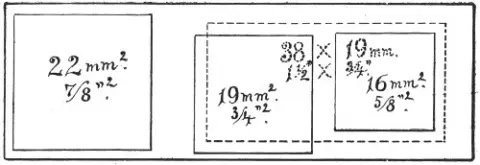
The initial unit of the metric system is the Metre (m.) or unit of length, representing one-fourth-millionth part of the circumference of the earth round the poles.
The unit of mass is the Gramme (g.), and represents the weight of one cubic centimetre of water at its maximum density (viz. 4 deg. C. and 760 mm. mercury pressure).
The unit of the measure of capacity is the Litre (l.), and represents the volume of a kilogramme of distilled water at its maximum density.
The decimal subdivisions of each of the units are designated by the Latin prefixes milli = 1/1000; centi = 1/100; deci = 1/10; the multiples of each unit by the Greek prefixes deka = 10; hecto = 100; kilo = 1000; myria = 10,000.
For a comparison of the values of some of the more frequently employed expressions of the Metric System and the Imperial System, the following may be found convenient for reference:
~Length:~
1 millimetre (= 1 mm.) = 1/25 of an inch.
1 centimetre (= 1 cm.) = 2/5 of an inch.
1 inch (1") = 25 millimetres or 2-1/2 centimetres.
~Mass:~
1 milligramme (= 1 mg.) = 0.01543 grain (or approximately
1/64 grain).
1 gramme (= 1 g.) = 15.4323 grains.
1 "kilo" or kilogramme (= 1 kgm.) = 2 pounds, 3-1/4 ounces
avoirdupois.
Your reading position is saved on this browser. Take it to another device with a library code. Reading pages adapt to text, rather than matching a printed edition.
BEHIND THE BOOK
This eBook is for the use of anyone anywhere in the United States and most other parts of the world at no cost and with almost no restrictions whatsoever. You may copy it, give it away or re-use it under the terms of the Project Gutenberg License included with this eBook or online at www.gutenberg.org. If you are not located in the United States, you will have to check the laws of the country where you are located before using this eBook. Read the source licence.
The original source file, including credits and licence, is retained by this library. Request an original-format copy at no charge. Please include the book title and Project Gutenberg identifier #27713.
KEEP YOUR CURIOSITY GOING
John Muir

Asa Gray
Asa Gray

Florence Nightingale
Elizabeth Robins Pennell
Denison Olmsted